

Make an appointment today to discover how our expertise in practice branding, patient acquisition, advanced marketing tactics, and patient retention can help you thrive.

Steve Schwartz reveals secrets to successful marketing campaigns and growth strategies for the concierge medical industry, this guide draws from 25 years of digital marketing expertise and experience working with over 900 clients.
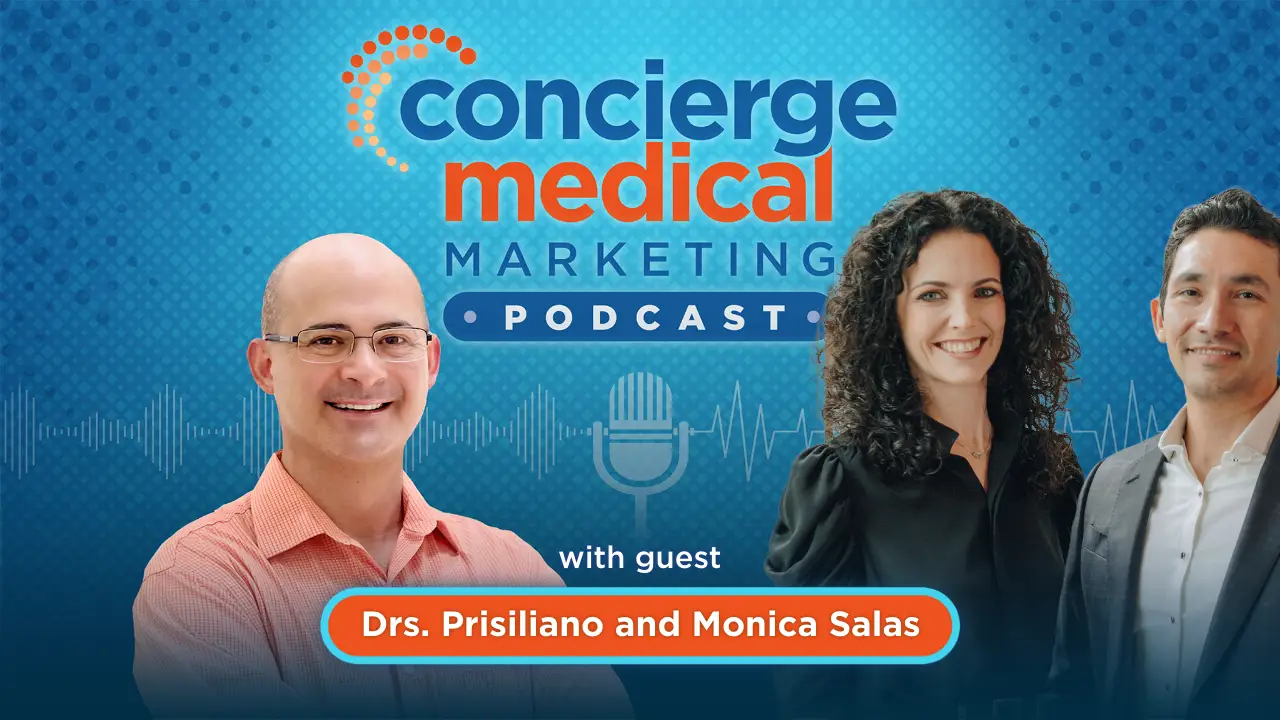
In this episode of the Concierge Medical Marketing Podcast, host Steven Schwartz interviews Drs. Prisiliano and Monica Salas from Salveo Direct Care. They discuss the structure and growth of their direct primary care practice, the importance of marketing and community engagement, and the role of AI in healthcare. The conversation highlights the benefits of membership medicine and how it can lead to better patient outcomes.
Chapters
00:00 Introduction to Direct Primary Care
01:56 Understanding the DPC Model
03:45 Transitioning from Traditional to Direct Care
03:45 Advice for New Physicians Considering DPC
05:40 Marketing Strategies for DPC Practices
09:46 The Importance of Community Engagement
13:40 The Role of AI in Modern Medicine
17:58 Final Thoughts and Future of DPC
Steven Schwartz (00:24)
Hello and welcome to the Concierge Medical Marketing Podcast. I’m your host, Steve Schwartz, and it’s my pleasure to have Drs Prisiliano and Monica Salas from Salveo Direct Care. Thank you for being my guests on the podcast today.
Drs. Salas (00:37)
Thank you for having us. Yeah. Thank you, Steven.
Steven Schwartz (00:40)
Awesome.
Thank you so much. And tell us where are you located and tell us a little bit about your practice, what it looks like today.
Drs. Salas (00:46)
So our practice is located in San Antonio, Texas. We have been around for a few years now. It was started by my husband, Dr. Prisiliano about six years ago, or a little over six years ago, and then I joined him four years ago. And we consider ourselves to be a direct primary care practice. DPC Plus, actually, I would say, we have a membership-based model.
we really provide a high level of care.
and do provide some what would be considered to be more concierge type of services and access, but just outside of an insurance based program, we contract with our patients directly in a membership basis. And so that’s kind of what we do. We have some other programs and things that we have in terms of wellness, hormone optimization, weight management, care coordination and things like that.
So we do a lot of stuff. We wear many hats.
Steven Schwartz (01:41)
Nice, and so just to clarify, your practice does not accept any insurance How big is your practice? How many patients either are you now or what are your goals for growth?
Drs. Salas (01:52)
Yeah. So traditionally most DPC practices are very varied,
I’ve seen numbers anywhere from four to maybe 600, sometimes a little bit more, but never is it close to what a traditional insurance-based or fee-for-service clinic would be, which that’s around 2,500 patients per doctor. So it’s never gonna be like that.
Steven Schwartz (02:11)
Yes, exactly.
Yeah, I’ve this story many times of my cardiologist who had over 3000 patients on his panel and he decided that he needed to start a new division or area of his practice that was concierge cardiology and wanted 300 patients that would have his personal cell phone and the ability to call or text
Drs. Salas (02:33)
Mm-hmm.
Steven Schwartz (02:36)
paying the premium, obviously, for that level of access. And then any of the patients that didn’t switch from the 3,000 to the 300 concierge umbrella would be seen by his physician assistant. And it made great sense for him in his situation as a blended or a hybrid practice.
Drs. Salas (02:39)
Right.
Yeah. And you know, that’s something similar to how my journey was to direct care. Actually my first practice. So our current practice, how do you direct care is actually my second practice. The first practice I opened from scratch was a traditional fee for service two physicians straight out of residency. And we grew that thing to over 7,000 patients between the two of us. And so we were quite busy.
Steven Schwartz (03:13)
Oof.
Yes.
Drs. Salas (03:17)
so then I, I very quickly realized that I couldn’t offer the care that I wanted to the time, you know, that I can spend with patients. I wanted them to have access to me more than, you know, a week or two later for a cold that’s happening today. And so I, I wasn’t able to convert the practice, like the cardiologist that you mentioned, my partner actually ended up staying with that side of the, of the practice. And so I left, started direct care. And so our practice now is only a few hundred patients.
Drs. Salas (03:45)
When you’re starting a DPC practice, when you’re joining a DPC practice, the vast majority of the time you’re, joining from zero patients because the physicians in the practice probably are full in their panel.
And unless they have a very long wait list or in DPC, we also work with employer groups, for example. So unless there’s an employer group that is teed up to maybe line up with when a new physician joins and they can start with a lot of patients there, the vast majority of the time you’re starting from scratch. so the ramp up period or rather there is a more
Aggressive, you would, maybe ramp up period that needs to happen to try to get you patients there. You do have to put yourself out there a little bit with, you know, community engagement. You have to get on social media one way or another, or, you know, use a service that can help you with your marketing efforts
because maybe the practice you joined had been doing well, they’re full, but now we have to market the new physician basically from zero patients. That can be sometimes a struggle, I feel like, for new physicians to understand and maybe one of the fears, especially if you’re starting out on your own.
Steven Schwartz (04:55)
Right, and I’m glad you brought that up because many physicians are trained in medicine. They’re trained in health, nutrition, exercise, these different areas related specifically to physical health. But correct me if I’m wrong, they typically don’t teach business marketing in medical school, right? They’re teaching you medicine.
Drs. Salas (05:12)
Yeah.
Steven Schwartz (05:14)
And so I’m really glad that you brought up the topic of marketing to help bring in new patients to a practice. Obviously, my agency is Concierge Medical Marketing, where we specialize and focus on helping concierge and DPC practices with their advertising so that they can get the exposure they need. So they can share that message, as you said, on social media and website and blog posts and all that, so that people learn.
get educated and realize the value of having a membership relationship with their healthcare provider so that they can then sign up and have better outcomes. And as we talk about marketing, what different techniques or methods did you use to grow your practice to where it is today?
Drs. Salas (06:03)
What haven’t we tried? And I’ll take that since I’ve been in it from the very beginning. Yeah. So, you know, we’ve done all different things. We’ve done print ads in the local church newspaper newsletter or in the local community center on their TV screens. Obviously, we’ve done some SEO. We’ve done some paid ads on Google or Facebook.
Steven Schwartz (06:09)
Sure.
Drs. Salas (06:27)
If you look on our social media right now at Salveo Direct Care, we obviously are trying to stay active there as well. We’ve hired someone similar to what you offer, Steve, but not maybe specific to direct primary care, but more just broad medical, someone local in the sense that does some medical marketing.
We just hired an in-house business development and community relations associate. And so she’s been now with us for about seven months. And it’s been great because we’ve had some some new growth and she’s been helping with the onboarding some of those patients. We’re trying to get more be more active or proactive with our member engagement as well.
and then just be more active in the community too. So we hired a new physician three months ago, she’s been working closely with her again, just like I mentioned earlier, to try to get her out there and get people exposed to who she is and get her name out there. Yeah. And even before she came on board and our business development associate has been working with her to get her more out in the community.
That’s something that we’ve done a lot of over the past few years, which I think is really key because it’s not a, if you build it, they’ll come sort of situation. mean, you know, even though direct primary care and concierge medicine are really great models and ways to practice, you do really have to be intentional about making sure people know that you’re there. And I think one of the best ways that you can do that is
allowing people to actually see your face and talk to you in the community as hard as it is. I know for doctors, sometimes that can be difficult because you think, my God, I got to see all these patients, finish all these charts, et cetera, et cetera. But then again, that’s the nice thing about what we do because we have that flexibility. You know, we’ve really been able to carve out time over the years to be able to, you know, go give talks to local community organizations.
local interest groups, whether it be health talks or just talks about our services in general, attend health fairs, chamber of commerce events, volunteering with different organizations, mean, all kinds of stuff. And the more that you really get out there and people see you and talk to you, the more they’re going to remember you. And the vast majority of the time, people are not going to make a decision based off of one encounter, especially when it’s a big investment.
For them, know, it’s something that involves their health also, you know a membership a lot of times people have to think about that and so, you know a lot of times they need to talk to you a few times and that’s okay, but the more that you can really make that effort to be out there the higher the rewards are gonna be and the more people are gonna come in to see you. Yeah, and you as a physician or your team, right? Yeah, exactly. They need to talk multiple times sometimes with anybody in your organization.
Steven Schwartz (09:09)
I love it.
There’s a term that we use in marketing called omnipresent. And the idea there is that you want to show your business’s name, face, logo, message literally as many times as possible on as many different platforms to the right people who you’re trying to target. So for example, this may not be your perfect target avatar, as we call it, but.
maybe looking for families, husband and wife with kids, 18 and above, who live within a 20 mile or so radius of your office, who maybe earn, I don’t know, 80,000 or 100,000 per year total or greater, along those lines. You can hone in on specifically the right category, is that the right word, of person, of potential patients you’re looking for. And then the marketing that you do,
Drs. Salas (09:56)
Mm-hmm.
Steven Schwartz (10:09)
should resonate with those people. For example, some of our clients are really focused on business executives, business owners. Their time is so much more valuable than their money. They don’t mind spending extra as long as you make it quick and easy for them. And so the marketing message would be, hey, are you a busy, successful executive who
Drs. Salas (10:11)
Mm-hmm.
Mm-hmm.
Steven Schwartz (10:33)
doesn’t have the time to wait in lines and wait on the phone and all this for healthcare and would rather have healthcare come to you, right? Whatever that message might be. And you craft that message specifically to resonate with those people, you’re gonna find that they’re going to start raising their hand saying, you know what, that makes sense to me, I want that. You know, I’m a busy mom, I’ve got three kids and I’m running around the place all the time. I don’t have time for X, Y and Z.
Drs. Salas (10:41)
Yeah. Right.
and
Steven Schwartz (10:59)
This membership thing sounds great. You mean I could text my doctor at 8 o’clock at night because little Bobby has a rash? Yeah, exactly. So I love this entire membership concept of medicine that truly provides better quality care quicker and less stress for everybody,
Drs. Salas (11:03)
Mm-hmm.
Right. Yeah. And I mean, at the end of the day too, or really in the long run, you’re, you’re, we’re trying to save the patient, um, on the backend because insurance is so expensive these days. And one thing that a lot of people don’t understand is that the more you use your insurance, the more claims you’re generating, the higher you are a risk.
Steven Schwartz (11:34)
Yes.
Drs. Salas (11:45)
to that insurance company, therefore the premiums like you pointed are just gonna keep going up. And so if you’re not generating claims with a practice like us, for example, or a concierge practice, although some concierge practices still bill your insurance, but with a direct type of model, we’re not generating any claims when you come visit us. So you can visit us as often as you need to and not have to worry about copays or generating claims against you and your insurance.
Steven Schwartz (12:14)
I think one of the best examples I’ve heard for people who don’t quite get this concept is that when you buy a car and you want to drive it, you need auto insurance. And the auto insurance will cover you in case of an accident or it gets crashed or damaged somebody’s property or whatever. But do you use your auto insurance to pay for gasoline, for windshield wiper fluid, brake fluid, the typical maintenance stuff?
Drs. Salas (12:40)
⁓ All changes.
Steven Schwartz (12:43)
Oil changes. Yeah, the answer is no. Yeah, you don’t use your
auto insurance for these maintenance items. And similar with direct care, you don’t need to use your major medical massive problem insurance for maintenance, right? And one story that I love to share, there’s a physician with a concierge practice, I forgot where she was located, but her
Drs. Salas (13:01)
Exactly.
Steven Schwartz (13:10)
practice has a 100 % success rate with her patients, zero heart attacks. Zero, not a single one. Why? Because they take the time and the effort and the tests and the talking and the back and forth. that anybody who even potentially had a problem risk factor for a potential heart attack was dealt with proactively. So there’s a person who may have spent, I don’t know, $200 a month for their their concierge doctor avoided
Drs. Salas (13:23)
Mm-hmm.
Steven Schwartz (13:39)
a hospital stay, the pain or risk of a heart attack and all the therapy and stuff that comes after that, all avoided because of membership medicine.
Drs. Salas (13:48)
yeah. And I love the analogy that you used because that’s actually one of our favorite ones. We use it all the time, our insurance analogy when educating folks about direct primary care. So we agree 100%.
Steven Schwartz (13:55)
Yeah.
Great.
Nice. You one thing I want to chime on just a little bit more about the marketing. We are in a very interesting, exciting time right now where membership medicine is growing super fast. I’ve heard, you know, going from like a six billion dollar industry to a 13 billion dollar industry in the next five years. I mean, literally doubling in size and from tech geeks like me, this is the time of AI.
Drs. Salas (14:24)
Mm-hmm.
Steven Schwartz (14:30)
AI artificial intelligence is literally a revolution, revelation, whatever, in technology, literally, that we haven’t had available to us ever. And the idea is that how could we take the power of an AI tool or system and use it to help us save time, save money, and have better outcomes?
Drs. Salas (14:35)
Both.
Steven Schwartz (14:56)
So just a quick segue with this is that I created a AI digital marketing assistant. And this assistant I call Maddy, M-A-D-D-Y. And the name came from M-A for marketing assistant. And the idea there is that a medical practice, either DPC or concierge practice, can utilize Maddy, the AI digital marketing assistant,
to help them with their digital marketing. And right now, the use of Maddy is free. I have it available for our listeners to try out and use. And I even wrote a book on how to use it called Just Ask Maddy. OK, so the idea here is that you have an account of ChatGPT. You pay the $20 per month fee to them for the plus account. That way, it remembers the things you’ve typed in and gives you more
Drs. Salas (15:38)
Thank ⁓
Steven Schwartz (15:51)
you know, ability to communicate with it each day. And you onboard your practice into your account of Maddy. In doing so, it learns about who you are as a medical practitioner. What’s the name of your practice? Where are you located? Who do you serve? What is the structure and size of your organization? And the extra, you know, services, ancillary services, they focus on weight loss or hormone replacement or whatever it might be. And
All of this onboarding effort, asks you questions. And when it’s done with this onboarding, it will then help you in your practice with pretty much whatever you need for your marketing, whether it’s writing blog posts that are relevant and timely, writing email drip sequences, text messages, so much more. And so if anybody’s interested in getting a copy of this book, it’s on Amazon. Just ask Maddy. It’s like $15. And if somebody reaches out to me personally, I’ll send you a
a signed copy. But I just wanted to mention that because you had mentioned you tried all these different things with marketing. And sometimes people who are listening to this podcast are thinking, well, I studied medicine. I don’t know anything about marketing. What should I do? And I encourage you get this book, read through it. It’s only 85 pages. It’s super easy. But use it as a tool to help you with your brand and your marketing to get your foot in the door and get things started.
Drs. Salas (16:59)
and
Thank
⁓
Steven Schwartz (17:13)
Obviously, my agency is available to help if someone wants to hire us, of course. But if you can do it yourself or your spouse or a team member or the front desk person, do it yourself. Give it a shot. Maybe you’ll have good success with it. So those are just some thoughts. Have you guys used AI in any of the areas of your practice to this point?
Drs. Salas (17:25)
Right.
Yeah, I to your point, some of the without the Maddy.
plug-in or whatever it would be that into CHAT GPT. But obviously we’re trying to harness CHAT GPT for some of precisely some of these things that you just mentioned. It’s interesting because even our patients are now using AI. ⁓ I’ve had at least a couple who have sent me a message and it’s a direct link to
Steven Schwartz (17:44)
Work.