
Make an appointment today to discover how our expertise in practice branding, patient acquisition, advanced marketing tactics, and patient retention can help you thrive.

Steve Schwartz reveals secrets to successful marketing campaigns and growth strategies for the concierge medical industry, this guide draws from 25 years of digital marketing expertise and experience working with over 900 clients.
Episode Summary
Summary
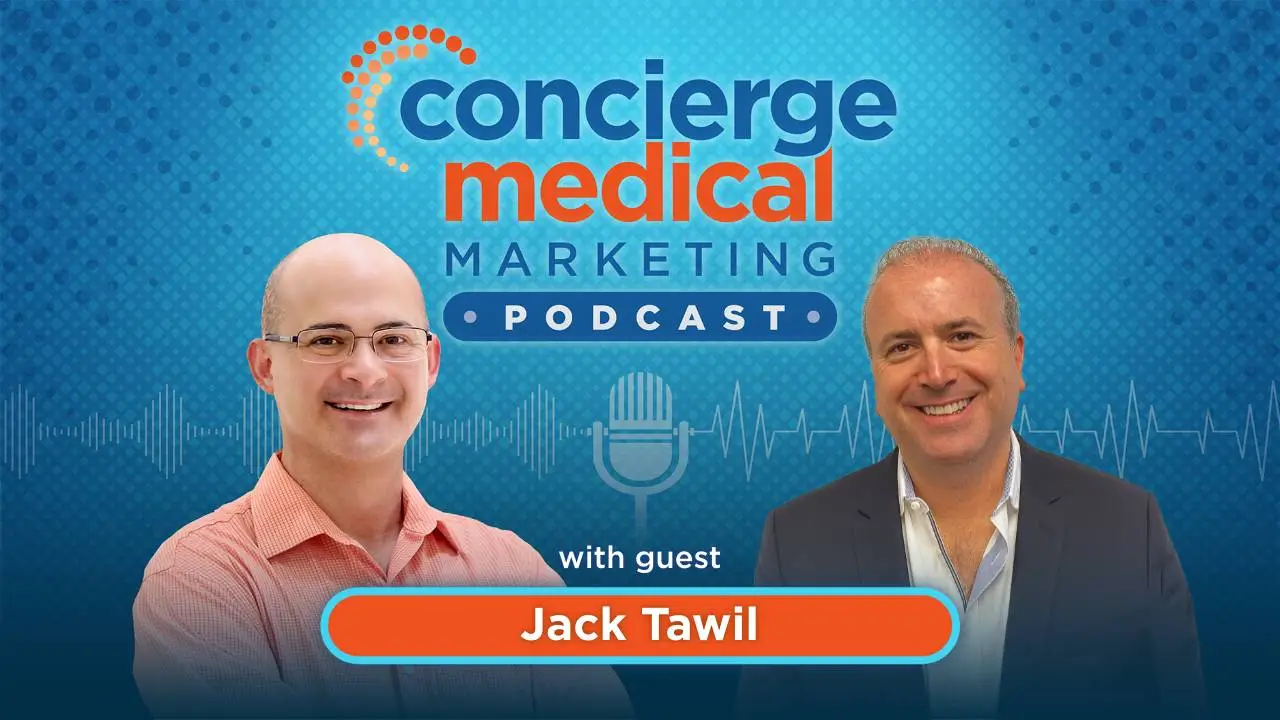
In this episode of the Concierge Medical Marketing Podcast, host Steve Schwartz interviews Jack Tawil, CEO and chairman of MedPod. Jack shares his journey from healthcare at Walmart to founding MedPod, a company focused on improving healthcare access through innovative technology. The conversation covers the challenges faced in healthcare delivery, the technology behind MedPod, its diagnostic capabilities, and how it can enhance concierge and direct primary care practices. Jack emphasizes the importance of patient-centric care and the potential for MedPod to revolutionize healthcare delivery.
Episode Chapters
Chapters
00:00 Introduction to MedPod and Jack Tawil
02:38 Jack’s Journey from Retail to Healthcare
05:33 Founding MedPod: Vision and Challenges
08:06 The Technology Behind MedPod
11:14 MedPod’s Impact on Patient Care
13:57 Applications of MedPod in Various Settings
16:31 MedPod in Concierge and DPC Practices
19:08 Business Models and Opportunities with MedPod
21:32 Conclusion and Future of Healthcare with MedPod
Full Episode Transcript
Hello and welcome to the Concierge Medical Marketing Podcast. I’m your host, Steve Schwartz, and it’s my pleasure and privilege to have you along today. My guest is Jack Tawil, the CEO and chairman of MedPod. Jack, thank you for joining us today. Thank you so much. Really had a great time getting to know you more off camera and can’t wait to have our listeners of this podcast to get to know you better, to learn about your background.
Jack Tawil (00:16)
Sure, great to be here.
Steven Schwartz (00:30)
and the amazing work that you’re doing with your company MedPod. So why don’t we jump right into this? Please give us your background of where you grew up and what got you interested in medicine and technology and whatnot. Let’s start there.
Jack Tawil (00:45)
Sure. I grew up in Brooklyn, New York, and I was actually not in the healthcare field originally. I was in large retail programs, and I crossed over into healthcare about over 20 years ago. The crossover was actually Walmart.
Steven Schwartz (01:03)
Great. And tell me what exactly did you do for Walmart?
Jack Tawil (01:07)
So I was the one who actually went to them with the concept of opening up clinics within their stores. Initially, the thought process was there’s 400 or so associates that work in each one of those supercenters so they could use health care. But in addition, they serve so many people, so many patrons. And so if you could take care of the employees, but then open it up to the community and turn it into a community access
point that could really open up healthcare for the country.
Steven Schwartz (01:41)
Wonderful. And how many stores had these type of clinics under your leadership?
Jack Tawil (01:46)
So
So we opened up the initial ones. The first ones that we opened were 23 facilities across four states. We started in Florida, quickly expanded into Alabama, Mississippi, Louisiana, some of the most underserved populations in the country. And it was they were ultimately over over 100. When I left, there was over 100 facilities. That was about 2008. And during that same time period, it was a very interesting time for health care at that.
got involved, was about 2 % of doctors actually used electronic health record systems. We actually used it across all of our facilities. were the first, we believe the first in the country to actually do a telemedicine network direct to patients. We ripped up parking lots and sidewalks to lay fiber in the ground in 2004 and five. I remember getting a call from the CEO while I saying, what do you have to do with all my parking lots being ripped up? But we were laying fiber and actually standing up a four state telemedicine
network
in those years which again no one ever heard of direct to patient. There used to be you know hospital to hospital NASA had a program right so you know
that was in use at the time, but no direct to patient programs. And so we built that. And certainly during that time, there was some other interesting things that we did as well. We formed the Community Care Association, actually was the one who named the category of care, Community Care. There was a naming committee. I was the only one that fought for the name. I remember them telling me that I should go back to retail programs. This is healthcare. They’re called patients. They’re not called consumers. They’re not customers. And I said, if you don’t
actually start treating your patients like customers, you’re to lose your patients. So, big advocate for patient-centric healthcare and one of my speeches in 2006 became the basis for the not-for-profit Dacia, which they used to model the Health Information Exchange Act on, or Intel, on 2009.
Steven Schwartz (03:46)
Wow, what a story. And you said you were with Walmart till 2008, approximately. What precipitated the move away from Walmart, and where did you go after that?
Jack Tawil (03:51)
Yes.
So there
was a very interesting dilemma that they were facing. And even till today, they faced that same dilemma in that many of their stores, if you take their stores and break them down, about one third of the locations could support a clinic with the need to see about 22 to 25 patients per day to breakeven in the model that we were using. Our model was a nurse practitioner based model. And actually in those years, nobody even knew what a nurse practitioner was.
And so, you we actually built the doctor network, the telemedicine network, to make people comfortable to say you could be seen by their own practitioner, but the doctor could come in and confirm the diagnosis and you can feel comfortable chatting with the doctor, which is exactly what we did. But the one third of the clinics could support, you know, the patient population, right, 22 to 25 to break even. Some locations were seeing 60, 80, 100 patients a day and were very successful. But then you had a whole bunch of them that were seeing 15,
into 20 and losing money. And so they were faced with this dilemma of saying, are we a for-profit or a not-for-profit company?
And if you’re a for-profit company, you’re not going to keep open all these locations that are losing money. So I hadn’t suggested at the time, why don’t we actually drive down the cost of delivery care? So it’s not 20 patients or 22 or 25 patients a day to break even, but actually something less and use technology to do so. So that was one of the things that was one of the foundation stones of MedPod to say, how do you actually change the way that care is delivered?
equal or better care than you would normally give in a normal scenario, but drive down the cost to deliver that care, open up access to doctors that you maybe wouldn’t normally have access to in those locations. So that was one of the major, major issues. They struggled with that for a good 15 or almost 20 years, since 18 years, whatever it’s been. And so they’ve gone through multiple iterations on their side. On my side, I founded MedPod.
And really MedPod was built to address that issue. And actually the second part of our founding story was very interesting in that I was invited in 2007 by the Dubai Health Ministry as they were building up a health care city in Dubai. And they showed me all the things that they were doing. I toured a lot of the construction sites. We talked about the future of health care and what they should be doing. And at the end of four days, the health minister actually said, would you be willing to stay for an additional hour? And we have a visiting health minister that would find
this
conversation we’ve had very, very informative. Could be very good for him. Be very good for you. Could be a business opportunity. And so I agreed. He brought the health minister in and said, the minister first said, I don’t have an hour. Keep it down to 45 minutes, but I’m very interested in hearing about this Western medicine thing that you’ve been speaking of. And 40 minutes in, he said, I would like to do this. I’m on board for Western medicine, but I will pay you $4 per year per patient. And my first reaction was, that’s
impossible. And he said, no, think about it. I will I will commit one billion patients to the project. That was the Health Ministry of India. So for four billion dollars, we could deliver all that care. I said, it’s still impossible. The only way to actually do this is to hear and see everything that a doctor could hear and see, understand how they diagnose and treat and actually use that computing power to solve the problem. At which point we could deliver care for four dollars, three, two or a dollar. It will make a difference. And so
MedPod was founded on those two pieces to say, do you actually enable access to healthcare anywhere, drive down the cost of care delivery, but at the same time also learn how doctors are diagnosing and treating, do you create a digital twin for the patient and a digital clone of the doctor, and then apply that for countries that don’t have access to doctors and can’t afford access to doctors.
Steven Schwartz (08:02)
Very cool. So tell me about how MedPod was founded, the technology, how was it designed, how did all that come together?
Jack Tawil (08:13)
So my first my first conversation was actually with a man named Stanley Bergman. He’s the chairman CEO of Henry Schein Which became a partner and MedPod carried the brand Henry Schein for many many years as part of its logo But I went to him with this what this concept saying look, how do we do this? And first he said boy money come join us right and work, you know Henry Schein, which was not really an option for me And then he spoke go with my guys, right? So he actually assigned the president
of the medical division at the time and a couple of senior people.
to go with me to go figure out how to build this. And the natural thing in 2008 was go to the big technology companies that were doing at the time what we would consider telemedicine or video networking. Polycom, Cisco, Lifesize were the big companies. And we had our meetings. Of course, no one said no to Henry Schein at the time. You over 10 billion, there were probably 15 billion at the time. And they each one said no.
Cisco went one step further and said not only will we not help you we actually hope you fail And I spoke could can I ask why now that you were so open? I hope you fail what why? And they said if you actually did this you would completely disrupt our business model of health care And so we’re not I’m not here to help you So we walked out of that meeting with Henry Schein guys and saying we need to do this if we’re such a threat to the industry We actually have to figure out how to actually do this and we put it together internally and we were quite
for many years because we knew that as soon as we came out we were gonna get crushed. so we kept it quiet, we built behind the scenes, we forged some really big alliances, companies like Valtallan, which today is part of Baxter-Hilram, companies like Midmark, Haribo Corporation, so some of the big players in healthcare that joined us to actually go ahead and build this.
Steven Schwartz (10:10)
Very, very cool. When did you open your doors for MedPod?
Jack Tawil (10:15)
So officially they were open in 2013, but there were many years that we were just quiet and we were building and built up to over a million lines of code before we actually brought anything to the market. And so I would say some of the pilot programs started in 2016 into 17. We did some very significant pilots, let’s say with the state of New York, where we actually showed using MedPod mobile doc. That was one of our units that it’s actually a small unit that fits in a suitcase, a carry on suitcase.
enables medical in any environment and we actually did that for the state of New York using BIP Innovation Funds where we pushed into homes for the intellectually and developmentally disabled, the ITD population. And they live in group homes, six or eight patients in a home. Generally they have a nurse or attendant that’s with them all the time, but a nurse practitioner cycles through once a week. And if something happens to that patient, nights and weekends,
go to the emergency room. There’s no option for them to go to an urgent care. And so the state was seeing enormous amount of cost coming out of that population for nights and weekends. So they came to us saying, hey, I think this could work. I think your technology could actually work to disrupt the normal care pathway. And what do you think about it? So we set up a program. We basically created a triage telephone number. So
Instead of calling 911 if it looked like a non-emergency situation, they would call this other number. We would further triage them, send out a nurse, and that program was actually RNs, took one of our mobile docs out, go to the group home and get their doctors on the line. So actually use the diagnostic ability and actually bring the doctors that see them during the day. So there was really no loss of knowledge from the doctor who was treating them. And in six and a half months,
the state of New York spent $250,000 on the program, including buying eight units. And they saved $2.4 million during that time. So 10-time return on investment, enormous savings. It actually resulted in the change of law. So they put together a bill. It actually ultimately passed and so made it mandatory for MedPod-like services in group homes for the intellectual developmentally disabled.
Steven Schwartz (12:17)
Amazing.
So exciting. That is great. Now, let’s talk a little bit more about the MedPod unit itself. What tests does it do? What diagnostic information is it collecting?
Jack Tawil (12:45)
Yeah, I mean, so it’s set up, there’s different setups of Med-Pod units. And so we break our units down into two categories. One is inbound patient applications. So it’s actually something like what’s behind me, this whole cart, similar to what a hospital cart would look like where the patients are physically coming into a clinic or into a hospital or even a nontraditional.
But inbound patient location where the patients are coming in then we have the unit like this one that’s actually on my other side and if you can see it, that’s a mobile document that comes out of a Out of a suitcase out of that travel case and that’s for outbound patient applications We’re going out to the patient and meeting them wherever they may be and wherever they may be could be their home We’ve actually done programs where we’ve done every level of care anywhere from urgent care concierge type of care to
to actually doing home hospitalization. But it could also be in other environments. It could also be in a community center. It could be in a village that has no access to healthcare. We just did a major program in Malaysia with the National Cancer Society, funded by Intel. And so the ability to really go in and literally put medical in any unit that it rolls in and you turn it on and you actually have the ability to have your doctor in. So it changes the game. And so those are the type of units. We even have a backpack type of
unit called the MedPak, more of like an EMS style, a lighter 14 pound backpack. And you can use it for military applications and things like that. So there’s many different applications. There’s many units that serve those applications. And we do programs anywhere from school programs where the doctor in the local hospitals providing care to a school system. have one great example in Texas where they have 70 schools have our MedPod units in them. One doctor and two
NERC practitioners take care of all of the students, all the teachers, all the administrators that actually present those units. And so thinking about a shortage of healthcare workers, this helps really solve those healthcare workers in that you train a low-level technician, we call them care facilitators, but you could stretch those resources of doctor, NERC practitioner, PA to really see many times. And in that example, it’s almost 35 times the stretching, one to 35.
Steven Schwartz (15:06)
And just a little bit more detail, what medical diagnostics are actually being collected and does the physician on the other side of the internet connection participate in real time or do they watch a recording or how does that work?
Jack Tawil (15:20)
Yeah.
So it’s obviously, it is real time, but we have the ability to store and forward as well, meaning record and then they call in. So generally, all of our units are set up with vitals. We’re pretty consistent on best in class. And so we’re part of with WellChallenged.
and Massimo. So we would have the vitals from them. So the blood pressure, the SPO2, the temperature, obviously pain score, scale with health meter. And so stadiumeter, so for height. And then we get into different scopes. And so we’ll go anywhere from general exam camera. So video scope where you can actually look at the full body. You could look in the back of the mouth. So it optimizes to check the mouth, to check the teeth and so on and so forth. Switch the lens. You could go then go
from there and check the ears. So an otoscopic lens off of that, you could also go to dermascope, right? So there’s our dermatoscope brother. So you could check the skin, any type of moles, things like that. We’ve actually had the head of Sloan Kettering for for skin actually to say we could take a diagnose skin cancers with us. And then on top of that, you go. So every one of our units has what I just mentioned. But then there’s add ons. So you could add on EKG, you could add on
spirometry. You could add on ultrasound, you could add on x-ray, you could add on colposcopes for women’s health, you can go into cognition, concussion, risk of fall, hearing screening, vision screening, and on and on. So it’s pretty significant amount of tools that are attached to it and that continues to grow.
Steven Schwartz (16:59)
So impressive. I love the fact that you have the base models to get all the typical vitals and then some real time activity with the physician or NP on the other side and recording the data so that you can look back on it and synchronize with an EMR somewhere makes perfect sense. So then to have all the additional add on tools based on the patient population you’re going to be seeing is great. Kudos to you guys for an amazing.
amazing product or suite of products that you’ve created.
Jack Tawil (17:31)
Yeah, there was one I did forget, which was the stethoscope, which is the obvious, but we have a remotely controlled stethoscope where the doctor
could hear everything live, but so could the care facilitator and even the patient and record that information and remotely modulate the stethoscope. And then we have a very unique tool in which we could actually tell if something is internet-induced noise or artifact or if it’s actually, let’s say, pneumonia. And so within about 15 seconds, you could actually rule out that it’s internet-induced noise and say, yes, in fact, that is a pneumonia or it’s not pneumonia.
Steven Schwartz (18:05)
Fascinating. I love it. As we’ve talked about, this is the Concierge Medical Marketing Podcast and our target audience for this podcast are concierge medical and DPC practitioners. Can you please explain or paint the picture of how medical professionals in the concierge and DPC space can use your MedPod to help them have better patient outcomes, less stress, more profitability.
Jack Tawil (18:34)
So.
Steven Schwartz (18:34)
Let’s
talk about that, please.
Jack Tawil (18:35)
Yeah, so I would say that first in that market, we’re in some of the on some of the largest yachts in the world. So MedPod is actually physically on site. We’re on on planes, jets and really in the homes of many very high profile individuals. And so from that one standpoint, there’s a higher level of care that can be provided. And we’re even working with a with a major yacht builder to actually have MedPod as an option. Every one of the yachts that goes out.
And so we definitely have the ability to cater to that market and actually even help bring together some of the best doctors if you need to augment the doctors availability. that’s actually significant. You can have a primary care doctor that’s taking care of a building. It has a concierge practice, but maybe they need access to the best cardiologist or one of the best in the world or the best pulmonologist or best whatever may be. And some of our doctors are ones that are taking care
We have one doctor who takes care of 18 heads of state and some of the best athletes in the world. And so having access to them. So we would be able to one, help our customers have access to some unbelievable doctors to help build their practice further. That’s number one. Number two, the units enable care anywhere. So mobile doc units can actually physically go out as part of a concierge service. We do this in some corporations where they have, let’s say, a corporate clinic where everyone could go to.
but for the senior executives, they actually have Mobile Doc that goes into the office of that executive. And then the doctor sees them, again, remotely, but with the care facilitator that’s actually helping to be the hands of the remote provider. So there’s many, many ways that you can actually build a concierge program. We just launched a clinic yesterday. It’s actually in Harlem. And we spoke about this earlier, but the tagline for that clinic is actually Concierge Healthcare.
care
for everybody. And so in that scenario, we’re actually providing concierge care for patients that are primarily on Medicaid. So it’s actually a higher level of care that’s being provided in this community where we’re providing a baseline, actually doing baseline using MedPod. So if you want to provide really good care, you can actually create a baseline of your patient with MedPod, with tools that no one’s ever had access to, store that information, create a very rich clinical data set.
And so provide better care, having that digital twin of the patient so that next time they come in, you can look at deviation from the norm. And then on that, really, again, offer better care and start applying some digital tools to help, right? Essentially, clinical decision support systems and things like that that we apply. So in the concierge market, there’s a lot of opportunity to build out the practice to make it one better clinical, more access because you get
access literally anywhere even down to the patient’s home without the doctor physically having to go into the home they could actually go ahead and offer it and then again just opens up a whole bunch of aspects of specialists and other other pieces.
Steven Schwartz (21:50)
I was thinking as you were speaking that especially for smaller practices where the physician may be away for a week on a conference, excuse me, or a vacation, whatever it might be. And if you have the MedPod unit at their location and the patient needs it to come in, that physician could also connect from wherever he or she is at the conference or vacation or whatever. All he needs an internet connection in a few minutes.
And that way they can still continue to provide the concierge level care to somebody who’s in their location, even though they’re not in their own location.
Jack Tawil (22:28)
Yeah, it’s fun. We had a doctor as part of one of our original programs, that IDD program I mentioned earlier, that said, look, I’m a dance dad, right? I’m never, know, on nights and weekends, I don’t have any time. I work really hard and I can’t actually be available to see the patient. And we said, you could actually still be a dance dad, right? You could still go to the dance, and all the time you have waiting, you could actually, you know, take an iPad or take your computer and you could connect up and see your patients. It’s good for them, but by the way,
you could actually make money doing that as well. And so he was skeptical initially. He actually went on to become one of our biggest supporters. At one point he was actually became our chief medical officer. And today he’s the CEO of a company that was built around this area that has about a $600 million mark.
So he did well with this, but you have the ability to really change the way that you could deliver care and get reimbursed for it. And many people, many doctors actually, they’ll answer the call. not getting, know, in concierge if it’s all covered under the fee, right? That’s a little bit of different scenario, but some have a hybrid scenario, right? They have the hybrid where they’re getting the fee, but they’re also billing the insurance for it. And it gives them ability to really bill the insurance.
for this and make more money.
Steven Schwartz (23:47)
Nice. It sounds like there’s certainly multiple aspects and methods. One of the things that’s impressed me so much in the concierge and DPC space is that it’s got so many different flavors of how a person wishes to run their business, right? And whether it’s an NP or an MD or a PA, whether it’s a brick and mortar or it’s in essentially a bus or an RV that goes to where people are located, whether you accept insurance or not.
whether you have one fee covers everything or one fee plus extras for this and that. In this industry, there are many different options and I can see how MedPod could absolutely fit into that in multiple ways. Just seems to me that if a physician or NP is interested in looking into this further to see how it could be integrated into their practice, how would they best get in touch with you and your team at MedPod?
Jack Tawil (24:47)
So really the easiest would be going on to the website which would be medpodhealth.com
And they could look around but they could also schedule a quick a quick conversation a 15 minute conversation right on the front page you could actually choose the time and Within that 15 minutes, you’ll actually you know have a good understanding as to what Med-Pod is how it could potentially work for you And then we could if they’re interested with they could actually set up a very easy Follow-up where they would drive the unit as a doctor. They’re no doctor. No, no special equipment for them They could use their stand-up laptop
set of headphones if they have it, could actually use the system and see all the data flowing across as if they were, they already bought it. And so very easy for them to figure out how to use this. From a cost perspective, they range between $25,000 and $35,000, but there’s also programs on a monthly type of lease or a finance program under $1,000 a month. so very often that just, many people take advantage of the
of that program of finance. It makes it very easy, very accessible. And again, we’re happy to speak with anyone and help guide them. We have many customers in the concierge space and the direct primary care space. I’ve actually built some companies in that space as well so we could really take them through potential business models and help them grow their business.
Steven Schwartz (26:12)
Right, and give them a chance to potentially meet some other physicians in similar type of practices and have them speak with them one-on-one and tell me what’s your experience with this and what’s the real deal, right? Yeah, I love it. Yeah, in this industry, it’s been such a pleasure for me to meet so many people who want to give and want to help and share others to elevate the entire industry. And in doing so,
elevating healthcare for really everybody. It’s so powerful. And I can’t recall talking to any concierge or DPC doctors who truly said, yeah, well, that guy’s my competition and I don’t want to share with him what I’m doing. Nobody says that. And it’s a beautiful thing that there’s so much need and it’s as we all have seen is so much of a better model that everybody can win and everybody can improve.
and provide better care for the patient. And hopefully for a lot less stress, aggravation, and expense for the practitioner themselves.
Jack Tawil (27:20)
100%.
Yeah, I mean, from our
perspective, we can help them grow their business. we’re seeing more and more on the concierge side that it’s a hybrid model. It’s not just, you know, we don’t take insurance anywhere, but they are still taking some sort of reimbursement. but yet they’re offering, you know, a higher level for their clients or patients that actually sign up for the concierge piece of it. And then you have other practices that are really going into I’m taking care of all my high net worth individuals.
and
on their doctor, on their yacht, in their plane, and things like that. So it’s quite a bit of opportunity, and there’s an enormous opportunity to take care of corporations in the backyard of those doctors.
Steven Schwartz (28:03)
Oh, absolutely. So often the folks I talk to may have a couple hundred, you know, mom and pops, couples and families, but they also sign up entire employer groups, 20, 50, 100, 500, you know, patients who are employees of those companies. And all of a sudden you can go from a light to a very full panel and you need to hire more people to to scale and be able to cover the employer group that just came on board.
Jack Tawil (28:30)
Right.
Yeah. We like to say with MedPod, you don’t have to build a bigger office, right? You can just literally have these MedPod mobile doc units and send them out into the field. Right. So it’s actually delivering care anywhere in any location. And so all of sudden, that corporation, a conference room turns into a medical office, you know, very, very quickly.
Steven Schwartz (28:49)
Nice. Well, as we talked about before, Concierge Medical Marketing is the marketing arm of this podcast business. And we offer three different programs for our clients based on where they are in their particular business and their story. And the first is transition for a physician who may have a practice with a couple thousand patients who decides, I don’t want to see 50 or 75 patients a day anymore. I can’t do it.
and they need help transitioning to a concierge or DPC model, we can assist with that. The second is growth. And that’s obviously for a practice who needs more patients to fill their panel, or perhaps if they’re full, they want to bring aboard more patients to hire more practitioners to grow a bigger business that we can help with growth. And number three is what we call nurture and the idea of staying in touch with your patients, your waiting list.
with emails and text messages and with advertisements and posts on the internet, just so that people continue to see the name and face of their concierge or DPC doctor, feeling good about their investment. And so it’s one more thing that can be done so that when the year rolls around, it’s time to write another check for the year that more and more of those people are going to sign up and renew for the next year. So that’s what we offer through Concierge Medical Marketing.
I actually wrote a book called the definitive guide to winning with digital marketing for concierge medical practices. And that book is available to anyone hearing my voice here, totally free. Just visit our website conciergemd.marketing, scroll down the page, find the picture of the book and put in your email address. Click the submit button. Our system will email you a link where you can download the book for free. It’s over a hundred pages and tons and tons of great actionable information for the offices and practices that want to do it themselves.
Please take it with my compliments. And of course, if there’s any struggles, any issues, any questions, and someone wants to have a conversation with me and my team about the challenges they’re facing with their marketing for their practice, please schedule a time with us. CMMKG.com slash schedule. Nice and easy way to get a time on my calendar. Jack, this has been such a pleasure getting to know you today and to learn what you’re doing to make medical care.
with a concierge feel to it available to people eventually everywhere across the planet. And I love what you’re doing and I definitely give you kudos because this is great.
Jack Tawil (31:23)
Thank you. Appreciate it. Thanks for having me tonight.
Steven Schwartz (31:25)
Yeah, it’s been my pleasure. This is Steve Schwartz with the Concierge Medical Marketing Podcast. We appreciate you and we’ll see you on our next episode. Bye, everybody.
Jack Tawil (31:33)
Thank you.
Take care.