
Make an appointment today to discover how our expertise in practice branding, patient acquisition, advanced marketing tactics, and patient retention can help you thrive.

Steve Schwartz reveals secrets to successful marketing campaigns and growth strategies for the concierge medical industry, this guide draws from 25 years of digital marketing expertise and experience working with over 900 clients.
Episode Summary
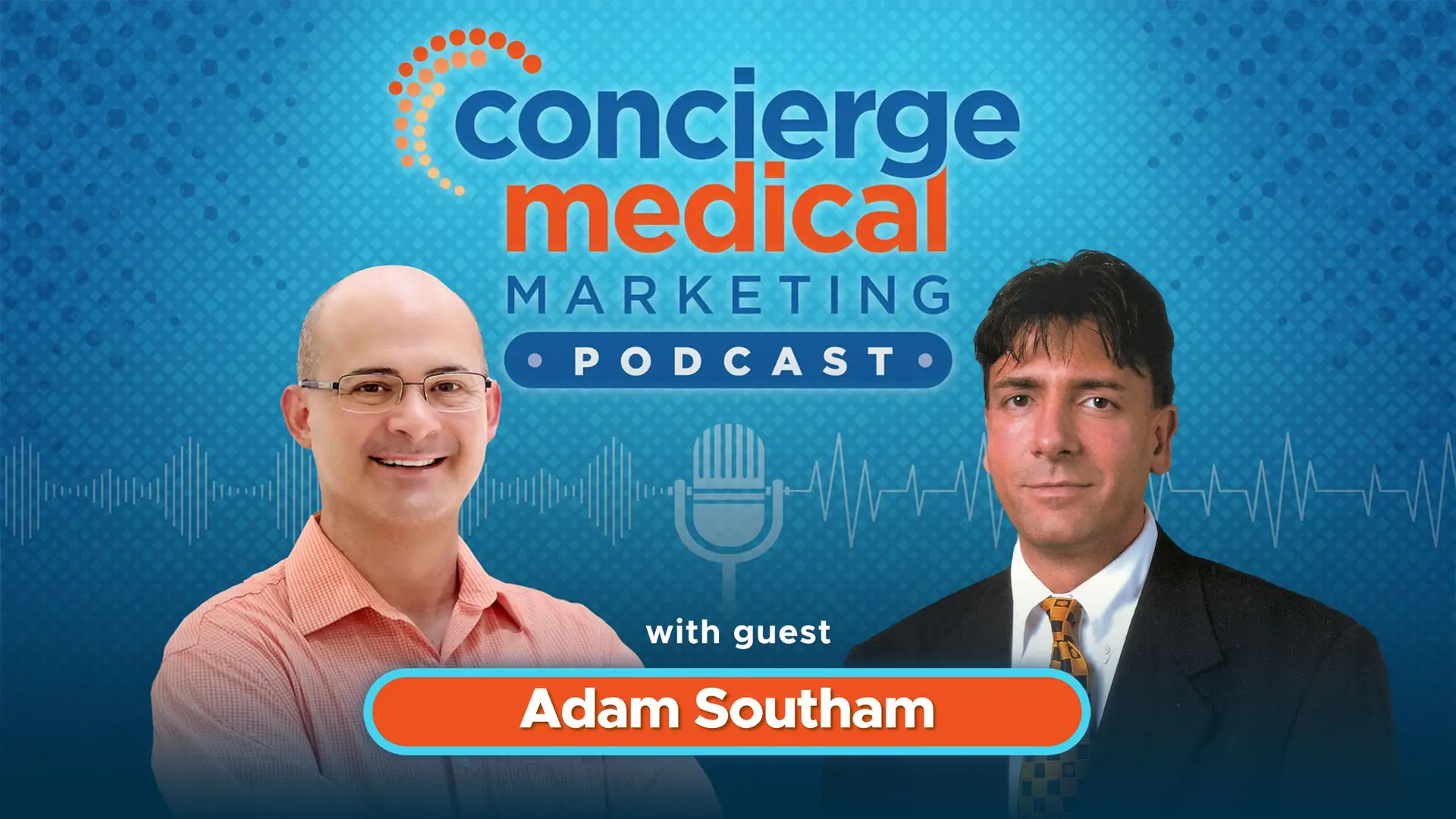
In this episode of the Concierge Medical Marketing Podcast, host Steven Schwartz interviews Adam Southam, founder of Food for Health, who discusses the concept of using food as medicine to improve health outcomes. Adam shares his personal journey of health transformation through dietary changes and how this inspired him to create the GoNo app, which helps users make informed food choices based on their individual health conditions. The conversation also covers the app’s functionality, its benefits for medical practitioners, and the potential for improving patient engagement and health outcomes.
Episode Chapters
00:00 Introduction to Food as Medicine
02:29 Adam’s Journey: From Problem Child to Entrepreneur
04:46 The Impact of Food on Health
07:09 The GoNo App: Personalized Nutrition Guidance
09:32 Understanding Efficacy and Clinical Evidence
12:29 Behavioral Insights in Food Choices
16:26 Collaboration with Concierge Doctors
19:46 Monetizing Health: Revenue for Practices
23:14 Patient Data and Privacy
26:27 Conclusion and Future Directions
Connect with Our Guest
Full Episode Transcript
Hello and welcome to the Concierge Medical Marketing Podcast. I am your host, Steven Schwartz. It’s my pleasure to have you along on our journey today. So glad to introduce you to Adam Southam. Adam’s company is Food for Health. And as we were getting acquainted before hitting the record button, he was telling me all about how his company focuses very specifically on using food, essentially as medicine. How do you help people get better?
by eating the right foods and how do you help them feel better by avoiding the wrong foods? Adam, thank you for being my guest today on the podcast.
Adam G. Southam (01:02)
Thank you, Steve. Pleasure to be here.
Steven Schwartz (01:04)
Wonderful. Appreciate that. So let’s do this. Let’s talk a little bit about your background first. Just where you grew up, where did you go to school, what got you eventually into having a business like this?
Adam G. Southam (01:15)
All right, well, I didn’t grow up and I haven’t gone to school, so let’s move on.
Steven Schwartz (01:19)
Haha,
love it. I love your sense of humor, by the way. Good stuff.
Adam G. Southam (01:22)
Yeah, thank
you. So I’m going to not to bore everyone, but I’ll go back 25 years, a little more. I’ve been solving problems my entire life. And so mom called me a problem child, but she meant it differently. And for the last 25 years, I’ve been creating software as a service technology companies using algorithms that I’ve patented as the basis of companies. And so this is, I know that’s a mouthful, right?
We need an acronym for that. And so this is the most important thing I’ve ever done in my mouth. Other than much, yeah, I know somebody else’s control in my life because this has an effect on humanity. So there’s broadcast media and channel commerce, nice companies, but this one affects everyone.
Steven Schwartz (01:49)
Yeah.
Say that one more time.
You know, very cool. So do you have medical training or did you study diet, nutrition? Where did you get into this space?
Adam G. Southam (02:19)
Yeah, no, we’ll go back to the problem child part. So no formal education. I was serious about that and yet very highly educated. I started my first business when I was, I guess I was 10 years old and by that age I was 14. I was actually profitable with my third business. yeah, well, yeah, mom was getting mad.
Steven Schwartz (02:39)
Fantastic.
Adam G. Southam (02:42)
and, and, eventually, really solving problems went into the field of marketing and branding. And then eventually I was in a situation where, the marketing need turned into a company. So all my training is around businesses. did three years of, turnaround work, which is when you go in your fixed companies that have gone very seriously wrong. Typically the entrepreneur or someone like me has mortgaged, you know, their wife, the car, their house, their dog.
and you need to bail them out. And so that’s the kind of work that I did for a while. But my life has been about a study of business problems and solving those problems. So there’s no medicine in here other than I do play a doctor on TV as we discussed. I’m not sure what kind of doctor, but we’ll just go with it. ⁓
Steven Schwartz (03:29)
Well,
you’re alive and you seem healthy, so that’s good, right? Something’s working.
Adam G. Southam (03:33)
I am healthy, though I’ll tell you, I started this company because I have hyperlipidemia. And I was fortunate enough, my doctor, my levels were 1830 and my doctor was wise enough to not treat me. And he sent me to a cardiologist, Elizabeth Clotis, and she said, well, I’m going to give you a book instead of a prescription. And the book was
Eat Yourself Slim by Michael Montagnac and it simply taught food as medicine for someone, know, again, hyperlipidemia, who is, in my case, was an athlete, I guess I still am, eating the wrong carbs. I’m no longer on a horse or a pair of skis for eight hours a day. I’m sitting in this chair and so the consumption wasn’t leveled out. So the impetus was she taught me food as medicine. I applied it.
And then I went back to her and we discussed what the basis of this should be. It all comes down to clinical evidence, which is incredibly important because, you know, let’s not leave the witness here, but everything else is hearsay. We can only rely upon clinical evidence. It doesn’t mean it’s the only thing that works, but it’s the only thing we can be confident about.
Steven Schwartz (04:39)
Now you had a health issue. You went to your doctor, doctor referred you to a cardiologist. Cardiologist said, read this book. You started following the guidance of this book of literally using food as medicine. And I’m assuming things turned around and your health is dramatically better because of what you learned in the book by implementing.
Adam G. Southam (05:01)
Correct. Started at a level of 1830 maximum for your triglycerides should be 150. So I was the problem child again. 90 days of just changing the carbs, the type of carbs. I was eating white rice and white potatoes and bananas and carrots. And by eliminating the bananas and carrots and changing from white rice to wild rice and white potatoes to purple yams, I got down to 410. Then
Steven Schwartz (05:28)
And that
was the only change you made. Wow, fantastic.
Adam G. Southam (05:30)
That was it. Nothing. No
extra time at the gym. No nothing. Yeah. And then was prescribed with a small P fish oil and betaglucan. And that took me down from 410 to 220. And 220 is just fine for me as my own weird little science experiment.
Steven Schwartz (05:48)
Very cool. so obviously this worked well for you a couple of months, changing your diet, no change of exercise and anything else. So it’s very clear that literally by changing a few things in your diet, you got huge dividends. how did that then lead to, hey, I should start a business offering this to other people? I mean, how did that happen? Walk us through that.
Adam G. Southam (06:10)
Yeah. Well, so Dr. Clotis has also written the only book ever published by the American College of Cardiology. And I read that book. It’s called Slay the Giant. So I had Eat Yourself Slim by Michael Montagnac and Slay the Giant. And as I read through these, it was very clear that the information that she was conveying and Montagnac passed now, we’re conveying with, it really wasn’t that difficult, but you had to get to it.
And you know, if you don’t pick up the book, you’re not going to read it. So you had to get to that information and you had to know it was legitimate. And so Liz and I were having wine on a patio and I said, how do I convey the information you’ve conveyed to me to everyone? And that really, you know, one thing led to another. And she told me about clinical studies and I went and I read a hundred of them, which…
meant 100 good nights of sleep and ascertained that we could use mathematics to create an algorithm that would look at all of the clinical studies and tie them, link them up to your individual conditions, medical conditions, wellness goals, preferences, and have a highly personalized, I hate to say it, but an uber personalized.
Maybe that’s a new name for a company, Uber personalized experience. Because again, you and I, we could be twin brothers and, and though you would be a lot, it would be not as good looking, but.
Steven Schwartz (07:39)
I was going to say I would get more hair.
Adam G. Southam (07:41)
Well, true, but yeah. But even then, as we get into genetics, the differences can be very significant. people get lost. doctors know that people don’t understand how unique they really are and everybody needs their own treatment. Well, so today, why did Jenny Craig and Weight Watchers go bankrupt? like…
because they tried to hand off the idea that it would work for everyone. And that’s just not true. And that’s one of the big things in concierge and personalized medicine is like, know that we need to focus on the person, not on a cohort of people who happen to have a disease. So that’s really the bottom line.
Steven Schwartz (08:22)
So help us understand you’ve got this business. Your focus is helping people get healthier by using food as medicine, the right things to eat, the right things to avoid. Let’s say I want to get more healthy. I want to lose some weight. I want more energy. I want to sleep better at night. How would I as a consumer work with your company? Is that available?
Adam G. Southam (08:43)
Right, great question, thank you. So you’re gonna get our app. So we have an app, it’s called GoNo, and you can download it at the Android or Apple store. You’re gonna download it, but you’re most likely gonna be given it or be told about it by your physician. And so your physician says, hey, Steve, guess what? You wanna lose weight, and I don’t really know that much about…
dietetics and nutrition, but here is a tool that you can use and it’s one of those multi tools that MacGyver had and it does everything and you can trust it because the basis for it is all clinical evidence. So download the app, put your name and your email and your zip code in and your register you’re done and choose the medical conditions that you’ve been told you have and in this case we’re gonna say
that you have high cholesterol and hypertension and gout. And choose your wellness goal, which is going to be to gain lean muscle, gain, gain lean muscle mass, lose fat and sleep better. And by the way, all in the context of you’re a little, you’re a little gluten intolerant and you hate round onions because you don’t know this, but you’ve got an allergy to them. So all of this information goes in.
All right, we’re now at 90 seconds. It took me longer to talk about it than it does to do it. Very quick.
Steven Schwartz (10:10)
Right, so quick onboarding of my information
into the app. OK, go ahead.
Adam G. Southam (10:14)
And then pretend this is a phone. Oh wait, it is a phone. Then we take the phone and we scan the product. All products have a UPC code, barcode on the back. Even lettuce, they don’t print it on the lettuce, but it’s on the label in the store. And you scan that barcode, that’ll go away pretty quick because AI will just figure out that this is in fact a white chocolate macadamia bar.
And the app will tell you immediately a go or no. Go is like, yeah, go ahead and eat it. And no is, yeah, you should stay away from this. And for most consumers, that’s enough. They’re going to say, okay, well, this is all backed by MDs and DCs and DOs and a whole bunch of other initials in their RDs, and we’ll trust it. The clinician, on the other hand, especially as we look at RDs, can say, okay, well,
Let’s take a little deeper dive here. And the deeper dive is that we’ll show every ingredient. So what we’re doing is we’re analyzing every ingredient in this Clif Bar to find out which of them have clinically proven benefits or will harm you. mean, both ends of the scale. And again, this is for you because you’ve got specific diseases. And we grade those conditions.
So we grade those ingredients by several factors. One of them is the degree of efficacy. So how effective is it in a study of 10,000 people? Well, let’s just say it’s fish oil for high blood epigemia, high cholesterol, and let’s go with 97%. I think fish oil is highly efficacious. That doesn’t mean it’s going to work for you because you might be the 3%. But we’re not going to get into the weeds with patients like that. Anyway, so.
So it takes all of the ingredients, all of the conditions and it grades them in an alphanumeric sense. So you end up with a funky grade like A to B3 C4. As, Bs and Cs are good for you. As are obviously better in a cohort of a thousand, 10,000 people. And Cs are not as good. Again, you know, the secret that we’re not gonna get into the detail with patients is C might be better for you than A.
But amongst this cohort, that’s what we got. And the results, by the way, the letter is also derived from who did it, who paid for it, how long it was, whether it was double, triple, blind, and who performed it, of course, let’s tell the doctor. So in the app experience, you can actually click on the know or the go to see the detailed grade and then take that all the way to see the actual clinical studies where
were the determination for the grade in the first place. So we’ve laid it all out. If you want to know, it’s all there. Oprah, if you’re listening, if you want to know, it’s all there. Most people don’t want to know, but clinicians will take a look at it to make sure that it’s legit. And let’s talk about that legitimacy again. So the clinical studies, what we allow in the system, are vetted by a panel of
of physicians and scientists. So we may say, gee, like we’ll allow everything at the Mayo Clinic to be considered. But then there will be certain doctors where we’ll say, okay, well, we’re going to put these into the system. And this is in the system of evaluating the study. It doesn’t do the evaluation. So step number one is do you get to play on the field? And step number two is do you actually get out on the field or you are on the sideline?
So there’s multiple layers of surety that make sure that these studies are legitimate, that they’ve been peer reviewed, and we know hand over heart that this is as good as it’s going to get.
Steven Schwartz (14:03)
Yeah, so interesting. I know we’ve looked into a couple of different apps like FODMAP and FIG and some of these other apps that seem similar, where you scan the item, you put in how much you’re eating, or can I eat this, should I not eat this? And some are good and some are really terrible. What makes your app different or better than these ones that are on the market, in your opinion, please?
Adam G. Southam (14:28)
yes. Well, my opinion, I wouldn’t trust that, but let’s go for it anyway. ⁓ Yeah. So, so the difference really comes down to advocacy and, I’ll use, first, first of all, categorically, there’s all sorts of apps, right? There are food shopping apps, there are recipe apps, there’s, menu planning, and then there’s menu kidding companies from menu planning.
Steven Schwartz (14:32)
Go for it.
Adam G. Southam (14:50)
And then there’s biometrics as a metabolic, how many steps am I taking? What’s my blood pressure? So there’s all of these apps that form the continuum of the wellness universe, if we will. And that extends from us out to Microsoft and Apple and Best Buy and Attain and all sorts of very large companies. So what we are is one thing, and that is efficacy.
Will the ingredient positively or negatively affect you? That’s the cornerstone. One of the cornerstones, one of the tenets of our company. The other one is that to make that determination, we’re going to ask you for information. You’re going to tell us that you’ve got hyperlipidemia as a patient, or you’re going to take it one step further and you’re going to say, hey, just import my electronic medical record and I don’t have to tell you anymore. And you’ll trust us with it because
nobody else gets into that information. In fact, we’re so adamant about this. If you wanna publish your information on a billboard, you go right ahead. But if you don’t want a certain doctor to get it or you don’t want your insurance company to get it, it doesn’t matter. It’s your information, you say where it goes. And that is an absolute tenet. That’s a rule, that’s a law. And so it’s the combination of what you’re buying and the efficacy around that.
determined by your medical records and your goals and your, and again, there’s no point giving you French onion soup if you hate onions, right? It doesn’t matter how nutritious it is. And there’s a little side piece of information here, which is huge, and that is behavioral modification. So you walk into Whole Foods, sorry, Whole Foods doesn’t have this product, and you scan Fruit Loops. Fortunately, they do not sell them. And Fruit Loops could be good for someone.
by the way, but you scan Froot Loops and the app says, nope, not for you. And it recommends Kashi. And you go on, you scan the Kashi and it says, this is great. But you’re looking at the box and you’re just going like, this is just too much for me. I’m not willing to jump from Froot Loops to this thing that looks like sawdust. And so you settle on Cheerios. All right, well Cheerios is not as good as Kashi for me.
because it might be better for you. But what the app told us is this behavioral decision making. I was willing to try something other than what I wanted. And then when I was thrown the kale cereal, I said, yeah, that’s a little too much. But I went so far with the Cheerios. And then the next time I come back to the store, we’re going to know whether you buy the Froot Loops, the Cheerios, or the cashier.
So now we’ve got a behavioral roadmap of what you’re willing to do. And last piece of this is, by the way, as you start buying things and you don’t buy anything from us, we don’t care who you shop from, but as that information gets recorded, we’re gonna learn about your taste buds. And then, and this is kind of the Magna Carta of it all, we’re gonna be able to tell you that, and I will use local store here, the Target, that has 145 frozen pizzas.
in a diner in Minnesota, targets from Minnesota, so that explains it. One of them is the worst for you. One of them is the best for you. You’re eating the worst and it’s not because you chose the worst. just that’s the pizza that you’ve been eating since we’re 12. And our job is to try to figure out clinically what’s best for you. And let’s just say that’s number one. Five would be number one. But number one is going to be disgusting to you. You’re going to hate it. You’re never going to eat it again.
Number 22 on the other hand, it’s going to match your gastronic profile. You’re going to love it. You’re going to love it more than you loved 145, by the way. Oh, and this is even better. It happens to be the Good and Gather brand, which is a private label brand owned by Target and it’s less expensive. It’s less expensive. It’s better for you. It tastes better. I don’t know what else you want.
Steven Schwartz (18:58)
Yeah, win-win-win, right? So very cool. I can’t wait to try the app. I’d like to get a copy of that and give it a shot. So obviously, this is the Concierge Medical Marketing podcast. And we talk with many different folks who are involved in the Concierge and DPC space. And how can a concierge doctor or a DPC practitioner who’s listening to this podcast say, wow,
I love what this guy’s talking about this Adam guy gets it. I want to somehow work with him. What’s available to the practice owners and how can they get in touch with you to further a discussion on working together?
Adam G. Southam (19:31)
Thank
absolutely. Happy to answer that one. One thing I should mention is that we’re really an underlying technology. So you’re not going to see our name necessarily out there in a lot of apps. We’re going to be underneath. And I say like Intel, but we don’t expect to be as big as Intel. So you may find as Dr. Smith might have a practice with.
120 doctors and he wants it branded Dr. Smith. So a couple of things. Everything we do is white labeled or it’s inside somebody else’s app. There is an app right now you can download at, you know, it’s called Gono. And when you get that from a physician and a practitioner, it will be their brand on the top. And that’s, there’s a few different reasons in between.
starting software as a service company and my first company, spent a lot of time as a brander and in marketing, et cetera. And the idea is let’s keep whoever owns the brand relationship, which in this case is the doc, let’s keep their name first and foremost in the patient. They may only see the patient once a year. Now, concierge is different, but all of a sudden, every time that patient shops, the name is there reminding them that
that they’re in the care of this person. All right, so how does a doc get involved? They just call us up and we can onboard someone in the same day. In fact, it takes all about 10 minutes to get somebody up and running. And we’re answering some questions. So the first question we ask, I should have mentioned this at the beginning, is we’re answering the question of health. How can we improve health?
And the answer, by the way, is, let’s start with what’s wrong with it. And I could have told the story of guess what? In 1901, World War I, forced us to make foods, make them preserved so that they’d make it in front lines, right? So we could be speaking a different language and who knows of America with America, et cetera. If we hadn’t done that, fast forward to.
Today, we’ve got all sorts of processes that we didn’t discard and that have caused a whole bunch of disease and exacerbated a lot more. So the problem isn’t food. The problem is who’s eating what food. All right. So that’s problem number one that the really the algorithm and the company sets up to do. The problem number two is that most of the docs don’t love diet, you know, nutrition. The RDs are qualified. I mean, if you’re a
If you’re an internist, you don’t need and why would you have a depth of knowledge around nutrition? That’s another practice area. don’t, we’re not going to go to our orthopedic surgeons for eye surgery. mean, you’d be insane, right? So, so we looked at the problem of the doctors really don’t have or want or have time for this knowledge. That’s number one. Number two is they don’t have time for anything. They are crunched. And so
Number two problem is, let’s see if we can solve this, it’s time. And number three is, there’s never enough money. I mean, I have friends who I’ve been out of medical school for 10 years and they’re still paying off their college loans. So we can cut the time, add knowledge, add the power of knowledge to the patient and add some income to this, then we think we’ve got a perfect combination. So we share.
Steven Schwartz (22:59)
Right, so
let’s talk about money just for a moment. How does your company get paid? And how does this help the profitability of the practice owner?
Adam G. Southam (23:09)
Yeah, all right, fine.
Be that way. I was just, yeah, I was about to say it, but you know, you’ve got ESPN. Bring it. All right. So, yes, we sell through doctors or through organizations that buy our app and they give it away. But either way you look at it, we’re a B2B company. And yes, so for a doctor, he signs up with us.
Steven Schwartz (23:16)
Bring it. ⁓
Adam G. Southam (23:36)
He recommends the app to the consumer. The consumer buys it in the app store just like they would anything else. starts at about 54 % of our profit goes into the doctor’s hands. So to put this into just some random numbers, a doctor who has 100 patients a month introduced into the system is going to walk away with about $50,000 pre-tax profit.
If they’ve got five, and in five years when that’s gone up from 100 a month to it’s still 100 a month, but now you’re dealing with five years, then it’s a quarter of a million dollars and you can do all the math. So it’s a significant revenue producer for doxamine lester in orthopedic plastic surgery. You don’t make that from things on the shelf. And so that’s a big one. And it’s doing an invaluable service for the patient.
Let’s switch to RDS for a second. Yeah. An RD cannot be with you when you shop and she can give you all of the information you need. How much of that you remember is partially dependent upon how healthy you are for cognitive reason. But when you’re in front of the cheerios, she’s not going to, or sorry, the Froot Loops, she’s not going to be there to yell, Steve, put that down. We are.
and, and, and, and you’ll make your own decision at that time. So we’re a tool, you know, we are not the advice. We’re a tool. We don’t write the clinical studies. We use the clinical studies, and, and push this into telehealth. So why does somebody need telehealth every month? Well, because they need to learn something new, except if something isn’t putting them into a query, then there’s no reason to book that appointment.
So this does augment total practice visits as well.
Steven Schwartz (25:25)
Is the practice owner able to see the types of items that their patients are purchasing or looking at through the app?
Adam G. Southam (25:35)
Tricky, I love the question. And so the answer is maybe, but the maybe goes back to what I said earlier. The patient has to allow it. Now why wouldn’t you, right? And you know, maybe I’m buying too much Frito-Lay, so maybe I don’t want the doctor to see. But the answer is that yes, unless the patient specifically opts out of that information. So let’s look at the doc, the RD, whomever. Now I can see, I can see.
Steven Schwartz (25:44)
I guess.
Adam G. Southam (26:02)
that Susie wanted to buy Fruit Loops and we’ve got dashboards with all of this information. And she was recommended the cash in she chose. Not only that, but we, and I may have mentioned this already, we get all of the information for everything she bought while she was in that store. It comes out of the cloud for that store or she scans the receipt if they’re not in our system.
And not only do we see what she scans, she never has to use the phone. She never has to use the app because we’re going to capture everything. And we send her a report card. So we say, Hey, Susie, nice going here, here, here. And, and, and, you know, I’ll do a comedy show about what we’re going to say with, with, with, it’s not good, you know, put that down. And so the report card again, for behavioral change, it’s like, Oh wow. I didn’t know that bananas were bad for me.
Well, I’ve got hyperlipidemia. Yeah, they’re generally bad for me. I would have never known if it wasn’t for my next book and Dr. Clotis.
Steven Schwartz (27:11)
So cool. Adam, this has been really entertaining, very interesting. And I just love what you’re doing using the technology, the research, apps, data, and working through the different medical offices to help patients make better choices on what they eat for them to be healthier. I mean, it’s all about elevating and improving health outcomes in the end.
and how you do it, very exciting, very interesting. So I appreciate you sharing all this with me today.
Adam G. Southam (27:39)
Thank you. And you you mentioned Fig and FODMAP and I could go into, you know, an hour of dissertation between the different types of apps. But I want to reemphasize that we, most of them we don’t see as competition. Most of them we see as a potential customer because we’re focused on this thing. We have patents in now three countries, five patents. And this is
all we do. We’re not doing any of the things that FODMAP or FIG does. Food is good now and there’s yucca, there’s bite well, there’s all sorts of things. They’re going to need us to deliver on the promise of clinical advocacy and that’s what we really want to do. So we don’t really care if you know our name.
Steven Schwartz (28:21)
Nice. Well, speaking of your name, how can folks get in touch with you directly if they want to have a deeper discussion one-on-one with you about implementing this app into their practice?
Adam G. Southam (28:31)
Gotcha. Well, thank you. So right now there’s a professional website which is intended for practitioners and it’s food for health, spelt out foodforhealth.pro and that’s where to go. Now that will take you to the consumer site. It’ll take you to all sorts of places, but that’s the place. And there’s a form that says enroll there. And so if you want to get started.
You fill out, you only need your name, your email, your phone number, and you’ll be contacted. Or you can fill out the whole thing and you’re done. We have a marketing team that looks at practitioners a little bit like franchisees. So we’re going to give you a nice package with a bow on it that has all the tools that you can use in your practice to bring your patients and engagement. And you can throw that out if you want and do it your own way.
We also have consultants that can help us. Our job is to make you succeed at this and as you succeed again all boats rise. I guess we’ll share that information with other docs and everybody gets better.
Steven Schwartz (29:34)
Love it. Well, this has been great. Just want to share briefly about Concierge Medical Marketing, obviously, as we’re talking about marketing teams and how do we get the message of our business in front of the potential customer. So with Concierge Medical Marketing, we are a digital marketing agency that specializes in helping concierge medical practices as well as direct primary care practices, pretty much any membership medical practice, helping them
with their advertising and marketing so that they can become successful in their businesses or more successful to gain the full panel that they’re looking for and to move forward. And we do this through three different programs. The first we call transition. And this is for practitioners who may have a traditional insurance based practice with let’s say 3000 or 4000 patients. And they decide they want to have a more direct higher level VIP relationship with their member patients.
So they need help going from 3,000 to 300 so we can help with that. Number two, we call growth. And the growth program is all about having the proper advertising and outreach so that people who are looking for a better health relationship with their doctor can find a practice in their area, feel good about it, reach out to them and get connected. And obviously to help those practice owners reach their panel goals and even build a wait list.
And the third program that we offer we call Nurture. And Nurture is all about staying in touch with your existing patients as well as nurturing your wait list so that people feel good about your practice, they continue to learn, they continue to grow, and every year they renew. Also, I wanted to share that very recently I created a custom GPT using an AI tool so that this
tool can help practitioners with their digital marketing to help grow their practice. And words like GPTs and AI and stuff can be very confusing. So what we did is we named our tool Maddy, M-A-D-D-Y. Maddy is the marketing assistant. And I wrote a book called Just Ask Maddy. And Maddy is the AI assistant who will help practitioners with their digital marketing.
to help them be successful, to help them with their brand, to help them analyze their website and their Google business profile or SEO or write blogs or write emails, drip campaigns and create images so much more. And if anybody’s interested in getting a copy of this book, it is available right now on Amazon. Just do a search for Just Ask Maddy. Also, you can send me a private message through LinkedIn or Facebook and I’ll send you a signed copy.
free of charge, I’ll even pay for the shipping, I don’t care. I’d like to get this in your hands so you can start using this book to do your marketing yourself. And of course, if you need help, if you’re confused, if you try to implement these strategies and it’s just not working for you, or you’re just like, I’d rather just be a doctor and focus on being a doctor. Can you help me with my marketing? Please reach out to me, I’d be happy to chat with you and we’ll see if we’re a good fit for each other. So Adam Southam make sure I say your name right.
Adam, it’s been my pleasure having you as a guest on the Concierge Marketing website podcast today. Thank you for being here. Thanks for sharing. Thanks for doing what you do. Any final thoughts to share with our listeners before we go?
Adam G. Southam (33:01)
Other than the fact that that I wish I was a doctor because your tools are amazing. I wish your tools were available to You know university to other practice areas and each other businesses. It’s fantastic And we didn’t have these sort of things when I was building my company’s yeah doctors are doctors to do doctoring and This is this is fantastic. So it’s been a great fun being on the show and I really appreciate it
Steven Schwartz (33:28)
Well, thank you. appreciate the kind words. I’ve actually thought about expanding Maddy the tool to different types of medical practices, dentists and doctors and of others types. But even beyond that, it truly could be available for lots of different types of businesses. But because in my agency and my world is all focused around membership medicine, I just need to stay focused here and really understand this space.
And I want to help as many people as possible be successful with their practices and hit their goals and achieve their dreams.
Adam G. Southam (34:01)
awesome.
Steven Schwartz (34:02)
So very good. This has just been a lot of fun. I thank you for your time, Adam. And this is Steve Schwartz with the Concierge Medical Marketing Podcast. Thank you for being along with us on our journey today. Folks, follow us, like, share, comment, and all those kind of good things. And we’ll see you on our next episode. Goodbye, everybody. Take care.