
Make an appointment today to discover how our expertise in practice branding, patient acquisition, advanced marketing tactics, and patient retention can help you thrive.

Steve Schwartz reveals secrets to successful marketing campaigns and growth strategies for the concierge medical industry, this guide draws from 25 years of digital marketing expertise and experience working with over 900 clients.
Episode Summary
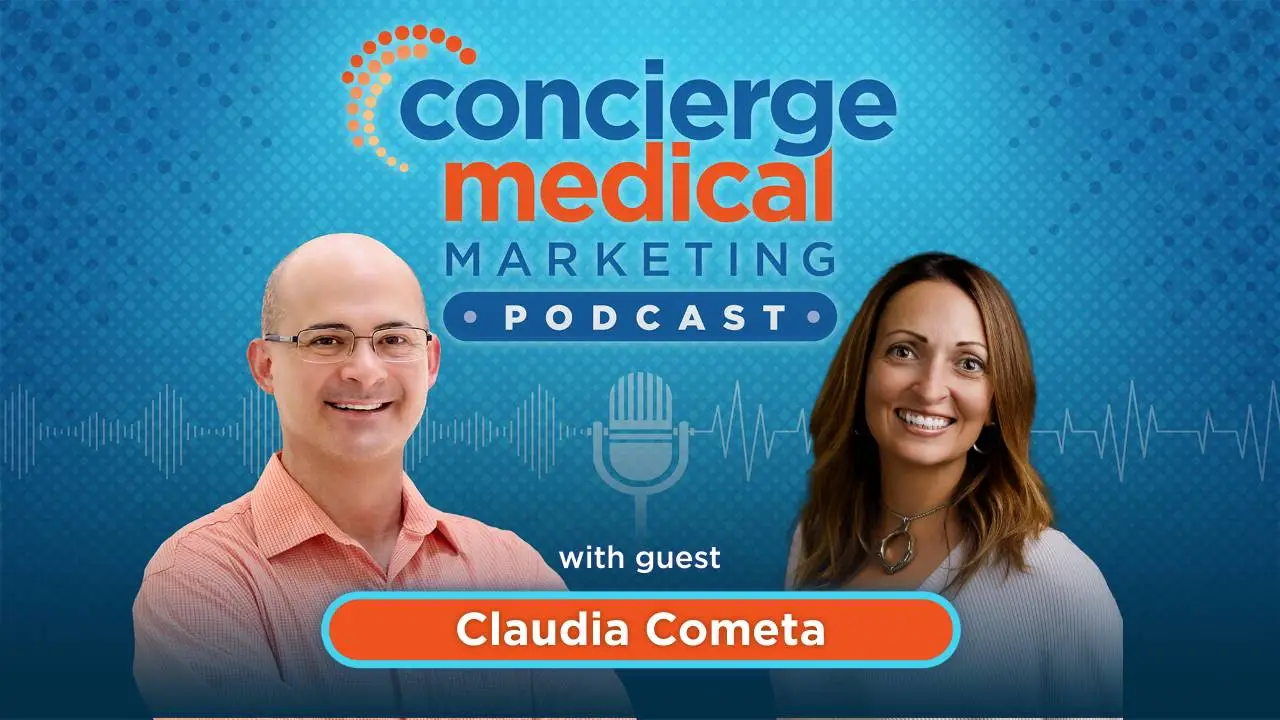
In this episode of the Concierge Medical Marketing Podcast, host Steven Schwartz interviews Claudia Cometa, a patient advocate and author. Claudia shares her journey into healthcare, emphasizing the importance of patient advocacy and the role of technology in improving patient outcomes. She discusses her new book, ‘Patient Empower Thyself,’ which aims to shift the paradigm of how patients engage with their healthcare. The conversation highlights practical tips for patients to navigate their healthcare journey effectively. To access Claudia’s course, use the coupon code: CONCIERGE
Episode Chapters
00:00 Introduction to Patient Advocacy
02:44 Claudia’s Journey into Healthcare
05:42 The Role of a Patient Advocate
08:16 Navigating Healthcare Challenges
10:51 The Impact of Technology on Patient Advocacy
13:45 Writing ‘Patient Empower Thyself’
18:31 Conclusion and Resources
Connect with Our Guest
Full Episode Transcript
Hello and welcome to the Concierge Medical Marketing Podcast. I’m your host, Steve Schwartz, and it is truly my honor and privilege to have Claudia Cometa as our guest today. Claudia, thank you for joining us.
Claudia (00:36)
It’s truly my honor as well. Glad to be here, Steve.
Steven Schwartz (00:39)
Wonderful. Thank you. Just learning more and more about you and your career, your background, you’re a doctor of pharmacy, you’re a patient advocate helping your clients navigate the craziness that is American healthcare. And you’ve written a book that’s available now. You’ve got so many exciting things to share. And as you know, this is the Concierge Medical Marketing Podcast.
where we cater specifically to concierge medical and direct primary care practices to help them grow and succeed. And so as we talk, we’re going to focus on what you do and how the work that you do can help these type of physicians with their practices and with their patients so that everybody wins, correct?
Claudia (01:22)
Absolutely, that is the name of the game and it’s not a game, but it’s the name of the game because we’re a team where the goal is to help the patient get exactly what they need and the care that they need. And I think working as a team is the only way to do that.
Steven Schwartz (01:33)
wonderful. And I know, you know, sometimes when you get into discussions like this, sometimes people can get a bit nervous. It’s like, wow, is this person trying to take my patient from me? Are they trying to replace me? And I just want to set the stage right now is that that’s not the case. We’re working together for best patient outcomes and certainly for the less amount of stress and hassle for the physicians in the DPC space.
Claudia (02:00)
100%. I work alongside physicians, all types of providers and healthcare staff with the intention of being a crucial and important part of the team. And a lot of times I know my clients, my patients at a depth that they just wouldn’t have the time to know them. you know, like I know exactly what’s happening in the home. I know exactly what’s happening in their social life. And all of these elements are really important to
providing holistic care. And so the other items are I’m usually on all of the appointments with my clients. So when they go see a specialist or they go have a surgery, I’ve been involved in all of those settings. And so for me to be able to share what’s happened there and utilizing medical terminology and being able to speak the lingo with the physicians, it’s only going to help.
the situation so that there is effective and efficient communication so that they can do what they do, which is not what I do. I know my lane and so that they can then turn around and make the right decisions as far as treatment plans go. So I’m a source of support, information and guidance.
Steven Schwartz (03:03)
truly a patient advocate. You’re standing beside them, working with them, helping navigate all of this, as I mentioned, for the best outcomes.
Claudia (03:06)
Absolutely.
Absolutely, and that’s exactly what I see happening in the almost eight years that I’ve been doing this is the absolute best outcomes can and are happening when there is a team approach. although a lot of, hospital settings and
and other types of facility settings have interdisciplinary teams because I’m kind of outside of the traditional system and I have a bird’s eye view and a very zoomed in view that not everybody has. I’m able to provide perspectives to the team that allow them to make more informed decisions when it comes to treatment plans, procedural plans. so yeah, I’m definitely sort of, I’ve got my arms locked with the client and the patient and we’re doing this together.
Steven Schwartz (03:54)
that’s so awesome. Well, let’s do this. Let’s go back to the beginning. Let us know a little bit about your background, how or when you decided to be involved in medicine and pharmacy and how did that story lead you to what you do today?
Claudia (04:10)
Yeah, I think it’s so important to understand the background for people because when people decide who they want to work with, this is a very, emotional decision when you’re dealing with a vulnerable health condition. And so I love that that a background question like this is asked. My decision to go into health care was very much based on wanting to help people. And this is not a story that’s new. You hear this a lot about people who go into the variety of fields of health care. And so I had sort of an idea
of I want to help people in a way that I haven’t necessarily seen my family do because nobody in my family was medically trained. But I also knew that I wanted to have a family and I also knew that there were strengths that I had in school. So it was very much.
checkbox, right? Like I want to help people. I’m really good at chemistry. I would like to have some flexibility in my career when I have a family. And so it, fit all of the check boxes to be quite honest. And, and it, and it did, it really did do all of those things. It did help me to, you know, execute on my academic strengths and it did give me the ability to be flexible.
when I had my son and so it did all of those things. But what I noticed after a decade and a half of working is I was sort of thrust onto the patient side of the equation when my dad was diagnosed with lymphoma. And for the first time of any real significance, I saw what the patient experiences. And it’s a little bit shocking that after working that many years in pharmacy, I really had not a great grasp on that. I didn’t have a firsthand
really personal experience, know, his bumps, bruises along the way, but otherwise relatively healthy. And so for me to experience with my dad what it was to be a patient and be on the other side of the equation was shocking to me. It was frustrating. It was disappointing. It was saddening. was all of the words. And I knew that something needed to change. And so as I was walking with him during that year long journey, I…
would just look around at the hospital base next to him and think, I am in the weeds right now. Like I know everything that’s happening real time. I know his labs, I know his meds, I’m talking to his primary care doctor. And I’m looking at all of these rooms of people who are just, there’s nobody with them. And if there is somebody they pop in and maybe, you know, bring them some food, but it’s not anybody who has medical knowledge and can really guide.
the situation and so I made a very, for the first time in my life, I made a very heart centered decision. I would say there was no check boxes. It was not an analytical decision. It actually made no sense if you were to put it down on paper because I didn’t know how to run a business. I didn’t have an MBA. I had no logistical reason to be starting a business, but I knew what needed to happen. I knew that there was a gap and people needed somebody
alongside them in a very concierge way, you know, kind of to your brand. And, and so I said, all right, I’m gonna, I’m just gonna have to fail forward and figure this out. I know how to do the work. I have no idea how to start or run a business, but I’m gonna trust that if I got through pharmacy school, I can figure this out. So that’s what I did in 2017. I had some people help me with some of the, you know, like website stuff. had no idea how to do. And, and I just hit the ground running and I helped.
My very first client that year was an adult son of an elderly gentleman who lived in Homo Sassa, so kind of a rural area with not a of medical options near him. And the son lived in Chicago and he’s like, hey, my dad’s in crisis and I’m not medically trained. I don’t know what to do. And so that was kind of my first case.
And it’s just been the most fulfilling path way more than even I could have known back then. But so it’s really just a testament to trusting even the most illogical paths if that’s where your heart’s guiding you.
Steven Schwartz (07:48)
Sure. How do you find that your clients are finding you?
Claudia (07:52)
So in those early days, it was really a directory-led.
lead referral system. So there are national directories for patient advocates. And in those early days, that’s really where almost all of my clients came from was people kind of Googling, you know, even if they didn’t know the term patient advocate, but Googling something that would take them to the concept of patient advocacy and ultimately to the nationwide directories. And those directories still exist. In fact, there’s more of them now. And some of my clients do come through that. but now it’s more, you know,
very much like you, I produce content, I have a podcast, I have a book coming up. And so it’s certainly been a trajectory and a path that has changed over time. But at the beginning, really was people just kind of finding me through some of the online directories.
Steven Schwartz (08:39)
Good. And how many patients can you work with successfully at the same time without feeling bogged down or overwhelmed yourself?
Claudia (08:49)
Yeah, quality is
really of prime importance to me. So there has never been a time where I’m trying to get a large number of people working with me. We go really deep. I’m very, very immediate in my responsiveness. And so to maintain that quality, would say it really depends. Some of it depends on the complexity of the situation. So I have clients who have been with me for plus years, and their utilization of my services is minimal. But when they need me, I’m there.
Then on the other hand, I have people who are in the ICU and their need for my services is immediate and frequent. And so I would say at any given time, five of the more complex clients is about all I’ll take. I do have advocates who work with me. And so if there is somebody who is in their area and we need some feet on the ground, I’ve got people who I’ve actually.
mentored and taught myself, they are all back healthcare background, but I’ve taught myself. And so I have a good level of confidence in their ability to advocate and, and then I’ve got, you like I said, the long term clients that don’t need me very often. And for those, there’s not really a ceiling because the utilization is relatively low.
Steven Schwartz (09:54)
and your clients I assume pay you a fixed monthly retainer fee.
Claudia (10:00)
So yeah, my long-term clients end up doing a quarterly fixed amount, and then they just have access to me anytime they want. And when people first get started, we do an hourly because we’re just not quite sure yet what the utilization is going to be. And also, they’re still getting used to what advocacy services look like. They may be working within a budget. And so we talk about all that at the outset on the onboarding of, we working within a finite budget, and what are the goals within that budget?
I always bill at the end of each week for my new clients. And so they all know where they’re at, where they’re not getting some bill at the end of the month and wondering what happened. So we know what the utilization is and we can adjust accordingly if that’s needed.
Steven Schwartz (10:38)
Yeah, nobody likes surprises. And unfortunately, the medical industry is chock full of medical billing surprises. a while back, I had some procedure, some tests related to like a heart scan or something. And I called the insurance company up front and said, you know, how much is going to cost? And they said, this looks like it’s covered and should be fine. And a couple.
Claudia (10:40)
That’s right.
That’s right, that’s right. No, all transparent.
Steven Schwartz (11:01)
months later after it was done, got a bill for three or $4,000. Like, come on. This is why I called you in advance to make sure that there would be no surprises. So yeah, good times navigating that mess.
Claudia (11:07)
Right.
Yeah, and that’s why the level of transparency for me starts at the very beginning conversation because everybody is dealing with these types of surprises and to deal with that when you’re otherwise healthy is already difficult, but then dealing with that and micromanaging that while you’re unwell is unfortunate and shouldn’t be the case.
Steven Schwartz (11:30)
And you had mentioned that you’re able to serve your clients nationwide, virtual phone calls and whatnot.
Claudia (11:37)
Absolutely. So advocacy can, because of the world we live in and especially the post COVID world we live in, the ability to utilize technology. So I have my own electronic medical records system that for which I use. And that allows us to very much like this use telehealth and we can see each other. Also the ability to monitor even in real time medical records is perfectly in existence now because of online patient portals. So even my patients who are in the ICU, they do not
need to be. In fact, I’ve helped a lot of people in the ICU who I’ve never faced face to face met yet. And that’s because we can do all of this speakerphone. I can talk to the team over phone. We can do telehealth. I can monitor all their labs and medications and physician notes all online. So all of this is very, very doable.
Steven Schwartz (12:23)
Right. It definitely sounds like you’re offering a concierge medical solution as the advocate and as we said before, working with the patient’s team, the boots on the ground and not trying to replace them, but simply adding to them.
Claudia (12:40)
100 % yeah, even thinking of one example of a client I had in the ICU and I just became part of the morning rounds for the ICU team and what they would do is get the laptop and put it in the middle of the conference table and they would just turn the laptop so I could see each each individual medical team member and you know, say hello, tell them what what role I played. Let them know I’m here to only help.
The situation, completely understand how overburdened and overworked everybody in the medical system is. So I’m just here to fill in any gaps. If I notice something, as far as a lab that might be a little bit off and a little bit of a red flag. For instance, I noticed a red flag that was related to a medication. My pharmacy background obviously helping me there. And so I just suggested to the team, hey, this might be just a suggestion, but we might want to check for what’s called heparin-induced thrombocytopenia, just easy labs to add to the next lab.
They did and it was positive and there wasn’t any, you know, pointing fingers or how did you miss this? We caught it in time because I saw the trend and the team acted and everybody worked together as a team. So it very much is me becoming part of the team.
Steven Schwartz (13:45)
Love it. I love those stories that really helps people understand truly what you’re doing here for the patient’s health and working together and not in competition. Tell me a little bit about how you navigated the pandemic with your relatively new business when everything was so crazy for a couple of years there.
Claudia (14:06)
Yeah, that was really tough. You know, on the other side of it, obviously, we’ve got all this technology and everybody’s used to telehealth. But before the pandemic, I was mostly driving, you know, especially to my Florida based clients, you know, hour and a half, two hours, it was very much feet on the ground. And so that was actually somewhat limiting just from a time standpoint, then, you know, COVID hit and it was like, okay, well, now nobody can even visit, you know, we, can’t, I can’t visit, can’t literally cannot be in person because the facilities won’t allow me to be there. And so
So that’s really when it shifted and I really had to maximize what I could do with technology. it was a lot of phone calls, was a lot of speaker, on whenever there was a care plan meeting, say at a nursing facility, I was on, rather than being there, I was on speakerphone listening, taking notes, talking to the team whenever I could be on computer.
where I could see faces, I would be there. So that was really the transition of, you know, kind of a little bit of a messy, how do we maximize and still get the one-on-one concierge feel when I can’t physically be there because I’m not allowed. And so that’s how that transition went. was definitely challenging, was obviously very challenging for staff, very challenging for patients. And I was, you know, just kind of trying to find a way that I could continue to advocate in that setting.
And then of course, now on the other side of it, the utilization of these technologies is now so widespread, it’s become the norm, but that’s definitely been a transition.
Steven Schwartz (15:32)
Right. Well, obviously it would be very hard for you to do what you do for serving clients on the other side of our country if you didn’t have the technology for EMR systems and telehealth and the video conferencing and whatnot. It unfortunately seemed like everything came together with the pandemic to really shoot the technology forward for health care so that we truly could help patients without being in the same
Claudia (15:54)
Mm-hmm.
Steven Schwartz (16:00)
physical room with them.
Claudia (16:01)
Absolutely. Yeah, I mean, you you think pre pandemic and people living in, you know, really rural, difficult to access places, they were pretty limited and their ability to get what they needed. so that there’s pros and cons to everything, right? Not that any of us wanted the pandemic, but as far as accessibility, you know, and ease with which we can, we can provide these services, that was definitely a pro.
Steven Schwartz (16:25)
I it. I want to shift gears just for a moment and you’ve written a brand new book called Patient Empower Thyself, a new paradigm for facing chaos and finding peace in healthcare. First of all, congratulations on writing and publishing a book. I’m really proud of you. Way to go.
Claudia (16:41)
Thank you, I
appreciate it. Yeah, definitely a work in passion and test in patience with the time it takes through editing and publishing and all the things.
Steven Schwartz (16:50)
And yes, tell us a little bit about your book and what made you want to write it and how has the feedback been so far.
Claudia (16:57)
Yeah, it’s been really great and I’m super honored. This is the book, Patient Empower Thyself. I know that’s probably backwards, but yeah, you know, I’ve been wanting to write a book for a really long time. I feel like a lot of us maybe feel that way. We’ve got a message, we’ve got a book inside of us, but the process of a book just feels so overwhelming. So, you know, I definitely credit some of that support to people who have encouraged me along the way that that’s actually
a possibility. But you my goal is as I’ve been working in a very concierge one on one way with my clients is how do I get a message out to more people? So maybe I can’t work with everybody. Maybe not everybody can financially access my services. you know, I mean, obviously I’m one person and there’s other advocates around the country too, but
we’re not at the point where we can help every single person as far as just the quantity of us. So how can I get this message out to people of how do we shift how we think about our healthcare, how we approach our relationship with our physicians, how we prioritize our health?
in every decision we make, not just when we go for our annual physical, know, so how do we really change things and see things differently? Not what to do, not check boxes of this is what to say, but how do we just change how we think about it? And so that’s really the goal of the book is shifting the paradigm of how it’s been modeled for us. So maybe our parents or our grandparents treated their health and healthcare a certain way. Maybe it was like to never ask any questions or, you know,
not to prepare for appointments, you just kind of show up and the doctor tells you what to do and then you leave. And if you were to ask a question, maybe that was seen as disrespectful or talking back or whatever the cultural and generational differences were. how can we see things a little bit differently? It doesn’t have to be disrespectful. Having a back and forth communication and a solid foundation with your physician is important. So just being a passive.
recipient in that care doesn’t really help you or your physician. So how do we shift that? How do we change that? And that’s what the book is about and really kind of achieving a level of peace in that navigation.
Steven Schwartz (19:02)
Wonderful. And for the listeners of our podcast today, if they want to get a copy of your book, how do they do that?
Claudia (19:10)
Yeah, so lots of ways. It’s on Amazon. So you can just search my name, Claudia Cometa. You can search Patient Empower Thyself. You can go to my website, which is peaceadvocacygroup.com slash book. So you can find it in all of the ways, but easily available to pre-order on Amazon and it will be shipped on launch date, which is World Cancer Day. And that is February 4 of 2025.
Steven Schwartz (19:32)
That’s really exciting. You had mentioned that you have a course available for our listeners that they could sign up for this course and download it and you could provide a code so they could get access to it for free. Is that the case?
Claudia (19:47)
I will give all that information to you and to put in the show details. If you go to my website, there is a pop-up that does also lead you to there, but I will create a specific coupon code for you and your guests so that they can access it from this podcast and not have to necessarily go outside of that. But yes, so my course is called Minding Wellness and it’s sort of my flagship. It’s like what I created years ago, probably 2018, 2019. And the goal there was,
very much like the book, how do I help people on a larger scale start to navigate things? So the course, a little bit different, a little bit more tangible and practical, kind of walks you through how to organize your medical records, how to access your online portal. It gives you some supplemental forms of, this to your next appointment and use it as a note taker and to help prep for the appointment so you’re not going in there forgetting what you wanted to ask and being a little bit more of an active participant. So that’s the course.
Steven Schwartz (20:45)
I know I’ve heard that story more than once where intelligent, thoughtful people who are clued into their healthcare go in to see their doctor. And once they get there, just forget all the things they wanted to ask and just go blank. And it’s a shame. I don’t know what causes that, but I’ve heard that story and I’m sure you have more than once. And so for me, you know, I make a list, write it down. Number one, this number two, that, and just so that way.
Claudia (20:59)
Hmm.
Mm-hmm.
Steven Schwartz (21:14)
can be sure to get good answers and even write the answers down. Obviously, when we write things down, they stick in our noggin better longer term.
Claudia (21:22)
Absolutely. Yeah, happens to all of us. instead of wishing it didn’t or trying to remember all the things that we have on our plates, create a system and that way you don’t have stress about it.
Steven Schwartz (21:33)
wonderful. As we wrap up our interview today, I love the story of how you were part of the morning huddle and you noticed something in the labs that gave you a pause and you brought it up. Do you have maybe one more story along those lines of cases where you were the advocate and you discovered something that ended up improving the health for your client?
Claudia (21:56)
Yeah, mean, so my team and I routinely check labs. Again, not to point something out that somebody missed, but we’re routinely checking labs. But we’re not just checking labs, we’re checking trends. So for instance, one of our recent clients, the sodium level, continued to drop. that can easily be
you can get desensitized to that in the hospital because a lot of people have low sodium. People who are in the hospital are otherwise sick as a whole, and so their labs don’t always look perfect. And so a few reds here and there don’t necessarily cause harm or reason for concern. But I did notice on this individual client’s medication list that there was a medication that is known to lower sodium levels. And whether or not that was contributing, whether or not that was the causative factor,
you can never say with certainty, but if we identify potential causes or at least contributing factors, we can start to see what actually is contributing and what do we need to do from a treatment and intervention standpoint. So these are things that we bring up to the team. Hey, just FYI, he’s on this medication. We know that this can lower sodium levels. I don’t know if that’s the cause, but certainly as we’re replacing the sodium and trying to get that back to normal,
Maybe we can consider whether or not this medication is necessary. Most of the time this medication is not 100 % necessary. Whether we can potentially take this off for a little bit until we see if it resolves. And so it’s just small things, seemingly small things like that, but they can easily go, not dismissed intentionally, but they can easily be.
you know, they just get lost in the mix, honestly. And so that’s, that’s part of the communication with the team is, just FYI with my pharmacy background, how can I help let you know that some of these things may be playing a role and a low sodium level? mean, it can be significant, it can predispose us to seizures, delirium, you know, we’re trying to recover and rehab, we certainly can’t do physical therapy when we’re, you know, delirious from a low sodium level. So it, you know, it certainly has down downstream consequences if we don’t get on it quickly.
Steven Schwartz (23:59)
This has been so interesting. I really thank you for taking the time to share with our listeners today, your stories and what brought you to this point and the fact that you’re getting such great outcomes for your patients, working with the concierge physicians and direct primary care doctors, not competing against them, but together as part of the team. I think it’s wonderful. again, thank you for sharing again, your website, peaceadvocacygroup.com.
for people to go and get more details about you and your work and to get a free copy or access to your course and your book. So many good things.
Claudia (24:35)
All the things, all the things, yes. I’m empowering you with all the things and then anybody who wants to work one-on-one with me, they can book the call right through the website as well.
Steven Schwartz (24:42)
Wonderful. That sounds great. Just one thing I do want to mention is that the marketing arm of my company is Concierge Medical Marketing, where we specifically help concierge and DPC practices with their digital marketing, web design and digital ads and all the things in order to help them get the exposure they need to either transition from a traditional insurance based practice to grow their practice.
or to nurture and maintain their existing practice. And we have three different programs to help our clients do that. I’ve written a book called The Definitive Guide to Winning with Digital Marketing for Concierge Medical Practices. And that book is available digitally for free through our website, conciergemd.marketing. Simply visit the website, scroll down the homepage to the book, put in your email and click the go button. The system will send you an email where you can download the book PDF and read.
through it to your heart’s content. Obviously, if anybody reading the book has any questions about either growing or nurturing their practice and their patience, that’s what I’m here for, to help you succeed in your practice. You’re also welcome to give me a phone call, 772-304-2420, and it’ll be my pleasure to chat with you and see if I can guide you along your journey. Claudia Cometa, thank you so much again for taking the time to be our guest here today, and I wish you all the very, very best.
with your business and with the patients that you advocate for and for the physicians that you support.
Claudia (26:12)
Amazing. Thank you, Steve. Happy New Year.
Steven Schwartz (26:13)
Yes, thank you so much. thanks for a great day and everybody thanks being here on our podcast. Bye bye.