

Make an appointment today to discover how our expertise in practice branding, patient acquisition, advanced marketing tactics, and patient retention can help you thrive.

Steve Schwartz reveals secrets to successful marketing campaigns and growth strategies for the concierge medical industry, this guide draws from 25 years of digital marketing expertise and experience working with over 900 clients.
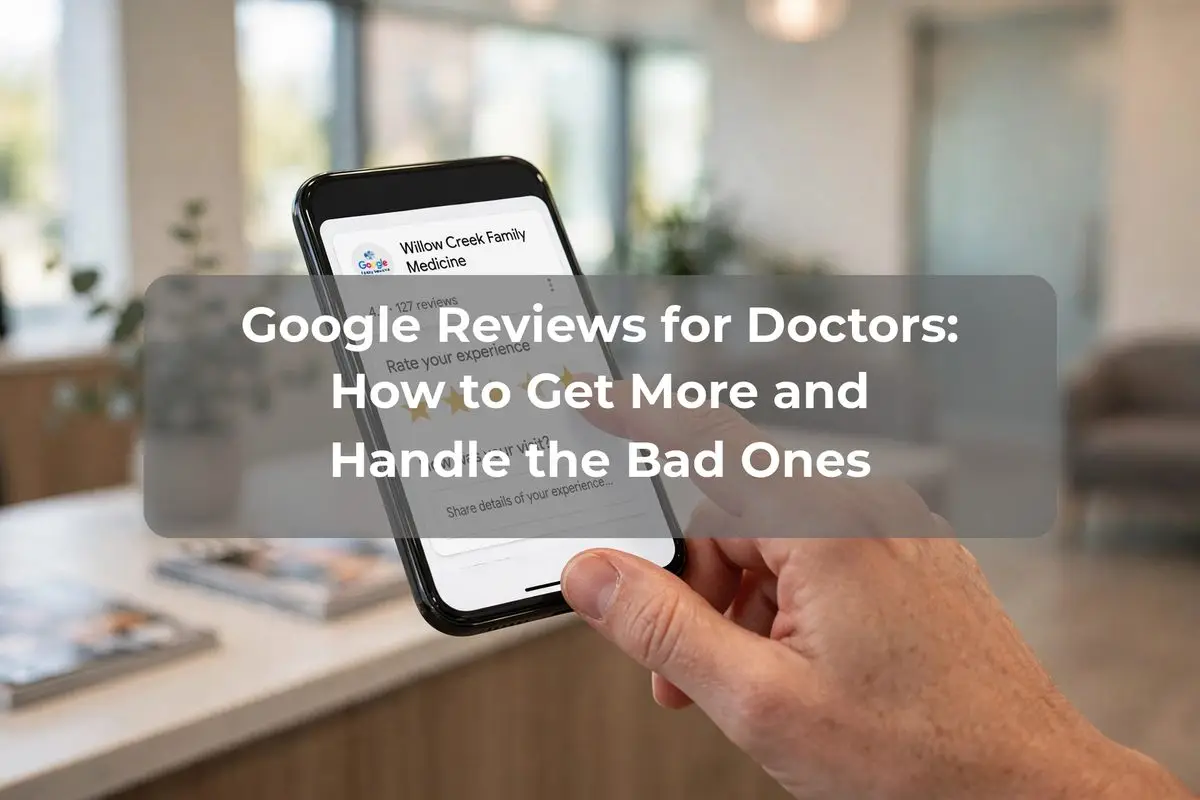
When a prospective patient searches for a concierge doctor, they see two things before they ever reach your website: your star rating and your review count. Those two numbers do more to win or lose that patient than anything on your homepage.
Google reviews for doctors pull double duty. They’re social proof that convinces humans, and they’re a confirmed local ranking factor that convinces Google’s algorithm. Practices that treat reviews as a passive byproduct get a trickle. Practices that treat reviews as a system get a pipeline.
Here’s the system.
Why Reviews Matter More Than You Think
Most practice owners understand that reviews build trust. Fewer understand that reviews directly affect whether patients find you at all. Google has confirmed that review signals, including quantity, velocity, and diversity, influence local pack rankings. In competitive markets, the difference between position one and position four in the map pack often comes down to who has more recent reviews.
The math is straightforward. The top three map pack results capture the overwhelming majority of clicks for “near me” medical searches. Moving from position five to position two can double or triple your profile views. Reviews are one of the few ranking factors you can directly and continuously improve, unlike your competitors’ domain authority or your distance from the searcher.
There’s also a conversion effect that compounds the ranking effect. A practice with 120 reviews at 4.8 stars doesn’t just rank higher. It converts a higher percentage of the people who click through. More visibility times better conversion is why review leaders in a market tend to pull away from everyone else over time.
When to Ask: The Exact Moment
Timing is everything. The best moment to ask for a review is at peak satisfaction, which for most practices is immediately after a great visit, while the patient is still in your office feeling cared for.
Think about the patient journey. They arrived frustrated with their old doctor. You spent 45 minutes with them. You actually listened. They leave thinking “why didn’t I do this sooner.” That feeling peaks in the ten minutes after the appointment and fades within 24 hours. A follow-up email three days later asking for a review catches them at 20 percent of that emotional peak.
The practices we work with that get the most reviews all ask in person, at checkout, before the patient leaves the building. Not by email later. Not with a card in the discharge paperwork. Face to face, in the moment.
If in-person asking feels awkward for your staff, reframe it. You’re not begging for a favor. You’re giving happy patients an easy way to help other people find the same care they just received. Most satisfied patients are glad to do it. They just need to be asked.
How to Ask: Scripts, QR Codes, and Follow-Up
Make leaving a review take less than 60 seconds. Every step of friction, finding your listing, figuring out where to click, logging in, costs you reviews.
The script. Train your front desk on one simple line: “We’re so glad you had a great visit today. Would you be willing to leave us a Google review? It takes about 30 seconds and it really helps other patients find us.” That’s it. No groveling, no bribes, no five-minute explanation. Practices that use a consistent script get three to five times more reviews than practices that leave it to chance.
The QR code. Generate a QR code that links directly to your Google review page (find the link in your Google Business Profile dashboard under “Get more reviews”). Print it on a small card or table tent at checkout. The patient scans, taps the stars, writes a sentence, done. Test the QR code yourself on both iPhone and Android before you deploy it. A broken QR code is worse than none.
The text follow-up. For patients who say “I’ll do it later” (and mean it), send a text within two hours with the direct review link. Text beats email for this by a wide margin. Open rates for SMS are above 90 percent. Email review requests sit unopened. If your practice management software supports automated text follow-ups, use it. If not, a manual text from the front desk works fine at low volume.
What not to do. Never offer discounts, gift cards, or any incentive for reviews. Google prohibits review gating (only asking happy patients) and incentivized reviews, and both can get reviews removed or your profile penalized. Ask everyone, accept what comes, and let the quality of your care do the filtering.
Responding to Negative Reviews Without Violating HIPAA
You will get negative reviews. Every practice does. How you respond matters more than the review itself, because prospective patients read your responses to judge your character.
The critical rule: never confirm that the reviewer was your patient. HIPAA applies even when the patient identifies themselves publicly. A response like “We’re sorry you had a bad experience at your visit last Tuesday” confirms a patient relationship and violates HIPAA. The Office for Civil Rights has fined practices for exactly this.
Use this safe template instead: “Thank you for your feedback. We take all concerns seriously and strive to provide excellent care to everyone who walks through our doors. We’d welcome the chance to discuss your experience directly. Please contact our office at [phone] at your convenience.” This acknowledges the concern, invites offline resolution, and reveals nothing.
For positive reviews, respond personally and specifically. “Thank you, Sarah! We’re glad the same-day appointment worked out for you.” Generic “Thanks for the review!” responses look automated. Specific responses show there’s a human behind the practice, which is exactly what prospective patients want to see.
Respond to every review within 48 hours. Speed signals that you’re engaged. A thoughtful response to a harsh review often impresses prospective patients more than a dozen five-star ratings, because it shows how you handle problems.
Set a Velocity Target
Review velocity, the steady pace of new reviews over time, matters more than your total count. A profile with 200 reviews but nothing new in eight months looks dormant to Google. A profile with 80 reviews and four new ones this month looks active and trusted.
A realistic target for most concierge practices: two to four new Google reviews per month, every month, indefinitely. That pace will outrun the vast majority of local competitors within a year. Track it monthly alongside your other marketing metrics. If velocity drops, the usual cause is staff turnover (the new front desk person wasn’t trained on the script) or complacency (everyone assumed someone else was asking).
Diversify slightly beyond Google. A handful of reviews on Facebook, Healthgrades, and Yelp rounds out your profile. But keep Google as the primary focus. It carries the most ranking weight by far.
Showcase Reviews on Your Website
Don’t let your reviews live only on Google. Pull your best ones onto your website where they influence visitors who arrived through other channels.
Add a testimonials section to your homepage with three to five strong reviews, including the reviewer’s first name and last initial. Create a dedicated reviews page that aggregates feedback from Google, Facebook, and Healthgrades. Use review schema markup so star ratings can appear in your search results, which lifts click-through rates.
One caution: never copy dozens of Google reviews onto your site verbatim. Duplicate content across the web dilutes value. Feature a rotating selection of your best, and link out to your Google profile for the full collection. And always get the patient’s permission before featuring their full name or photo.
Make It a System, Not a Campaign
The practices that win at Google reviews for doctors don’t run review campaigns. They build review systems: a script at checkout, a QR code on the counter, a text follow-up for stragglers, responses within 48 hours, and a monthly velocity check. Total ongoing effort is maybe 30 minutes a week of staff time.
Start this week. Train your front desk on the script, print the QR code, and set a calendar reminder to check your velocity on the first of every month. In six months, you’ll have 15 to 25 new reviews, visibly better map pack positions, and a conversion asset that works while you sleep.
Want help building a complete local presence that turns searches into consults? Schedule a call. It’s a free strategy call, and we’ll show you exactly where your reviews, profile, and rankings stand.