
Make an appointment today to discover how our expertise in practice branding, patient acquisition, advanced marketing tactics, and patient retention can help you thrive.

Steve Schwartz reveals secrets to successful marketing campaigns and growth strategies for the concierge medical industry, this guide draws from 25 years of digital marketing expertise and experience working with over 900 clients.
Episode Summary
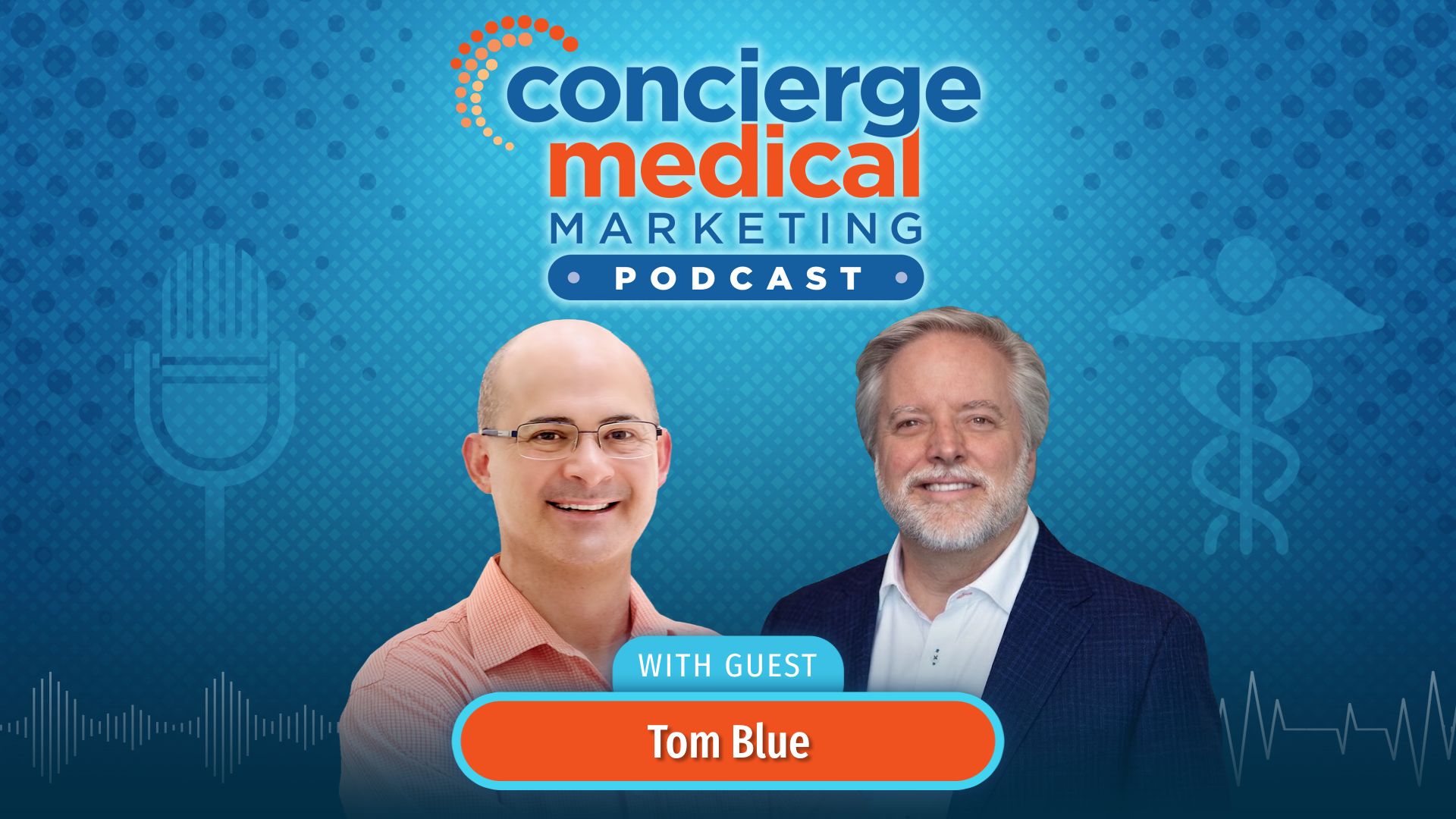
A California doctor whose insurance-based practice was offered $150,000 to $200,000 for sale saw its value soar to nearly $6 million three years after converting to a membership model, despite seeing 85% fewer patients. Tom Blue, Co-founder of Ovation Lab, explains on the Concierge Medical Marketing Podcast that this illustrates how membership practices become valuable, recurring revenue assets. He details why retention rate is an investor’s number one concern, not growth, and how every new dollar of earnings can add five or six dollars to a practice’s purchase price. Discover how optimizing your pricing and leveraging health assessment assets you don’t own can further fortify your practice for a lucrative future sale.
Episode Chapters
00:00:00 – Introduction
00:00:38 – Early Career in Concierge Medicine: Setting Up the First Practice
00:05:01 – The Medical Time Machine: Compressing the Translational Gap in Medicine
00:06:24 – Tom Blue’s Background and Journey into Healthcare Entrepreneurship
00:09:33 – Ovation Lab: Curating and Supporting Next-Generation Healthcare
00:15:57 – Maximizing Practice Value: What Investors Look For in Concierge Practices
00:25:52 – Digital Marketing Strategies for Concierge Practices
00:33:39 – The Patient Acquisition Pyramid
00:40:18 – Contact Information and Final Thoughts
Full Episode Transcript
Hello and welcome to the Concierge Medical Marketing Podcast. I’m your host, Steven Schwartz, and it’s my pleasure to welcome Tom Blue of Ovation Lab. Tom, welcome to the podcast.
Tom Blue (00:36)
Thanks, Steven. Good to be here.
Steven Schwartz (00:38)
Yes, so so grateful for you taking the time to speak with our folks and just the fact that you’ve had such an interesting career from really the beginning of concierge medicine, starting in the very early two thousands. And I know I don’t want to steal your thunder in in your story, but some of the things we talked about off off camera outside of the recording were so fascinating. So
Let’s do this. Let’s speak a little bit about your background, where you grew up, and we’ll get into what got you into concierge medicine as a focus.
Tom Blue (01:11)
Yeah, sure. So so I I got into concierge medicine as you mentioned in the you know in in believe it or not in two thousand one, setting up the first concierge practice in Virginia. And and funny enough at that time
There were, I wanna say, I want to say there were about six practices in MD VIP. MD Squared was up and running. private medical had launched in San Francisco. There were a few, yeah, but it was not actually certain that it was even legal at that time for a doctor to sell a non-covered service to a patient. And and so obviously a lot has happened in the you know in the time since, but I can remember.
getting into it, and and I’m not a physician. And so when we started this practice, we had to go out and recruit a physician. And and you know, most practices, as as you certainly know, are born out of a practice conversion, and you know, where a busy, well-liked doctor decides to you know, that that he or she’s gonna gonna transition into a membership model. And and one day their patients are notified of this, and you know, 20% of them decide to stay, and thus a concierge.
In our particular case, recruiting a doctor was was challenging, especially at that time. We finally found one, but but very few patients. He had to move a good distance to come to come to where we wanted to be. And so we had to build the practice from the ground up, which actually became a a very
Like my favorite formula for building these practices, it’s nowhere near as simple as converting, but it is kind of nice because you get to design from scratch what you want the patient experience to be, the office to be like. It’s, you know, everything is built intentionally around the vision. But for me, what dawned on me was that, you know, we got into the as we got into it, you know, we were designing, I can remember looking for office space and
The timing is so funny to look back this far. But but
The the space we ended up picking was right next door to an imaging center that that had that had brought in Richmond, Virginia’s first electron beam tomography scanner. And it had this glass window from the hallway. You could look in and see this thing. It looked like the Starship Enterprise. And I thought to myself, I’m like, I would love it if there was a way for us to factor this thing into our health assessment so the coolness of that could rub off on what it is that we’re doing. And it turned out that this thing did did it did three things.
It did a virtual colonoscopy, which sounded great. Who wouldn’t rather a virtual one? It did a whole body scan, which sounded awesome. And then it did a thing I didn’t even understand called coronary calcium scoring. Turns out the virtual colonoscopy was sort of a disaster. You had to be inflated with air and it was terrible. The the whole body scan with CT was was filled with incidental OMAS and noise, and that was scary, and and and we had to immediately discontinue that. But the calcium score did.
You know, did some remarkable things. And of course, that’s still in wide use today. around that same time, Liposcience had launched the its very the very first advanced lipid testing lab down in North Carolina. And so in a very short while,
We, you know, this little tiny practice that started out with seven or eight patients, you know, the doctor had had learned about these, you know, these two new things, the calcium scoring and the advanced lipid testing. And we had what was for at the time a remarkably modern, even by today’s standards, cardiovascular assessment program. And the epiphany that that that I had at that time, and it has kept me completely invigorated ever since, was
Essentially a concierge medical practice can become a medical time machine.
And so if you think about the, you know, what’s what’s referred to as the translational gap, the time it takes for a best practice in medicine to find its way from having been proven as a best practice to widespread application. Now, hold aside the launch of a new drug or a new imaging technology. It’s a best practice. It’s, you know, they say it’s 17 years. I my observation is that that 17-year time horizon is actually quite conservative. And it brings about a very interesting question, which is what how do you compress that? It’s tragic.
To think that if you were to think about a cell phone from 17 years ago versus the phone you’re carrying today, that the difference is ridiculous. You would never consider that fossil of a phone for today’s needs. And yet that is the you know that is the you know sort of the the vintage of most of the health care that most people get out in the system. And so
When you think about what’s what it takes to compress it, it’s really two big things. It is on the one hand, you need a doctor who has the time and inclination to learn about these
new best practices. And then you need patients who are willing to invest in their own health ahead of what is valued by their health insurance.
And so, I mean, if you wait for insurance to reimburse a thing and decide that you want insurance to essentially curate what you have access to, then you know you’re gonna be waiting an awful long time for state of the art. You’ll never, you’ll never enjoy state-of-the-art medicine.
And so anyway, I’ve just been completely enchanted with that concept of a medical time machine ever since. And and have have now gone on many adventures building practices of of of all shapes and sizes, doing you know doing this type of thing.
Steven Schwartz (06:24)
So many cool nuggets that you’ve just shared. because you’re not a physician, tell us about your background. I mean, originally, where did you go to school? Where did you grow up and and how did you end up with even the idea of starting a medical business?
Tom Blue (06:40)
Well, the I mean I just have a have a liberal arts bachelor’s degree and and so I’m not you know don’t have any unique educational background to this, all business related. the I’d gotten into the world of entrepreneurship and biotech the you know in in a in a at a very young age actually, developing
I I had gotten into this developing a what turned out to be the world’s first wireless and prepless EEG device to be used as a biofeedback tool for attention training. And this was in collaboration with NASA Langley. And and so anyway, that that product ended up having to go into clinical trials. One of the one of the board members of the of the company realized okay, when it’s in clinical trials, we can’t sell it. The intention of the investors was to was to essentially sell off the the patent.
Portfolio from that company. And she had read about a concierge medical practice like on an airplane one day in a in a in an airplane magazine. And she had been reading about MD Squared and thought, boy, this would be a great thing to have, you know, in Virginia. And the two of us decided to, you know, to see if we could create such a thing. So it was just sort of a strange turn of events. I’d always been very interested in in in kind of cutting-edge healthcare stuff, but but
you know, this gave me a chance to dive in with both feet. And then, you know, after doing that practice, I became so enamored with it. I ended up working on the launch of another practice that was sort of a higher end executive health kind of membership based practice, also in Virginia called the Executive Health Group. They’re still still there today. the
The I then went on, you know, the Trade Association of Concierge Medicine had kind of fallen on hard times. And just by a strange turn of events, I wound up taking over responsibility for that. And we kind of rebranded it and and and and I ran that for nine or 10 years, which then put me in contact with loads and loads of people looking to transform their practices into a membership-based model all around the country. And so I started working on setting those types of practices up you know, as a as a career.
career and and then found my way gradually, always in search of different value propositions into the world of functional and integrative non-longevity medicine, really in pursuit of just better and better value propositions for concierge practices.
Steven Schwartz (08:54)
Well, you definitely sound like a business guy, an entrepreneur, and so much interest in healthcare, making it better for the patients and the providers. so many interesting things that you I just had to laugh a little bit because I remember reading through the magazines on in the airplane seat pocket in front of you, and all the amazing stories and articles and things that I’ve read in there over the years and seeing an ad.
Related to a concierge medical practice. And somehow that led you and your partner to saying, hey, we should set up one like this. That’s just hilarious and wonderful all at the same time. What a great story.
Tom Blue (09:31)
Yeah. yeah.
Steven Schwartz (09:33)
So fast forwarding to where we are today, you’re the co-founder of Ovation Lab. Tell us maybe the 30-second snapshot of what you and your team do at Ovation Lab.
Tom Blue (09:44)
Well the DNA of Ovation Lab is we’re really the former leadership team of the Institute for Functional Medicine. that up up through about the year two thousand nineteen or so. we all had worked together, you know, growing that. And
And decided when when the CEO at IFM wanted to we wanted to do something different, we decided to launch Ovation Lab really for the purpose of of helping. There’s a you know, as with everything, there’s a big difference between the companies that kind of succeed from a marketing standpoint and the companies that may that may or may not be the very best. And oftentimes the ones that are the best marketers aren’t the aren’t the best. And so and so in the in the healthcare professional channel in particular.
And in the world of functional and concierge medicine and longevity medicine, there’s actually a really it’s there’s an interesting and healthy ecosystem that exists between the practitioners and the and the industry players around them that’s a little bit different than it is just out in the in the healthcare system at large. Most most doctors in the system think about the vendor ecosystem around them, and they think about pharmaceutical reps coming with lunch and whatever, and it’s a
You know, it’s sort of this thing they do for free food and w whatever. But in the in the world of of of private pay medicine and longevity and functional medicine, you know, the whether it’s the supplement companies or the specialty labs or the device and technology companies, they actually play an important role in in kind of
Continuing the education and practice implementation process. And so we
created Ovation Lab to really help companies that are doing something special come to the attention of practitioners. So we play a curation function and a practice implementation and education function. About a third of our businesses in doing clinical research so that we ourselves can kind of curate better the things that are the most remarkable. About three years ago, when the you know there became
A an awakening in the investor community around the value of concierge medical practices. My phone started ringing and I found myself transported back into my previous life really that was focused on purely on concierge practices. Weirdly enough, for all these years running the Trade Association and actually thereafter, you know, for whatever reason, I’ve been a
a go-to for the media, you know, when they have quite you know, every now and again a reporter from somewhere will want to write an article about about concierge medicine and and the Wall Street Journal did one a couple years ago and and it’s I I still just get these calls and I love talking about it. And so anyway, so I start getting these calls from investor groups and and and became quickly aware that wow, a thing that I had always talked about at conferences, and it was kind of a speculation really when I think back to like 2000 probably nine or 10.
When I would when I would do talks on this, I would speculate when people are thinking about transitioning their practice from the insurance-based model into a membership-based model. The, you know, what what what’s occurring that people aren’t aware of that’s quite spectacular, is the practice is being changed from an asset that’s almost non-transferable. The system is very engineered in favor of the
Of the health system acquirer of a medical practice and not the physician entrepreneur. You know, it is illegal to sell patient relationships when you you know when it involves government payers. And yeah, there’s all sorts of interesting, interesting and and and you know rules that why would a doctor think about it when they’re setting up their practice? Real life, right before this call, I was on a call with a doctor in California. He had been
you he transitioned his practice to a membership model about three years ago. Right on the on the eve of doing that, he had been offered, I want to say it was $150,000 to $200,000, he just said, for his, you know, for his insurance-based practice.
Fast forward to today, it’s almost inconceivable that that same practice isn’t worth six million dollars, you know, seeing maybe 15% of the patient volume that he was seeing at the you know at that time. And the reason is that now you have this, you have this recurring revenue contract relationship with the patient. It’s it’s it’s at a distance from you know the payers. It’s you know, it becomes an asset, a retirement asset to sell.
And so anyway, I’ve been, you know, with all the investor interests in this in the space now, I’ve been I’ve been drawn a lot back into helping to facilitate those, you know, those relationships and connections between really you know kind of top-performing practices and and investors. So yeah, it’s just been a very, very interesting kind of adventure over the last 25 years.
Steven Schwartz (14:26)
I love it. And so for my audience of the Concierge Medical Marketing podcast, we have people who are considering starting a membership practice. We have people who have already started their practice and are trying to grow it. We also have people that have a practice and are looking for an exit. when I consult with folks, I always tell them look, if you’re starting a new practice or thinking of transitioning,
You need to always think and plan with your end in mind, the exit. At some point, you’re not gonna want to or need to own this practice anymore, whether it’s selling to partners, selling it to investors, closing the door and just simply retiring and walking away. God forbid something happens with the practitioner’s health.
or you know, death or some awful untimely accident, we never quite know what the last day of our business is gonna look like. So to help our listeners, no matter where they are in the spectrum of considering a practice, running one, or looking for an exit, can you please share maybe the top bullet points from the very beginning?
Through the end, what are the main things that practitioners should do or keep in mind so that at some point they can either sell their practice to a member of their team or sell their practice to an investor who might be interested?
Tom Blue (15:57)
Gotcha. Well, let’s hold aside for a second the the person considering starting one, because that’s a you know, they’re a different set of considerations there. But when you look at what it is that that that investors are are valuing in in practices today, the probably the number one thing is retention rate.
Steven Schwartz (16:19)
Yes.
Tom Blue (16:20)
And so it’s you might think, because a lot of businesses are rewarded for a rapid growth rate.
now of course, you know what they’re buying is you know is essentially the you know the leftover earnings after everyone is compensated. So the practice needs to be profitable enough to pay a reasonable wage to the practice owners and then and then have profit left over for an investor to buy at a multiple. But so that’s an obvious one. But
A lot of people, a lot of I would I will tell you, I have seen plenty of of deal of conversations about these transactions end over a lackluster retention rate. I have not seen any conversations end over a lackluster growth rate. Most practices tend to, you know, that have been around for a while.
tend to kind of fill up and and and and the the practice owner is very happy with the way things are
going, doesn’t want to disrupt things, has a great kind of quality of life, and they’ll kind of hover and maybe even accumulate a waiting list of patients that are you know that are you know waiting to get in as as openings as opening surface. And and that’s you know that’s exciting to investors. The you know the thing that’s you know that’s frightening is having to be on the customer acquisition treadmill because of a high a high
attrition rate. So if you think about this I’ll tell you the story as I have kind of picked it up now.
From a bunch of different investors that are excited about the space. It’s kind of a simple story, actually. It’s you know, essentially, these folks have their own concierge-physician relationship. As time goes by, some of them have had very significant kind of health events that have been that have happy endings because of their concierge practice. And they’re like, and they realize a series of things. Number one,
Science is advancing way faster all the time and getting more and more media coverage, especially with one in the longevity world. And when you look around the healthcare system outside of this private pay space, yeah, the the gap between what you get and what’s available gets wider and wider. And so the alternative to concierge medicine gets uglier and uglier every year that goes by. And so there’s that. Then they realize.
There is a supply and demand imbalance. You know, the number of people who would want this quality of healthcare vastly exceeds the number of providers that have capacity to deliver it. And unfortunately, as you and I’ve discussed, the
You know, it’s not a the universe of concierge physicians is not renewing itself. And so, you know, because most practices are born out of this practice conversion exercise where an independent practice owner transitions their practice, they’re you know, the the world’s not reproducing more independent practice. Not many doctors leave medical school with a mountain of debt and say, I think I’m gonna hang up a shingle and start my own practice. The system is kind of engineered to discourage that.
And so and so they real the investors realize, gosh, you know, this is a supply and demand thing. And and then they realize, why would anyone ever leave this relationship? So it’s a it’s a subscription with a very it’s very, very sticky with a very high switching cost. And so you add all that together and it makes for a really, really good investment thesis. And and so, you know, the the if you think about that story, there
They’re already conscious that there’s a supply and demand imbalance. And so I think they bring a good bit of bullishness to the potential for growth. There are experts like you that know how to unlock that and bring in more demand when the you know when the practice is ready to take it. and so what they’re looking for is something is something sticky. And so that’s what I would say. Number one, focus, focus a lot on retention. The other thing I would say is the
The rewards for increasing the practice’s kind of leftover earnings at the end, you know, after everyone’s compensated before the practice is acquired is kind of high. I mean, you have every every new dollar of earnings you you’re gonna get, you know, you’ll recapture and purchase price maybe five or six dollars. And so, and so thinking about one of the things I’ve observed is that there is a lot of kind of untapped potential for price optimization.
A lot of folks have, you know, again, they’ve got a practice they’re happy with. They don’t want to rock the Apple cart, as they say. And so they’ve been at a they’ve been at a price point that that might might have made sense six or seven or eight years ago, but but today, given the dynamics I just described, you know, the the pricing could be a good bit different. What I’m seeing is is that most people are.
you know, increasing prices after the acquisition has occurred and and and getting growth incentives, but but but they’re discovering that there’s a lot of untapped potential there. so thinking about you know how might you create a premium membership tier or outright in you know just you know look at opportunities to increase pricing.
and optimize to to what today’s market will sustain is is kind of a is kind of a big thing. and then of course there is thinking about fortifying the practice for what you might think of as succession risk. So the as you and I’ve talked about the
You know, it’s sort of a story as old as concierge medicine, just the challenges of adding providers to a practice, you know, getting the chemistry right, getting the new providers to stay and not try and take the patients and move across the street. increasingly, you know, the you know the I think there’s gonna be an opportunity to do that with
You know, emerging AI tools that that manage a really, really robust knowledge base about patients. And I think there’s gonna be a whole nother sort of flavor of service that that wraps around that. The other thing that’s really interesting is if you think about just trends in our space, it’s kind of the decoupling.
Of the health assessment from the physical plant of the practice. So I can remember for forever thinking about, okay, if you think about the year of a membership relationship with a patient, kind of the high point of the year, barring something sensational with a health problem, the high point of the year tends to be your health assessment. So you get this annual physical, the physical is gonna be more souped up than the physical you would get out in the out in the in the healthcare system. And so you have to think all right, how am I gonna, what am I gonna design into the physical?
And you want to create differentiation. And so we would do things like we would, you know, buy an in-body body composition scale, or we would buy the photofinder mole digital mole mapping technology, or do carotid IMT. I mean, what are the things that we can do in the office to really differentiate the physical? Well, you know, in in the in more recent years, you have the emergence of whole body MRI. And so
You know, you’ve got places like Human Longevity and Fountain Life that that bring that technology in-house. But lately
we’ve seen, you know, Prenovo and Ezra and other places spin up where, you know, Simon Med, where you can get that type of imaging done without having to acquire the machinery. And so starting to think about how do you take advantage of of health assessment assets that you don’t own and then bring all that together into your physical, to me, is a really
Really interesting possibility. Then you throw in, you know, the integration of wearable data, which has not really been a terribly easy thing to do up until pretty the emergence of AI. I mean, there have been ways to get the data, but you’re still sort of sifting through an individual’s HRV and sleep patterns. I think now we’re going to see with AI.
the you know the ability to kind of have that health assessment just run three hundred and sixty five days a year passively is gonna be a is gonna be a real thing. So anyway, I think it’s we’re entering into I’ll throw in one other dimension that we’re about to study
you know, we do at Ovation Lab, we do a lot of industry research. One of which, one ongoing project of ours that we’ve been doing in partnership with A4M has been a has been now, it will be in its fourth year, a social listening study on just kind of consumer perspectives on longevity medicine and and medical relationships, how what they you know feel is valuable, frustrating, et cetera. We’re gonna look more deeply into patient perspectives on virtual practices, completely virtual. And so we’re starting to see.
More and more of these 50 state virtual offerings. And I think people are starting to get more comfortable with this idea that you can engage in a real substantive medical relationship without, you know, driving across town and sitting in a waiting room and giving my insurance card to a person behind bulletproof glass. And you know what I mean? And it’s and it’s I think we’re starting to see that that kind of flexibility create creative options. So
Yeah, very, very interesting times for curating the the value proposition.
Steven Schwartz (24:54)
Yeah, so important.
I’m glad you mentioned the AI, where you can have a secure HIPAA compliant system that takes the data from your ring and your CPAP machine and the different devices that we wear, that or I Apple Watch, even or whatever, and feed that data into one platform and that system chugs the data, stores the data, and can even offer.
the medical provider things to look into or test further for, like, by the way, we noticed that you’re you’re not breathing enough and your blood oxygen content is too low when you’re sleeping or whatever it might be. That’s a heads up item that you need to reach out to your patient for, all of which is providing that VIP level concierge type care that people truly want. And when it comes down to it, this is our health we’re talking about, right?
Tom Blue (25:50)
Right.
Steven Schwartz (25:50)
This is truly our health.
Tom Blue (25:52)
Yep.
Steven Schwartz (25:52)
And so I use a lot of AI for my digital marketing business and all the time. And seeing how AI is used in so many different areas of business, healthcare, and so much more is truly exciting. obviously, this is the concierge medical marketing podcast, and we like to talk at least a little bit about digital marketing and marketing techniques.
To help medical practices grow, to acquire more patients, get more eyeballs on who they are and what they do. And in your several decades of experience working in membership medicine and consulting with your practice clients, what different digital marketing or traditional marketing methods have you seen work the best for the people you’ve worked with?
Tom Blue (26:39)
Well, I think I mean I have to say, I think it you know that that the work that you’re doing is is really foundational. Showing up on search engines is you know, is is you know, is the you know, and and and now with you know with Google reviews, it’s like there’s you know, there’s like a foundation that you would then
established to build on. And so so let’s establish that that’s you know that’s really foundational work. One thing that to me kind of relates to the foundational work you’re doing and and I’m betting that it spills over into this is not just visibility in search engines, but visibility in call it answer engines. You know it’s yeah I’ve got to imagine that these activities are very related and if you’re boosting search results you’re probably showing up better in in you know on chat GPT searches.
And the kind of patients that are looking for these types of services are not only asking questions about their health specifically of these types of tools, but they’re also asking about healthcare providers. And so, yeah, so that to me, visibility is is is foundational. The the next thing I would say, if you think about it, there’s so much of
You know, the the the world of you know the world of kind of next generation healthcare requires the patient to learn something new and then to participate in applying it. And and so the the ability to deliver high return on effort education and insights is kind of a is kind of a big deal. And so and so one of the things we’ve observed is that
Practices that you know that become really quite good at growth, beyond the foundational,
you know, are oftentimes will apply a strategy that is: I’m gonna attract a patient with a particular health solution, you know, reverse your diabetes or IBS or whatever. You know, if I’m gonna target patients that have a particular problem to solve, and then I’m gonna I’m gonna solve that problem and transition people into a membership model.
And and to me, it’s real, I had a very sobering, very sobering wake up call on this. Like it was well before COVID. This practice that I had had helped to set up out in California was was it was a great practice with two IFM certified doctors, a man and a woman. They custom built the office space. I mean, it was a really, really great practice. And in fact, both were like IFM faculty members, they were terrific.
And one day the the the female doctor had you know came to me, she said, I’ve discovered a reverse your diabetes kind of program. And and I’m gonna license my market area and and and do this thing. And so I was thinking to myself, I’m like, you know, as I’m looking at the program, I’m like, the person who created the program is certainly no smarter and arguably not as smart as you are.
The supplements that are included in this program are no better and probably a little worse than the ones that you’re already selling to patients. You know, it was like, you know, the the scope of this a six-month reverse your diabetes program. You know, and the you know, the scope of this is very much included in what you would otherwise do for your concierge practice. So I was kind of perplexed. What I noticed though was she could sell the six-month reverse your diabetes program.
Which was again a subset of what you would have gotten anyway as a member of a practice for more than the membership for the year. And it taught me an immediate lesson, which is, you know, again, it’s if you can speak to a specific problem that people have as a way of initiating a relationship, it you know, it it goes a long way. And if you think about the concierge medical value proposition, the way it has like I’ll tell you, I’ll give you I’ll give you a little quiz.
When you’re converting a practice, what would you guess is the is the patient characteristic or or data point that is most predictive of whether they will join the converting doctor’s practice?
Steven Schwartz (30:35)
Boy, good question. I mean, could it be more time? It could be more attention or solve my problem.
Tom Blue (30:40)
No, no, the a descriptor of the patient.
No, no, I’m talking about a descriptor of the patient, you know, is is some characteristic of the patient.
Steven Schwartz (30:49)
I would say self motivated or they really care about their health, it it’s it’s truly top of mind importance for them to be healthy and be able
Tom Blue (31:00)
Yeah.
Steven Schwartz (31:00)
to live a long and healthy a life as possible.
Tom Blue (31:02)
That would be a very sensible thing to guess. In fact, the answer is age. The older
Steven Schwartz (31:08)
Age.
Tom Blue (31:09)
the patient, the higher their likelihood of staying with the practice.
Steven Schwartz (31:13)
Interesting.
Tom Blue (31:13)
Traditional
concierge medical conversion. yeah. And so and so if you’ve ever had a practice that goes through a screening from one of the big concierge conversion companies, they are counting Medicare age patients and and then they are looking at how recently and how frequently those patients have visited the office, second to that. So a lot of people say income. You know, they say, you know, the patient’s gotta be able to afford it, so income’s gonna be the thing. You know, the most most concierge medical fees are not.
you know, gonna put you into bankruptcy. It’s a you know, it is a yeah, it’s a priorities thing. And you would think that that priority is I value health. In fact, again, b thinking broadly in the history of concierge medicine, the priority really has been
I want access to my doctor. And so what you’ve seen is that the value proposition of concierge medicine in a traditional sense has been I want my doctor’s cell phone so that in an emergency I know I have the security of being able to access my doctor when I need him or her. And that is
The central value proposition of generic concierge medicine. And so if you think about okay, what that’s a great value proposition when you’re converting, because patients can assess immediately how valuable is Steven’s cell phone number to me. And if I’m 85 and I’ve got COPD and other things, it’s like it’s maybe it’s very high. And I’m willing to just pay the money not to be put back out into pasture and have to find a whole nother doc medical relationship.
If you’re if you’re trying to attract a new patient, though, I have no idea what how valuable your cell phone number is to me. You know, I it that that value proposition at best implies that you might be able to better solve my actual health priorities. And so it’s it’s it’s a very, very interesting thing, the difference between marketing a conversion and and marketing for growth.
And so being able to speak to a problem or or an aspiration, longevity has been the a very unusual breakthrough on on selling something positive that that people aspire to and attracting and attracting patients.
We on another conversation we can kind of take apart like what’s actually happened to make that possible. But but yeah, it’s a really, really interesting it’s a very interesting thing that just I’ve I’ve just observed over time, but but has has kind of played out.
Steven Schwartz (33:39)
so many great nuggets that you’ve just shared. one of the things that I wanted to touch on is that in my business and consulting practices, there’s something called a patient acquisition pyramid. Three levels of this pyramid. The base level is your foundation, which includes a quality website that looks great on a mobile device because I don’t know what is it, 80 plus percent of visits are now on.
on mobile iPhones and Androids and whatnot, having a quality Google business profile set up and optimized, syndicating
Tom Blue (34:12)
Mm-hmm.
Steven Schwartz (34:13)
the information from your Google profile to many other directories around the internet, which shows Google that your information is accurate and consistent and they can push you higher. And having some sort of a marketing automation software running at the base level of the business, a program like Go High Level or a similar program.
So that when people fill out the form on the website showing some interest, it captures their data, it saves it in a database, and then it triggers automations like emails, text messages, voicemail drops, and all
Tom Blue (34:45)
Right.
Steven Schwartz (34:45)
that, leading them, nurturing them, giving them education, leading them towards setting up a meet and greet appointment. So that’s the foundational level. The next level is what I call active searchers. These are people who are sitting down at Google, Bing, Yahoo, as well as now ChatGPT and
Claude and Gemini and whatnot, the AI tools, asking the AI or Google for the best concierge practice near me or something along those lines. And in order to have your medical practice appear in those places, you do this by doing two things very specifically. One, paid Google ads and doing it, not just doing Google ads, but doing it right. One of the things we offer from
our website stevenschwartz.info is a case study showing how we helped a particular concierge practice go from spending eight or nine thousand dollars a month on their Google ads spend to down after they hired us to like three thousand to four thousand dollars a month while doubling the number of leads and the leads were of much better quality. So doing Google ads correctly is super important.
also good quality good quality SEO search engine optimization will not just help the website appear more favorably on Google and Bing and Yahoo type searches, but also on the A AEO or answer engine, the AI tools search results as well. And one of the things you mentioned about solving people’s particular problems, meaning their health problems, it’s it’s important.
That you write blogs, articles, right, on your website, publish them. You can even turn them into videos. So you have the video and the text. And then once that’s published to your website, then you share the link to that location as many places as you can, such as your LinkedIn and your Facebook and your Instagram, but also hundreds of other places across the web where you can link back to that article. We call these backlinks.
And kind of the idea there is that if you write an article, that’s topic is something that people are actively interested in. For example, Ozempic versus Monjaro, which is better for my situation, something along those lines. These are the trendy weight loss GLP1 medications, of course. And if you write an article, let’s say a thousand words, and it talks about
Ozempic and Monjaro, and it talks about you know, your town in I don’t say Sacramento, California, because you’ve mentioned California. You mentioned Sacramento several times. You mentioned the practice name. You talk about why concierge medicine is a great method of or style of practice to help people with their weight loss. They’re not just buying some medicine online and then hoping it works, but having that one-on-one with their doctor or nurse practitioner.
to really specifically work through it. If you write articles like this, publish them to your site, and then link back to them from all these other places, Google sees that. And because of that, Google will reward you by pushing your article higher up on the resulting search screen when people search for it, than your competitors who are not doing these things. Does that make
Tom Blue (38:07)
Mm-hmm.
Steven Schwartz (38:07)
sense?
Tom Blue (38:08)
Total.
Steven Schwartz (38:09)
And so these are the things that we recommend that all practices do if they want to grow and if they want to compete. about a year ago, I created MADI, the AI digital marketing assistant, specifically for membership medical practices. And with MADI, a practice can literally onboard their practice information, who they are, where they are, what they do, their website, the Google profile.
All this kind of stuff can onboard it into this AI. And then Maddie, the AI, can give suggestions on things that can be done to make things better. articles, blog posts, so much more that can be done in order to help take it to the next level. And this is really good for practices that are either starting and want to grow, existing practices that want to grow, or those that are, you know, trying to bootstrap and do this themselves.
Are there some things that agencies simply have to do for you in order to get the results? Yeah, probably so. my company, Concierge Medical Marketing, is certainly here to do that. But we’ve created a lot of tools for these practices who need these tools in order to to grow if they want to try to do it themselves. So in fact, one of the things I’ll I’ll mention and I think would be helpful, I wrote a book called The Definitive Guide to Winning with Digital Marketing.
For concierge medical practices. This book is free with my compliments. Feel free to download it from our website, conciergemd.marketing or from stevenschwartz.info. Basically, download the book, read it. It’s a PDF, it’ll get sent right to you. And if there’s any information there that can help you grow, please take it with my compliments. And I really do hope that it helps you. as we wrap up today, Tom, you’ve given us so many great things to think about and our listeners.
If somebody wants to talk to you personally and, you know, hop on a call, talk about, hey, what should I do to grow my practice or what should I do to get myself positioned in in such a way so that you can help me find an investor who might want to buy the practice in a few years for seven figures, whatever. How can people contact you?
Tom Blue (40:18)
Easiest thing is just email [email protected]
Steven Schwartz (40:23)
Okay, [email protected] this is great. do you have any final comments or thoughts that you want to share with our audience before we wrap it up here?
Tom Blue (40:33)
You know, my my only thought, my only parting comment is is that, you know, and and it’s maybe more to the to the practice owners that are thinking of starting a practice like this. Number one, I’ll tell you an interesting an interesting factoid. we just finished our every five years we do a we do a sort of state of the industry research study of practices. And what we discovered this year, not unique from previous years, is
The fastest growing practices in the, at least in the longevity functional, integrative space, are actually those owned by nurse practitioners. So don’t think for a moment that if you’re a nurse practitioner, there’s not really a ready market for you as a as a concierge provider. Thing number one. Thing number two is
Recognize the the same dynamics in the marketplace that the investors are observing. The risk of doing this just gets lower and lower every year. There’s basically no regulatory risk if you set your practice up, you know, correctly. There’s there’s so many, you know, this is now so familiar that all the things that used to be scary are just not. and and the question of whether there will be patient demand if you create a legitimately compelling value process.
proposition,
there’s almost no question about it, regardless of how many competing practices there are in your in your area. You’d almost there, you know, the the the demand is is just too great for the supply. So I would really, really urge folks to, you know, to get into this. It’s a yeah exercise creativity and and and begin to create something that’s more a reflection of your own kind of values and interests. It’s you won’t regret
Steven Schwartz (42:12)
Love it. Well, Tom Blue, you’ve been a wonderful guest on the podcast today. I’m so grateful for your enthusiasm and your friendship and looking forward to working with you and clients that we have in common going forward, helping the whole industry just continue to grow so that our practitioners can have more successful practices, have less stress, less burnout, more discretionary income, more time freedom.
that’s what this is all about from the practitioner side and from the patient side, let’s give folks better outcomes, less stress, more time. And so, in doing so, everybody wins. And I think it’s just such a beautiful industry. It’s growing. And as you said, whether somebody’s a nurse practitioner or an MD or a DO or ARNP or whoever it may be, you can do this too. And
If you’re not sure if you can do it, I encourage you, reach out to Tom Blue directly. I know you can also find him on LinkedIn. but reach out to Tom, talk to him, and and you know, chat for a while and get the direction and advice that you may need to see and confirm that is this the right direction for you, your practice, your life, and your family. we’ll wrap it up now. This has been Steve Schwartz, Concierge Medical Marketing Podcast.
And please like, subscribe, follow, share. You know what to do, all the different cool podcast podcast places and things. We appreciate you helping us get this message out there. If anybody wants to speak to me personally, please reach out to me through our website, LinkedIn, or whatever. Have a great day. Tom, thanks again for your time. And folks, we will see you on our next episode.