

Make an appointment today to discover how our expertise in practice branding, patient acquisition, advanced marketing tactics, and patient retention can help you thrive.

Steve Schwartz reveals secrets to successful marketing campaigns and growth strategies for the concierge medical industry, this guide draws from 25 years of digital marketing expertise and experience working with over 900 clients.
Episode Summary
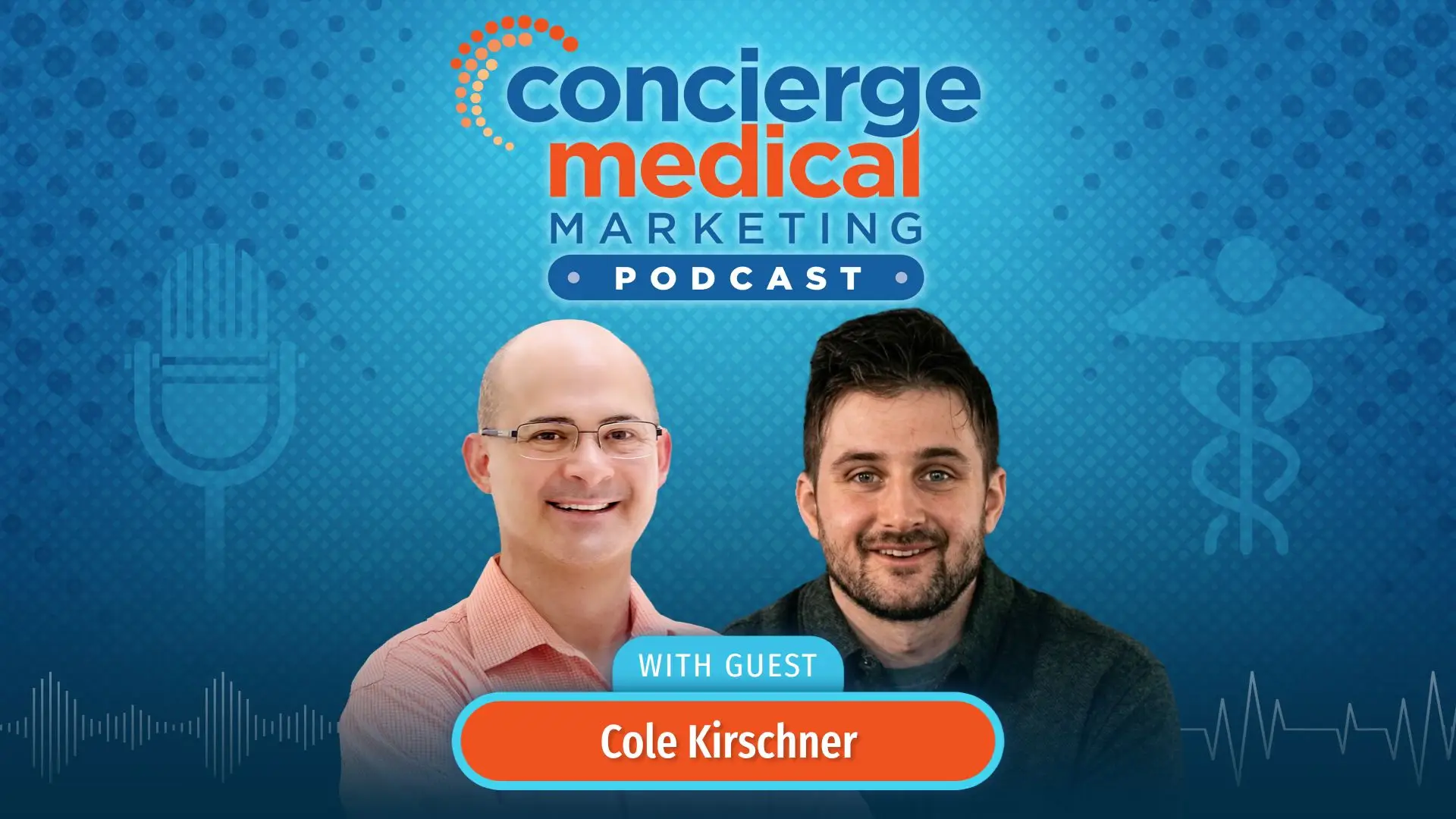
This podcast episode features an interview with Cole Kirschner, CEO and founder of AgeRate, discussing their at-home blood test that measures biological age through epigenetic analysis. Designed for concierge and direct primary care practices, the test helps patients track and optimize their aging process by providing insights into chronic inflammation, metabolic, and immune health, beyond just their chronological age. Practices can use AgeRate to improve patient retention through follow-up testing, quantify the effectiveness of their longevity programs, differentiate their services, and generate income, with a convenient consignment model for clinics. The discussion also touches on AgeRate’s marketing strategies, focusing on B2B outreach to medical practices and their plans for future report expansions, like analyzing marijuana usage impact.
Episode Chapters
00:00 Introduction to AgeRate and Guest Background
01:09 Cole shares his background and interest in health optimization
02:11 Overview of AgeRate’s biological age testing service
03:01 How the blood test measures biological age and its significance
04:28 Results delivery process to practitioners and consumers
05:25 Recommendations and lifestyle changes based on test results
07:07 Chronic inflammation and long-term health insights
10:52 Marketing strategies: digital ads, trade shows, and outreach
22:02 Success stories and real-world outcomes
23:46 Future updates: marijuana and other health insights
Connect with Our Guest
Full Episode Transcript
Hello and welcome to the Concierge Medical Marketing Podcast. I’m your host, Steve Schwartz. It’s my pleasure to have Cole Kirschner today. Cole is from AgeRate. He’s the CEO and founder and want to have him share with you what AgeRate’s all about and how it can help you as a tool in your toolbox at your concierge or direct primary care practice. Cole, thank you so much for joining us today.
Cole (00:48)
Thank you so much for having me, Steve. It’s a pleasure and excited to dive into it.
Steven Schwartz (00:53)
Awesome. Well, let’s do this first. We always like to have our guests share a little bit about their own personal background, where they grew up, where they’re from, what made you want to become involved in the medical industry. And then we’ll get into what age rates all about.
Cole (01:09)
Yeah, so we’re Canadian based. based in Canada, in Ontario. Grew up always interested in health optimization, biohacking, listening to…
and had a personal passion for health optimization and how we can apply science to give us a competitive advantage. I went to University, McMaster University to study biotechnology with a keen interest in genetics and molecular epidemiology. And for my final year research project, we were exploring ways to measure different biomarkers to see whether or not we could.
provide some really meaningful insights in terms of how folks could help optimize their performance, whether it’s fitness related or health related. And we really landed on something that we’re really excited about, which is biological age testing.
Steven Schwartz (01:57)
Nice, so that literally went straight into creating a business and a product that you can share. Let’s just jump right into us. Tell us all about age rate and what you specifically offer to your customers.
Cole (02:11)
Yeah, so at AgeRate, we offer an at-home blood test in a mobile app that helps you track and optimize how well you’re aging. So the process is really simple. So a patient would get a test kit, provide a small blood sample, send it to our lab, undergoes a custom lab analysis where we measure thousands of different epigenetic sites or DNA methylation sites.
and use those raw values with algorithms to calculate your biological age. So your biological age is how old you appear to be on a biological level and the difference between your biological age and your actual age represents how fast you’ve been aging. So that in and of itself is a really valuable tool when it comes to understanding how well you’re aging, what’s your expected health span, lifespan.
but also a really good tracking tool when it comes to seeing what interventions are actually working in regards to slowing down the aging process, right? So a lot of us are putting in a lot of effort into the gym or the kitchen to help us live a longer and healthier life, but how do we know that the effort we’re putting in is actually paying off, right? I mean, no one really wants to wait until they’re…
80 or 90 years old to see whether the efforts they put in when they were 50 or 60 actually had a meaningful benefit in terms of them being functionally independent and functioning well in their later years. So that’s where a tool like this really comes in handy. You can really get an idea in a short period of time to repeat testing whether or not the changes you’re making are having a meaningful.
impact on your trajectory to live a longer and healthier life. But beyond the biological age, we take it a step further too with our test results. So we also provide a variety of other insights to help you understand why you might be aging faster or slower than normal. So looking at things like chronic inflammation, metabolic health, immune health. We really see that. Yeah, sorry, go ahead.
Steven Schwartz (04:11)
So
no, no worries. So based on the results of the blood test at your lab, those tests go back to the physician who requested them or back to the consumer who requested it personally? Or how does that work?
Cole (04:28)
Yeah, so we do work with quite a few clinics who have the test kits on hand. They can either do a traditional blood draw if they have that already set up in house and provide us the blood samples, or they can use our test kits here. So use a device called a TASO device for the blood collection where the patient just puts it on their arm, pushes a button, waits a couple of minutes, and the blood comes out into a small tube.
he would ship that to our lab and then we provide the results back to the practitioner or the end user. Most of the time it’s both. PDF reports for the practitioner and then for consumers we have a mobile app as well that can deliver the test results through digital format.
Steven Schwartz (05:08)
Nice. And when somebody receives the results of their test, is there any advice or suggestions on what changes might be recommended to improve the situation? Or is that literally the recommendation of the medical practitioner?
Cole (05:25)
Yeah, so we see it both ways. So a lot of the clinics that we work with already have their own frameworks for providing recommendations. And they really see this as a great tool to pair with their traditional packages and programming that they offer. So let’s say there’s like a three month sort of transformation package, for instance, right? Where they’re already offering that. You could have this be baseline and follow-up testing as a part of that package with a longevity focused approach.
We also do provide recommendations based on the latest science available in regards to what sort of lifestyle changes could have a meaningful impact on the test results. And for that, we take a risk factor based approach. So there’s no silver bullet right now when it comes to what’s actually going to slow down or potentially reverse aging, at least what we’ve seen in the literature. But there’s a lot of things that people can do in regards to
fitness, nutrition, wellbeing and recovery to help them improve other aspects of their health that would have a benefit in terms of slowing down their biological age. So when you get a test done, there’s about 10 different areas we work with beyond the biological age, like the chronic inflammation, metabolic health. We identify the area that needs the most amount of improvement. And then based on the latest literature and science, we suggest some lifestyle changes that could be done to.
help improve some of those particular test results. And practitioners use that as guidance.
Steven Schwartz (06:53)
OK, cool. I’ve heard a lot of discussion about chronic inflammation with regards to leaky gut syndrome. Does your test help identify if your patient has leaky gut?
Cole (07:07)
So that’s a really great question and we’re really excited about our chronic inflammation score that we do offer. It’s actually quite a bit different from traditional sort of inflammation tests that are out there. So a traditional inflammation test, they usually look at a marker called CRP. CRP is a great marker for short-term inflammation, but…
it doesn’t necessarily get to the root of like long-term exposure to inflammation. So that low-grade chronic inflammation that could be underlying over a long period of time. That’s where our tests can come into play, where we can actually pick up on certain epigenetic sites that are changed in a way over time due to exposure to inflammation. And we can get a really good idea in terms of
long-term exposure to inflammation as opposed to that short-term inflammation. And there’s a variety of things that could be impacting chronic inflammation. I’m assuming that leaky gut syndrome, as you mentioned, would be one.
Steven Schwartz (08:11)
Yeah, so interesting. I find that the more people I interview for this podcast, the more tests that are sound truly groundbreaking to me. Again, I didn’t go to medical school. My background’s digital marketing. But the more things that I hear and the fact that you can not just test for a short-term inflammation, but a long-term inflammation, and to share that information back to the medical provider and or
your consumer client, add so much value to their lives. One question I had, are you finding that the majority of the people who take this test are more along the lines of the fitness focus, peak performers, athletic, or is it more average Joe, mom and pops who just want to make sure they’re healthy and
You know, want to live life as healthy and comfortable as long as possible, or is it just generally a mix of folks?
Cole (09:07)
Yeah, so it is a bit of a mix, but it does lean more towards that more fitness related population that you alluded to. mean, we have a few different demographics that we see in our users and one of them being optimizers, we call them. So these are folks that we identify that are more into biohacking the latest science or looking for any sort of
peak advantage that they can get. And a lot of our early users have been from that group of folks. And we do believe that obviously the wider population is more so in another category we would call like preventers, for instance. And this is more like general wellness and they’re looking for ways to prevent the onset of disease and live a longer and healthier life. I think a lot of the
A lot of the education out there is being consumed by the optimizer group in our opinion. And I think that it’s still very early days in regards to biological age testing and longevity related interventions and practices becoming more mainstream, but that shift is happening. And as that shift continues to happen and as more practices begin to adopt these sorts of tasks, I do believe that
There’s incredible value for that preventer category or their general health and wellness folks.
Steven Schwartz (10:27)
I love it. Obviously, this is the Concierge Medical Marketing podcast. So we do talk about marketing. And so let’s shift the conversation just a little bit. And in your business, what digital marketing or general marketing or advertising have you done to help get the word out about your business? What’s worked best? What hasn’t worked? What challenges have you come across?
Cole (10:52)
That’s a great question. So early days we were doing a lot of experimentation with Facebook advertising for direct to consumer testing out different user personas, different creatives. I kind of took a crash course myself on how to actually run the Facebook ads and everything. It’s not something I had much experience in. Again, I went to school and more of like a research science.
focus, but it was lot of fun experimenting with those mainly targeted towards lead generation. So folks interested in learning more information about biological age or mitochondria health or signing up for a wait list to be one of the first to actually try the test. This was before we even launched. That’s how far back we were doing the Facebook ads and we were getting decent conversions with it. And after we launched, we made more of a shift towards
working with clinics and practices just because it was, it just seemed like the ad spend would have been crazy to, us to really double down on the direct consumer side of things. So, when it comes to working with clinics, I mean, something that’s worked well for us has been going to conferences and trade shows. actually we haven’t, we haven’t done too much yet on the digital front. We’ve gotten a lot of inbound, inquiries, but going to trade shows and conferences have been,
have been great for us. Like the A4M conference, we were at a couple of times. It’s a really great event there and a few other ones as well. LinkedIn is another good tool that we use too. But yeah, like always open to learn more in terms of better ways to refine our marketing.
Steven Schwartz (12:28)
Very good. A lot of businesses jump straight to Facebook ads as a starting point because they spend time on Facebook themselves. And they think, OK, well, this is where I should do this too. In Concierge Medical Marketing, we talk about a patient acquisition pyramid where the base of the pyramid is the foundation, your website, your Google Business profile, and a marketing automation platform.
that keeps track of your leads and drip campaigns and sequences and whatnot. The next level up would be active searchers, people who are actively looking for the product or service that is offered from a practice. And then at the top would be the passive prospects, those who are maybe not actively looking for your thing right now. But if you put your ad message in front of their eyeballs enough times and in an attractive way, they could be persuaded to learn more.
come to your website to join your mailing list to watch a video. And so many times people jump straight to the Facebook ads. you had a challenge of how do we get this ad message to the consumer? And when you look at it, say, well, who are the consumers who could use this product? Well, men and women age 18 and above who live anywhere in the United States or Canada, I would guess, would be your starting market, correct?
Cole (13:45)
Yeah, it’s pretty wide, right? So.
Steven Schwartz (13:46)
Right. It’s very,
very wide. so the idea is, know, unless you have, you know, a hundred thousand dollars a month to blow in Facebook ads to get everybody covered, you really want to niche down. You want to focus down. And so I really agree with you that focusing your digital marketing efforts toward different medical practices to learn about your product, to know, like, and trust you as a person and as a company and for them to see the value
of what your test offers to their patients and how easy it would be for them to utilize your test within their practice. And then literally as they’re meeting with their patient, they say, you know what? We have this test that’s available. It’s an optional thing, but it can tell you your age rate and it’s a simple blood test and we can get this back. And this is what it would tell us. That would be dramatically a better way of spending your marketing time and dollars and mental focus.
to work through these different practices. So as we discussed that, if a concierge or DPC practice owner or manager is listening to this podcast today, what would you say are the top benefits to them and to their patients for utilizing age rate within their practices?
Cole (15:04)
Yeah, I think that’s a really great question. So there are a variety of benefits. So one of them could be customer retention, like labeled as like retention of patients, right? So I think getting a baseline.
age rate test done, it has value, but really the more times you actually do the test, the more value and insights you’re going to be able to unlock because you can begin to identify trends, right? And be able to understand what’s working and what’s not in regards to slowing down the aging process, right? So having a framework in place where you can get a patient tested at baseline, do a results consultation with them, right? And then offer
additional programming or support to help them improve those results and then have a follow-up test scheduled, right? I really think that having that end goal in mind for the patient could help them stay motivated and want to come back because everyone likes…
likes to see numbers improve, right? Like we’re living in an age where almost everyone has a wearable device, right? Tracking steps and whatnot. So kind of setting a goal of being able to slow down your biological age and really looking forward to that follow-up test. It’s a really good way, in my opinion, to help keep patients retained and want to continue to go back and see those great results afterwards.
It’s a really great pairing as well with different interventions too, to kind of almost have case studies. So we have quite a few different clinics, sorry, quite a different clinics that are utilizing the test as kind of like a proof point for them. if users agree to kind of share their anonymous data, like an aggregate, right? And if a clinic could, let’s say get,
50 people tested right before and after and be able to show that hey my program is actually working and it’s people that follow my program over six months slow down their biological age by two years let’s say right i mean like that’s really great scientific evidence in a case study to kind of show that hey like this is actually working right so i think when it comes to
It’s pretty easy to, well, not easy, but you can, you can clearly see with someone’s focused on like a weight loss sort of transformation, right? If that’s kind of like the goal for the practice and a program, can kind of quantify that in terms of folks on average lose this many pounds, right? But if you’re going more towards like longevity medicine, right? Like how do you actually quantify the benefit there, right? In a short period of time, I think that’s the key. So being able to show a short-term reduction in
biological age and have this test kind of be that proof point for you as a practice could be really great information to include in marketing material or help further differentiate yourself, which I guess would be the other benefit, right, is differentiation as a clinic, right? It’s a new and emerging sort of test. So if you want to be at the forefront of research and innovation, like offering these sorts of biological age tests and kind of being on the ground floor of it, it’s an incredible opportunity.
Steven Schwartz (18:06)
I love it. You’ve got so many wonderful benefits. As far as the finances behind all this, many of the DPC practices that we talked to don’t accept any insurance whatsoever. They don’t want to fool with it. Some concierge practices accept insurance, but only to the level that it covers some specific extra tests or MRIs or whatever different things. How does it work?
If a concierge or DPC practice is listening to this podcast and they think this sounds good, how does it actually work? Like, do I have to buy 10 kits? Do I buy 100? Do I pay upfront? Do I pay later? I mean, how does all that stuff work?
Cole (18:47)
Yeah, so we took an effort to make it as convenient and as easy as possible for clinics, right? So most of it’s based on a consignment model where there’s a small fee to get the actual kits on hand and then we just charge off where they allow them.
for most of it, right? So once the results are delivered, then we’ll send an invoice to you for reports that are actually delivered to you. And you can have the kits on hand to be able to use at your convenience, but it’s not much to get the kits there. So yeah, it’s kind of the financing piece. And of course, there’s, depending on volume, right? There’s other opportunities there too. And white label opportunities is something that we’re exploring with quite a few clinics as well, right?
a larger clinic or a franchise that’s actually interested in having like your branding on the actual kit itself and more customized reports like we’re pretty dynamic in the sense where we can we can make that happen.
Steven Schwartz (19:41)
That’s very cool. Obviously, our goal is to make this as easy as possible for our practitioners to utilize your service and to bring value to their practice. Have you found that some practitioners mark up the cost of the test so they can use this as an income generating test?
Cole (20:00)
Yeah, and there’s a variety of different ways to position it within your practice, right? So yeah, is a way to, there’s discounts for practitioners where they could mark up the test, right? To kind of match like what the retail value of the test is on our website. So it is income generating. Some folks almost use it as a loss leader too, right? Where they just…
Steven Schwartz (20:24)
Right.
Cole (20:25)
to get people in the door, right, or include it in some of these other packages and the opportunity to have the follow-up consultation, right, I think that there’s value in that, right, and then the additional program that can be provided based off the test results. So there’s a variety of ways to actually monetize the test beyond just selling it and having a markup on it, which a lot of clinics still do.
Steven Schwartz (20:48)
Yeah, I would imagine that during the first medical appointment that a patient has with their provider, they could do this test literally as the baseline. And then knowing that in concierge and DPC, it’s a membership arrangement where they’re paying each month to be a patient of this practice so that every six months they’ll take another test and see how things have changed based on the advice, direction, supplements, exercise, diet, whatever it might be.
that their provider is sharing with them. And that can certainly help with the longevity of that patient staying a patient of that practice because, this is working. This is where I was. This is where I am now. And because I took my provider’s advice, this is how much better. I’ve just saved three years of my life, whatever. So great stuff. One final question for you as we wrap up here.
You’ve got so many wonderful things to share. You’ve got a great product. Can you give me a story of how somebody has taken their age rate test, got the results, perhaps made some significant changes in their lives, and had an amazing outcome? Do you have a story along those lines that you could share with me?
Cole (22:02)
Yeah, I mean, there’s quite a few different examples. I’m just trying to think of maybe one really good one to share off the top of my head. I because I do a lot of the customer service right now with AgeRate. We are still a startup very early days, right? So I’m engaging with a lot of the users. So one of the reports that we’ve looked at is related to
tobacco smoke exposure. So that’s like one score that we look at where we can actually see what the impact of tobacco smoke exposure has on someone’s epigenetics, their health, their biological age. So although like most of the audience that we’re targeting right now are never smokers, there are some folks that do.
smoke or have smoked in the past, right? So I’ve had one or two examples where folks quit smoking within the past. One person was five years, the other person was like seven years. And they were kind of on this journey to help improve their health. And they got the baseline test done and their tobacco smoke exposure score was, was still like kind of not that great just because of the long lasting impact. But
Two years later, they got the test done, right? And they can kind of see, there’s subtle improvement there. So it’s just kind of good to see that, okay, like there is actually benefit in terms of, like I’m seeing the noticeable benefit and changes in my epigenetics in regards to me abstaining from tobacco smoke exposure for this period.
Steven Schwartz (23:29)
Love it.
along those lines, not to get political, but many states have made recreational marijuana legal in their state. Does your test check anything related to marijuana usage and how that is helping or hurting their biological age?
Cole (23:46)
That’s a great question. Yeah, so that’s one that’s in the pipeline for us. So our current scores focus on tobacco smoke, but…
With our lab analysis, we have, as I mentioned, these 10 key areas right now beyond the biological age. There’s many more reports that we’re working on right now that could be done with this single lab analysis. And one of them is related to that. So that’s another benefit of, guess, using this test is that we will continue to update the reports and you get access to those reports. So again, going back to the retention strategy, right? Like let’s say we release this new score, right? So we can go back to old
samples and create those reports for the marijuana smoke, for instance, right? You can kind of maybe approach your patients and come back and like, hey, we have this new insight that you want to come in for to review it, right? We can look back at past test results, right? So even like a year down the line, if someone’s already done two tests, we have this new report. We can look at what they did a year ago, what they did six months ago, and kind of look at changes there too. So it’s pretty exciting.
Steven Schwartz (24:52)
Love it. You’re just staying innovative and moving forward with the times on your roadmap for continuing to develop your business, adding more more value to the results of that test. Again, we’re all about helping patients have better outcomes and the medical providers having less stress and more pleasant lives and businesses. So this is definitely a great addition.
to pulling all this together to help achieve these goals. We’re setting up a link that if people want to learn more about age rate and to try out the product, the special link you gave me is cmmkg.com/agerate A-G-E-R-A-T-E. Again, cmmkg.com/agerate And that’ll take interested parties
to a special place on your website where they can get more information, get in touch with you, purchase the product or the sample boxes to start with, correct?
Cole (25:51)
Yep, yeah, exactly. yeah, that would be the link there and yeah, feel free to reach out. I’m sure my contact information in the show notes as well, but definitely take advantage of that special offer. We’re happy to share with your audience.
Steven Schwartz (26:04)
Great. And again, your name is Cole Kirschner and age rate is available. Your main website age-rate.com and you’re available through LinkedIn very easily if people want to find you and connect there and start a dialogue. Correct.
Cole (26:18)
Yep, LinkedIn or you can contact me at [email protected] Yeah, feel free to shoot me a message. to chat anytime.
Steven Schwartz (26:25)
Okay, and just to specify, [email protected] or age-rate.com.
Cole (26:29)
We have both working. you can, and the URL
Steven Schwartz (26:31)
Okay.
Cole (26:32)
too, if you forget the dash, it’s all good. It’ll take you to the same place.
Steven Schwartz (26:35)
Perfect. Good. Just making
sure because as a digital marketer, we know that every single one of those characters makes a difference. So kudos
Cole (26:42)
very scary.
Steven Schwartz (26:43)
to you to using both for both
Cole (26:45)
Yeah.
Steven Schwartz (26:45)
email and your primary website will make it a lot easier on your customers and partners to find you and connect with you. Just one final thing I want to add is that obviously this is the Concierge Medical Marketing Podcast.
My agency is Concierge Medical Marketing. Our goal is to help concierge and DPC practices with their growth goals, with transition assistance, as well as nurture. These are the three different programs that we offer to our clients to help them transition from traditional insurance-based practices to a membership practice to grow to the certain panel size that’s desired, as well as nurture, which is
helping staying in touch with your existing patients and leads and prospects and wait list and whatnot so that when they’re ready to sign up, they’re available and obviously to help your existing patients continue to feel good about their investment in your practice and renew every year. So any final things to add Cole before we close up our interview for today.
Cole (27:51)
Also great, Steve, and really appreciate the time and chatting to your audience. Like, really appreciate it.
Steven Schwartz (27:56)
Truly my pleasure. It’s great getting to know you and folks. I encourage you to reach out to Cole with age rate Get acquainted see if his product is going to work well in your practice And if so, let them know that you heard about him on the concierge medical marketing podcast, please it would be So important and would mean the world to me if you would like share Follow, you know our podcast and our website and our socials were on Facebook and LinkedIn and a bunch of places, please
do so and share the message because we really want to help as many concierge and DPC practices grow and thrive and achieve their goals to have happier, healthier lives and businesses and have better outcomes for the final patients as well. So we thank you Cole for being part of the podcast today, folks. We’ll see you on our next episode. Have a great day. Bye for now.