

Make an appointment today to discover how our expertise in practice branding, patient acquisition, advanced marketing tactics, and patient retention can help you thrive.

Steve Schwartz reveals secrets to successful marketing campaigns and growth strategies for the concierge medical industry, this guide draws from 25 years of digital marketing expertise and experience working with over 900 clients.
Episode Summary
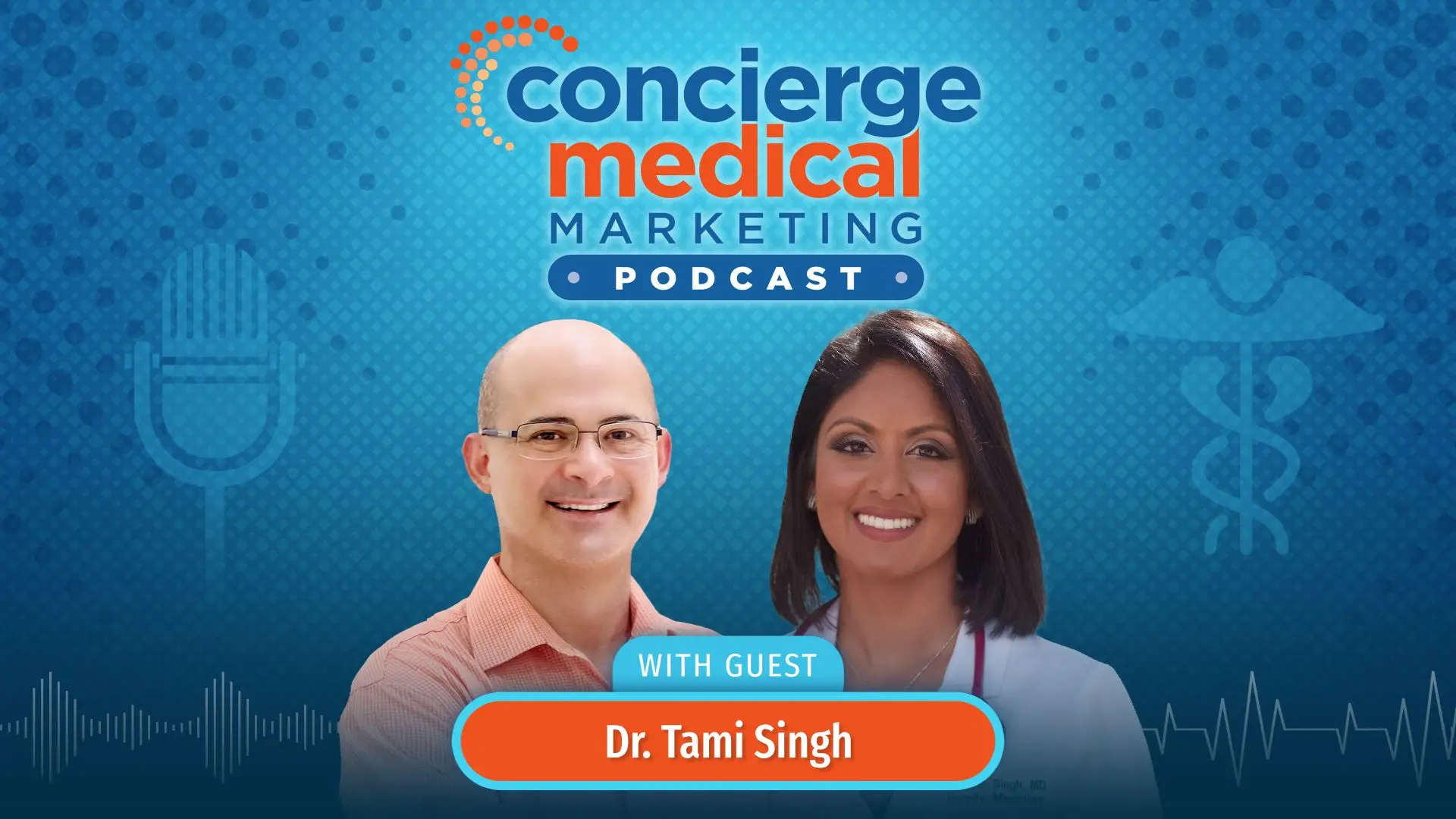
In this episode of the Concierge Medical Marketing Podcast, host Steven Schwartz interviews Dr. Tami Singh of Aspire Health Direct Primary Care in Plantation, Florida, about her journey from growing up in New York and South Florida to attending Ross University in Dominica and completing residency at USF. Dr. Singh shares how she moved from physician-owned group practice into DPC after a hospital takeover introduced quotas and administrative burdens that made it harder to practice medicine the way she wanted, prompting her to launch her own membership practice in 2017 with support from her family. She discusses building her patient panel, now full at about 430 patients due to her mix of traditional primary care and functional medicine, adding a partner to help meet demand, and using transparent pricing, in-office support, and AI-assisted EMR tools to improve care. The conversation also covers practical marketing strategies like social media, reviews, chamber involvement, and walking around as a branded “billboard,” along with broader reflections on why DPC and concierge medicine help physicians avoid burnout and give patients more attentive, personalized care.
Episode Chapters
00:00:24 – Introduction and Welcome
00:01:31 – Dr. Tami Singh’s Background and Education
00:04:20 – First Job, Hospital Takeover, and Discovery of DPC
00:07:31 – Partner, Growth, and Practice Expansion
00:09:41 – Benefits of Membership Medicine and Better Patient Care
00:12:19 – Panel Size and Practice Capacity
00:15:36 – Labs, Imaging, Medications, and Staffing
00:17:02 – Pricing Model and Functional Medicine Visits
00:19:36 – AI, EMR, and the DPC Community
00:21:17 – Marketing Advice: Social Proof, Community, and Reviews
00:25:45 – Tracking Marketing Results and Patient Lifetime Value
00:27:33 – Business Growth, Exit Planning, and Steven’s Story
00:31:58 – Advice for Physicians Considering Membership Medicine
00:34:04 – Closing Remarks and Farewell
Connect with Our Guest
Full Episode Transcript
Hello and welcome to the Concierge Medical Marketing Podcast. I’m your host, Steven Schwartz. It’s my pleasure to have you along on our journey today. I’m really excited for our discussion today. Dr. Tami Singh, her practice is called Aspire Health, Direct Primary Care, and she’s located in Plantation, Florida. Tami, welcome to the podcast.
Dr Tami Singh (00:44)
Thank you, Steven. Thank you so much for having me on. I’m excited to explain my story.
Steven Schwartz (00:47)
Really?
Wonderful. Thank you. You know, as the podcast has so many valuable things that we can add to the body of knowledge for folks in DPC and concierge or membership medical in general. And we have folks who are not just medical practitioners, but also business owners and those that offer services and other technology for our space. And it’s such a pleasure to pull all these folks together in this podcast and
There’s there’s always something for everybody in here if we dig far enough. So again, Tami, thank you for being here today. why don’t we just go ahead and get started? Tell us a little bit about your background, where you grew up, where you went to school, just kind of the early years, please.
Dr Tami Singh (01:30)
Yeah, so I was born in New York and Brooklyn, grew up a little bit a few years in Long Island, and then when I was six, my parents moved to South Florida and Miami. And I went through elementary, junior high, high school, Miami, ended up going to University of Miami for undergrad. Unfortunately did not get accepted to any medical schools in Florida. That’s was I kind of closed my I guess my view on
interviewing at other places or applying other places because I thought I would get accepted in Florida. And I had no family members in medicine. So it was just me kind of figuring things out on my own. And then I ended up going to Ross University in the Caribbean. I didn’t want to waste time. And it got me to become a doctor and I did my residency at USF in Tampa, well Clearwater area. And I kind of still stayed in Florida but ended up on the West Coast.
And I got stuck there after because I got a great job with a physician-owned group, Clark and Daughtry. And we’ll probably get into that more later about how I transitioned into where I’m at now.
Steven Schwartz (02:33)
Yeah, what a great story. And I’m sorry, where was the school in the Caribbean?
Dr Tami Singh (02:37)
it was Ross. It was it was in Dominica and now it’s not there anymore. It’s in Barbados. It’s one of the I would say the longest standing Caribbean school, one of them. it’s been around since nineteen seventy eight.
Steven Schwartz (02:49)
Beautiful. I love going to the Caribbean. My wife and I try to get on a cruise ship as often as possible. And whenever we get a chance to get down into the islands, it’s always just such a different pace. the the ability to focus on medical school studying tests and everything in the midst of having these gorgeous beaches right outside the window, perhaps. kudos to you for sticking to it.
Dr Tami Singh (03:12)
Yeah, Dominica is very different than the other more I guess, populated islands. the school was in a very deserted area, so you really only studied, but you had definitely while like just adventures with diving. I got certified diving and you know hiking, and it was beautiful, beautiful terrain. but no fast food.
No movie theaters, no shopping malls. So it was definitely a focus on medicine. And it was a great place to do your medical bookwork and came back to America and got to do all our clinicals.
Steven Schwartz (03:45)
Wonderful. Yep. And I’ve been in Florida now since about two thousand and two. we have some family outside of the Tampa area. I’m located in Vero Beach, Florida, on the you know, the Atlantic coast. And we love it here. It’s just a great little town. but as we said, it’s always fun traveling and seeing new places and having new experiences. so on your story, you said you went to school in Tampa residency at UCF, you said? USF, South Florida.
Dr Tami Singh (04:10)
USF.
Mm-hmm.
Steven Schwartz (04:12)
And
what happened next with your first job? How did you get your job? How did you apply? t talk us through that.
Dr Tami Singh (04:19)
Yeah, so I went through some recruiters that were trying to help me find places because I actually wanted to come back to South Florida. And that wasn’t looking very promising because I didn’t speak Spanish and the cost like the salary that they were offering me in South Florida versus the salary they were offering me in Lakeland, Florida was very different. And it was a multi-specialty group. It was physician owned, which was amazing.
And I took a jump and I was like, Well, I’ll figure it out. Let’s see, my first job. And they actually say, like, your first job, you don’t stay more than a few years. Like, and you’re still trying to figure things out. So I took it. I actually was there a lot longer than I anticipated. but they really allowed us to be physicians and practice the way we wanted to, which is what a lot of us want to do. And unfortunately, the hospital took us over.
And when the hospital took over, that was when I was like, this is not going the direction I want to. They were telling me I had to reach a certain quota of patients and changing my levels and just doing a lot of things that I didn’t feel comfortable with. And that’s when I ran into DPC. And I went to the AAFP, had a conference in DC in 2017.
In Washington, that I it was called DPC Summit, and I went and I took my dad, my brother, and my mom, because it was my brother’s birthday weekend, and I was like, just come, let I’ll go to this conference, you guys will hang out. And so happened, I pulled my dad into one of the lectures and I was like, just listen, that’s all I want you to do. And we walked out and he was Are you crazy? No insurance. Like, this doesn’t make any sense. Who’s gonna come and pay you when they can use their insurance?
And I was like, hey, I really wanna practice medicine this way. I think it’s going to make me enjoy it more. It’s gonna give me that drive that I don’t have anymore because I was so bombarded with paperwork and numbers and rather than patient care. And so he’s like, what what’s gonna happen? A year, give it. If it doesn’t work out, you’ll go work for somebody else.
And I just needed that support system. I didn’t need it financially or anything else, but just the support of I am behind you. I don’t think it makes sense, but sure, whatever, it’s a crazy idea and go ahead for it. So 2017, put my paperwork in, quit my job, moved back from the West Coast to the East Coast of Florida that nobody knew me. So this was a a a very enlightening experience of like, well, how do I market myself?
How do I build a name for myself when nobody knows me? I was four hours away. And so that’s how I ended up opening up a DPC practice. I was fortunate to find a space of a, it was a plastic surgeon who was renting space and actually took a chance and said, okay, I’ll give it to you for a year. And so that was very nice of him as well. And it was fully furnished, and I just had to show up.
And so I opened doors November of twenty seventeen. And yeah, and now we are about nine years later and we’re going strong and yeah, we would love to expand even more.
Steven Schwartz (07:31)
Right. And from your website you have a partner. You want to tell us about your partner?
Dr Tami Singh (07:35)
Yeah, so she has been now with me for two years. We brought her on. Prior to her, there was somebody else that was a hospitalist, and it did wasn’t a good fit at that moment anymore. So she was leaving. Dr. Falden was coming on board, and it worked out. She kind of absorbed her patients. And right now I have a wait list, so I’m trying to funnel my patients to Dr. Falden. We’re also looking for more.
physicians to come on board because we are growing. We’re looking to open more locations if we can. But again, it’s it’s this model is growing and I’m excited for where it’s going in the direction. Because when I started the DPC model, there was only two other physicians doing it in Broward County. now there’s so many other doctors doing and it’s just growing every day the membership model. So I really think it’s the way to medicine.
Steven Schwartz (08:27)
I love it. you mentioned how the big hospital system started buying up the family practices. here in Indian River County, a couple hours north of you, Cleveland Clinic came through several years ago and you know, bought the hospital and tried to get that turned around and then started buying up the little practices as well. And from as an outsider, I saw quite a few
Practices that were owned and run by friends of mine. And they kept working for two years. And then as soon as the two year mark was up, they dropped out and started their own practice elsewhere. And so now we have a bunch of concierge practices in our county as well. But it’s so often we’re hearing that the practitioners went to school and their love and their passion.
is to provide excellent medical care to their patients. And when they’re forced to meet quotas on the number of patients you have to see in a particular day, if you just simply do the math, you don’t have enough time to really dig into the situations and the backstory of your patient. And before you know it, you know, a three to five, seven minute encounter and prescribe a Z-Pak and get them on the way because you got three more people, you know, waiting for you.
Dr Tami Singh (09:26)
Mm-mm.
Steven Schwartz (09:40)
It’s not enough time and people can miss things. we are all human. And beyond that, our our practitioners are burnt out. You know, so many folks I’ve talked to in my career working in this space, where they’re almost to a point of like, you know, forget it. I’m gonna go, I don’t know, like you said, teach people how to scuba dive. It’s like you went to medical school, you want to go have a business teaching people to scuba dive? Yeah, that would be fun. And so I love that membership medicine is.
Dr Tami Singh (09:57)
Yeah. Yeah, yeah.
Steven Schwartz (10:06)
Helping our practitioners be relieved of a lot of the stressful things that corporate insurance-based medicine has say foisted upon them to work within that model in that space. And through membership medicine, they’re really getting to enjoy what they do again. And I assume having much better results and outcomes for the patients. What do you think about that?
Dr Tami Singh (10:17)
Mm-hmm.
yeah, definitely. I spoke to an individual today on the phone who she went to see one of my colleagues who takes insurance. She’s a GYN and she’s like, the I was like, How was your experience? She’s like, the GYN, she was great, but our office, like nothing can get done, like the staff, the you know, just everything. It’s it’s just it’s so tedious to to ask for things or people call you back, or you know, you’re just it’s you know, I know a lot of people have this
Steven Schwartz (10:35)
Yeah.
Dr Tami Singh (10:58)
dilemma about saying that medicine is s customer service, but I think there’s somewhat of some customer service there that I provide my patients where I want to make sure they’re happy with their care, just as if I went to a doctor’s office, I wanted to be treated this way.
Steven Schwartz (11:15)
Exactly. And, you know, under the DPC model and the concierge brand, the idea that we’re treating patients better, we’re giving them more time, we’re giving them our our ears and our brains and our ability to truly take the time that we need and help get to the bottom of the medical issue or the emotional issue or something that’s going on there. And through that relationship, people feel loved.
They feel appreciated and they become a raving fan of your practice. And it is so important, as you’ve just mentioned, to have a successful practice is to have from every encounter from people finding you on the web through a Google search or an AI search or something to coming to your website to feeling good and welcomed through the website to communicating and getting their meet and greet appointments set up.
the actual meet and greet discussion, their first clinical appointment, and just loving on them all that time again, turns them into raving fans. They’re gonna love you. And these type of people will stay with you if you treat them right, correct?
Dr Tami Singh (12:19)
Mm-hmm.
Correct. Yeah. These are your your biggest fans, your marketing tool. They are the ones that are spreading that word around the community for you and writing good reviews that also help you.
Steven Schwartz (12:35)
absolutely. you talked about having a wait list. So your panel is co totally full now.
Dr Tami Singh (12:40)
Yes, my panel is full, but like I tell the patients that I have meet and greets with, you know, you have to understand that I only want a certain number of patients to make sure that I’m taking care of myself. I’m not overbooking myself in a day where if my patient was to call me and something was happening and my staff would tell me, I can jump on a call and not feel over burnt out, like, my God, I’m here till six o’clock at night.
answering calls or messaging people. So I want to make sure I have safe space in my schedule to accommodate my members. So that’s why I have a waiting list. So I try to explain that to them and they’re very receptive. But I also tell them if you want a sooner appointment, Dr. Feldon’s just as amazing and I would highly recommend her.
Steven Schwartz (13:23)
Excellent. And help her grow her panel to the level she wants to or needs to be at. And then obviously continue to bring on the next practitioner, fill up their panel. do you mind me asking what your panel number is and where you found you’re comfortable?
Dr Tami Singh (13:26)
Mm-hmm, exactly.
Mm-hmm.
Yeah, I I’m at 430 right now. I thought I was gonna be comfortable at 500, but I also do functional medicine. So functional medicine patients, their first visit is two hours, whereas traditional patients, primary care traditional, is one hour long for their first appointments. So it’s a little bit more in-depth the functional medicine. So because of that kind of overlap and that mix in my my panel, I decided that was a good number for me.
but I’m opening up as I go like in the future months, like in July and maybe September, I’ll find a spot here and there. I might add people in somewhere if it’s reasonable for me.
Steven Schwartz (14:21)
Sure, that seems like a pretty strong number. I mean, many of the folks I talk to on the lower side, maybe 250 and 300 seems to be a a very nice number for a lot of folks. again, you know, we we have to discuss so many so many items, so many criteria for how to determine what a good panel size is. How much time do you need to spend with your patient? How much do you charge?
Dr Tami Singh (14:26)
Mm-hmm.
Steven Schwartz (14:43)
how much do you need to earn as a business in order to cover all of your expenses, put away some profit, and to be able to have the you know the lifestyle that you need and so many different numbers. We actually put together a spreadsheet that we offer to to folks if they want to grab it from our our page of web page of resources where you can literally put in how many I have in my panel now, how many is my desired panel? What do I charge per patient per year?
how many leads do I get per month? What is my conversion percentage? And so much more, so that you can really chug your own numbers and figure out wow, I really need to charge more per month, or I need more patience, or any whatever it might be. So a great resource that a lot of folks have utilized that I’ve shared with them. as a DPC practice, different practices handle labs.
Dr Tami Singh (15:19)
Mm-hmm.
Exactly. Yep.
Steven Schwartz (15:35)
and imaging and medications differently. How does your practice handle those?
Dr Tami Singh (15:41)
So for self-pay patients, we offer client billing for that. They can either do it in our office, there’s no extra charge for them, or they can do it at the actual lab. and then in regards to the ones that have insurance, again, they can come in our office, no charge extra, or we give them a lab order and they go elsewhere to get it done. And in regards to the imaging, we have local imaging places that have
dropped by pricing for us so we can notify our patients up front this is the self-pay rate versus if they wanted to go through their insurance or not, they had that option as well. And then medications, we have some limited medications in the office that we prescribe to our patients. we have a dispensing license. However, a lot of our prescriptions we just send it to the pharmacy patients can use good RX. We educate them about that and coupons. So we’re very
knowledgeable and try to help navigate them with that. So in in our practice though, we also are very heavy on our staff because we kind of want to do less. So we have four virtual assistants, three office medical assistants. And so of course our overhead is a lot higher than a traditional or maybe a concierge or a DPC doctor that wants a smaller panel and maybe wants to do more.
Steven Schwartz (16:57)
Excellent. are you willing to share your pricing model on the podcast here?
Dr Tami Singh (17:01)
Yeah,
yeah, definitely. And it’s on our website. We are s definitely transparent. There’s no hidden fees in our with our patients at all. And that’s what our our drive is as well to be transparent. So we have 105 is our enrollment fee slash appointment hold fee. So the enrollment fee is for our traditional patients. The enroll hold appointment fee is for that two-hour functional medicine patient. So both
tiers have to pay this fee. For the traditional patient, when they come into the office, they will pay their monthly membership. So it’s dependent on their age. If they’re between the age of zero to 64, it’s $95. And if they’re above $65, it’s going to be $160. If there was a parent enrolled, a kid’s membership is $68. So that’s for our traditional
Primary care and believe it, when we started nine years ago, I had twenty dollar kids’ fees. I had forty-five dollars, but of course inflation. And you know, I did grandfather my patients that started with me for quite some time, I think like five years. And you know, there is still some patients that if they are in financial distress, I wanted to help them out. I will reduce them for a few months or however long to help them out. And there
They’re they’re very loyal to me and they really wanna they really value their service. So we really try to help them at the end of the day. And then our tradition our functional medicine patients, they actually pay because it’s a two-hour visit. It’s a very in-depth visit where we’re looking at all their medical records, we’re looking at all labs. A lot of times they come with a lot of information. Sometimes patients of mine come with a big folder and I have to review all their stuff. So
It that appointment is a lot and it’s from the time they were born until now, kind of what has manifested, and we’re really trying to get to the root problem. So that appointment fee is I think five hundred and fifteen dollars. So the one five goes towards that fee. So we deduct it. So it’s like four ten at that first visit when they come to see us. Mm-hmm.
Steven Schwartz (19:08)
Excellent. You know, the the
thought of people coming in with a big stack of paper and labs and the other medical history and spreadsheets and all that is so good. the idea of the people taking charge of their health, you know, if if you’re if you don’t make your own health the priority and advocate for yourself, who’s going to, right? ⁓ and so I love that people come that way. are you using AI at all to help?
Dr Tami Singh (19:20)
Mm. Yes.
Mm-hmm.
Yeah.
Steven Schwartz (19:35)
Sift through all of this data.
Dr Tami Singh (19:37)
Yes, we we do have an AI system, our EMR actually. If we put it into the system, upload it, they will come up with a a a a summary for us of the patient, which is an amazing, amazing tool to help me and then again, help our patients better.
Steven Schwartz (19:48)
Nice.
Right. Which EMR do you use?
Dr Tami Singh (19:56)
We use Atlas. Atlas is a DPC owned group that they’ve been around, I think maybe over 10, 12, 15 years. Yeah, they’ve they’ve been they’ve been the grandfathers into this. Yeah. So I actually when I was going into or thinking about DPC, their doors are always well welcome for for questions and advice. So it’s it’s very nice that the DPC
Community is so opened, and we would just want this movement to grow.
Steven Schwartz (20:25)
Yeah, I agree. last few years I’ve attended the Concierge Medical Forum, Michael Tatrow’s organization in near Atlanta. And it’s been such a wonderful conference to attend. And same, obviously there’s things in common and things a little different between concierge brand and DPC brand focus. But I was so amazed and encouraged by how kind, how open and giving and sharing the folks in this
community are with each other because they all, you know, understand that the the rising tide raises all ships. It’s not just a silly cliche, but it really does help. And if I through my medical practice can help 10 other people with their medical practice, you’ve got happier practitioners, more successful businesses, lots and lots and lots of successful, happy, healthier patients, everybody wins.
Dr Tami Singh (21:16)
Exactly.
Steven Schwartz (21:16)
Such a great thing. So we talked a little bit about growing panels and, you know, for you reaching your magic number that you’re comfortable with. And this is the concierge medical marketing podcast. And we do want to talk a little bit about marketing. What marketing techniques have you tried in your practice that have worked well? What lessons have you learned? And if somebody’s listening to this podcast and says, you know, hey, I’m starting a practice, I only have 10 patients or zero patients at this time.
What advice might you give them on how to properly market their business, perhaps on a shoestring to start, or more advanced when you actually have some some money to invest in it?
Dr Tami Singh (21:55)
Yeah, so I definitely give the advice for those who are thinking of concierge or DPC and they’re still in the system to make up your Facebook page or make up your Instagram page and ask, you know, your current patients to write reviews on Facebook or also follow you on Instagram and start building a following. So again, when you decide you’re gonna leave the system, you have already a following and they know where to find you.
Steven Schwartz (22:24)
Nice.
Dr Tami Singh (22:24)
That’s
that’s definitely my advice with that. And and that’s what I did with Facebook page. I had them start leaving reviews because I knew I was moving to a new location and nobody knew me. So I really needed that again, validity somewhat from online presence to to help me when I did my move. So that was a very, very good idea I came up with and and and went forward with it.
Steven Schwartz (22:48)
Yeah, it’s very, very clever. We
call that social proof. And we as a marketing agency, you as a physician, somebody else, we can tell people that we’re great, but there’s no credibility there simply because obviously we’re we’re biased, right? But if multiple other people say you’re great, well, let’s go and work with that person. Let’s go talk to them. because, well, they’re not us, right?
Dr Tami Singh (22:58)
⁓
Right.
Exactly.
Steven Schwartz (23:12)
So that’s a really clever method. I love it and love to share that with with folks that I talk to in the future. What other you know traditional marketing did you do?
Dr Tami Singh (23:22)
So I also joined the chamber. I wanted to get to know my community, the community that I was gonna work in. And so I started volunteering for events. I started setting up my table and learning my 30 to 60 second pitch. and just spoke to anybody and anybody that would talk to me. And then I got my scrubs made with my name. And I was a selling billboard, I guess I can kind of say. ⁓
Steven Schwartz (23:47)
Yeah, walking billboard. Mm-hmm.
Yep. Walking billboard.
Dr Tami Singh (23:49)
Wal walking billing yes, that’s what I meant. Walking
billing board. Walking billboard where I would be at Publix or I would be at a coffee shop and I had my scrubs on and I didn’t have patience at the time, but I was marketing myself and I would talk to people and you know get to know them and that was me kind of planting the seed. And years later, somehow we would meet again and I remember I met you.
And it’s such a small community that it it was it was very nice that I was able to get to know the community from that.
Steven Schwartz (24:22)
Nice. did you do any other marketing like Google Ads, SEO? Tell us about that experience.
Dr Tami Singh (24:28)
So
I I did Google ads, but I didn’t really see very good benefits personally. And eventually when I spoke to my web designer, he’s like, This isn’t working for you. So he helped with the SEOs and things like that. And he kinda c every couple months will revisit things and he’ll change some SEO stuff. but I I got like a Google QR code for our office and we would
our my staff would encourage our patients if you had a good r you know experience please leave a review and so the reviews have definitely helped. We have over 300 reviews, we’re 4.9. So for a doctor’s office this is pretty decent amount of reviews. ⁓ so we’re yeah so so we’re we’re trying we we’ve been a lot of patients and I’ve made a spreadsheet from the time I I started that you mentioned like to find out about you know your
Steven Schwartz (25:10)
Definitely.
Dr Tami Singh (25:21)
How many patients you’re keeping, how many patients are canceling? so I keep that and where do they find us from? You know, when they do they fill out on our website for a meeting greet, it asks, where did you hear about us from? Did you hear Google? Did you hear, you know, from a podcast? Where did you hear about us from? So we try to to utilize that for our marketing as well.
Steven Schwartz (25:44)
I love it. It’s so good to keep track of these different methods and and find out from technique or method A resulted in this that led to that, which resulted in so and so amount of of income or patients or whatever. As well as when a patient signs up with you, what is the average lifetime value of that patient? In other words, if you know someone’s paying you.
What did you say, like a hundred sixty okay, let’s just say a hundred dollars a month and they’re with you for one year, that’s a twelve hundred dollar ⁓ quote value. And if they stay with you three years, that’s thirty six hundred. Knowing those numbers can really help you as you plan for expansion, growth, or eventually when you want to sell your practice. And at some point, you know, you’re gonna want to retire. I’m gonna wanna retire, or whatever may happen.
Dr Tami Singh (26:13)
Mm-hmm.
Mm-hmm.
Steven Schwartz (26:37)
I actually interviewed a gentleman yesterday for the podcast whose business is all about growth, helping practices grow to the level so that they can, when they want to sell, have a seven-figure exit and possibly selling to investors who want to buy the concierge or DPC practice. So always keeping the end in mind when you’re building your business, because at some point you’re not going to be doing this, right?
whether you’re gonna sell it to your other practitioners in the practice or an investor or investor group or somebody else we don’t know but think about those things as you do it because obviously where you are now and where you want to go, there’s things that we need to do in the middle to make that happen. Have you ever thought about how long you want to do this and how or where you may want to get done and retire. I know you’re young.
Dr Tami Singh (27:32)
No, I haven’t really thought of that yet. I still have like goals and dreams of more. don’t get me wrong, I’m not I’m happy, but again, I I I just love this vision that I have and wanna continue. so yeah, I’m not really sure where but yeah.
Steven Schwartz (27:48)
Yeah, okay. Well, you’re you’re doing great. And the your practice started in 2017.
I started my first website design company in 1999. And I ran that business until 2024. We had built somewhere over 2400 websites for small businesses and nonprofits across the country and did lots and lots of digital marketing and all that. And for me it was kind of interesting, is that I
Dr Tami Singh (27:57)
Yeah, I like that.
Steven Schwartz (28:14)
I I got to a point where I was feeling pulled in so many different directions and the different technologies and methods that we built in our business were no longer special or unique anymore. And I felt like we got to a point where we weren’t I don’t want to say effective. It’s not quite the right word, but just nothing special anymore because you could get websites that you could do it yourself from a hundred different sources and you can get SEO from all these different places.
Dr Tami Singh (28:35)
Hm.
Steven Schwartz (28:38)
And so with me, and my just quick, my quick personal story here is that after building hundreds and hundreds to, like I said, over 2,400 websites, eventually I sold the business. I sold it to a friend of mine who wanted to grow his similar agency through acquisition. And he had and his team had already done a lot of work with many of our clients. So it really made good sense. But and for me, I kind of did what
Concierge doctors do, which is going from a panel of 3,500 patients down to a panel of 300 patients, right? And the ability to spend more time and more focus with each one to help them knock it out of the park. And so I created Concierge Medical Marketing, this digital marketing agency focused on this space of concierge and DPC practices to help them succeed in their businesses. And it’s certainly been a wonderful ride and thrilled to
To be a part of it. so that’s my quick story. I do have a couple of things I just wanted to mention with concierge medical marketing. We can help our our clients with a transition from a traditional insurance-based practice to a membership. We can help with growth. You already have a a growing or existing medical practice with a membership focus, and you want to grow and get your 300, 400 or so patients.
Dr Tami Singh (29:33)
Awesome.
Steven Schwartz (29:59)
We have methods and techniques to help you do that. We can also help with nurture. This is one area that we see a lot of people kind of miss the boat on, which is you need to nurture the people who are already your patients, plus the folks that are on your wait list. You got to keep nurturing them, loving on them, and letting them know that you’re here so that when it’s their time to join, they’re ready, right? So these different things we offer. I wrote a book.
Dr Tami Singh (30:24)
Mm-hmm.
Steven Schwartz (30:26)
Called The Definitive Guide to Winning with Digital Marketing for Concierge Medical Practices. The book is entirely free as a download from our website, conciergemd.marketing. And if anybody’s listening to the podcast and is really considering that they want to jump into having a membership medical practice, whether DPC or concierge, please download the book with my compliments. And I think you’re going to find a lot of great value there. I also created a tool called Maddie.
Maddie is the AI Digital Marketing Assistant for Membership Medical Practices. And that’s also available for free. I put together a website, stevenschwartz.info. And this website has, I don’t know, a dozen or more free tools and resources and books and links to my podcast and the blog and all this stuff. All these things are available, just about everything on there is for free as a way of helping this space, helping folks grow and succeed in their practices.
Obviously, if anybody wants to talk to me personally, please reach out to me. the link to schedule a time with me is cmmkg.com/schedule . And it’s like a Calendly tool where you pick out a date and a time and it goes on a calendar. but Tami, I’ve really enjoyed our conversation today. as we wrap up our discussion today, what I don’t know, what thought would you have?
For somebody who’s listening to this and maybe they’ve been in insurance-based medicine for five, ten, fifteen years and they’re considering this membership DPC concierge thing that they keep hearing about, what advice would you give them?
Dr Tami Singh (31:58)
I would tell them if they really want to take charge of their life, being a physician and practice medicine the way they want to practice it, please. There’s so many resources like you, Steven, that you’re doing amazing things to make this easier for us as physicians to take the leap, to take the jump. Again, we weren’t taught business and how to run a business, but
Definitely your tools sound amazing to help others out there to take this leap and know they can do it.
Steven Schwartz (32:29)
Absolutely. I appreciate the kind words. you know, one of the things that that I created is an AI tool that can analyze a practice’s website, learn everything they can about the practice, generate a list of, I don’t know, 700 or so phrases relevant to the practice that people might type into Google searching for a service or practice that does that thing.
I take that list, I put it into Google’s keyword volume tool and select the geographic radius of the area where the medical practice serves. For instance, if somebody is based in, I don’t know, Sacramento, California, right? We just get all of Sacramento or the county around that space where people are willing to drive to that practice, or some telemedicine practice, like everybody in New York State or whatever it might be. But, anyways, taking the list of phrases that people
might look for, putting that into the Google tool and specifying the geographic radius, I’m able to see how many people are searching for those exact phrases on average per month for the last 12 months. And simply by looking at that, we can have a pretty good idea if we did a properly optimized Google campaign, will that help them get more eyeballs on their practice and likely more meet and greet appointments? And
So like you said, free tools that are available, that’s something that’s available for free to help people grow their practice. And we’re thrilled to be able to offer it.
Dr Tami Singh (34:01)
Awesome.
Steven Schwartz (34:03)
So without further ado, Dr. Tami Singh, it’s been my pleasure getting to know you today and letting you share your story and congratulations on just a great growing practice, helping folks from birth up to seniors and you know, really everybody in between, bringing aboard your your second practitioner for two years now and growing. And, you know, I just expect to see more and more great things out of you and your practice and your team.
In the years to come, let’s stay in touch, okay?
Dr Tami Singh (34:33)
Yes, definitely. Thank you so much, Steven, for this opportunity. I really enjoyed it.
Steven Schwartz (34:36)
Sure, it’s
truly it’s my pleasure. And we’ll get this launched and published. In fact, folks, if you’re listening to this podcast, please like, share, subscribe, repost, whatever you do at the whichever platform you find it, please do those things because that’ll really help us share not just this podcast episode, but all the ones before and after. So we get the most effective outreach. Okay. folks, this has been Steven Schwartz with the Concierge Medical Marketing Podcast, interviewing Dr. Tami Singh.
It’s been our pleasure having you along on the journey today, and we’ll see you on our next episode. Goodbye, everyone.