


“What is this going to cost me?” It’s the first question almost every provider asks us, and it’s the question the marketing industry works hardest not to answer. You get talk about “custom solutions” and why “it depends” — everything but the number.
So here are the numbers. This is what professional marketing actually costs a concierge or direct primary care practice, what drives the price up or down, and the membership math that tells you whether it’s worth it. If a provider is charging you far outside these ranges, in either direction, you should know why.
The Two Buckets: Program Fees and Ad Spend
Every marketing budget has two separate buckets, and confusing them is how practices end up surprised.
Program fees are what you pay for the ongoing work itself: strategy, search engine optimization, content, review management, and campaign management — the exact mix depends on the program you choose. This is a monthly service fee, and it stays the same whether your ads have a good month or a slow one.
Ad spend is the money that goes directly to the advertising platforms, mainly Google. You pay Google for clicks. Many agencies quietly retain a percentage of that ad spend as part of their monthly income (if yours does, ask why). We do not do that. We believe that money is for advertising, not additional agency income — every dollar of it should go toward buying clicks. Ad spend is a separate line item, and you control the ceiling.
When someone quotes you a single blended number, ask them to split it. You deserve to know how much is work and how much is media.
The Patient Acquisition Pyramid: Why the Pricing Is Built in This Order
The fees below aren’t arbitrary. They follow the framework I lay out in my book, The Definitive Guide to Winning with Digital Marketing for Membership Medical Practices (request a free copy): the Patient Acquisition Pyramid. A practice’s marketing is built in three levels, in order, and you only climb to the next level when the one below it is solid.
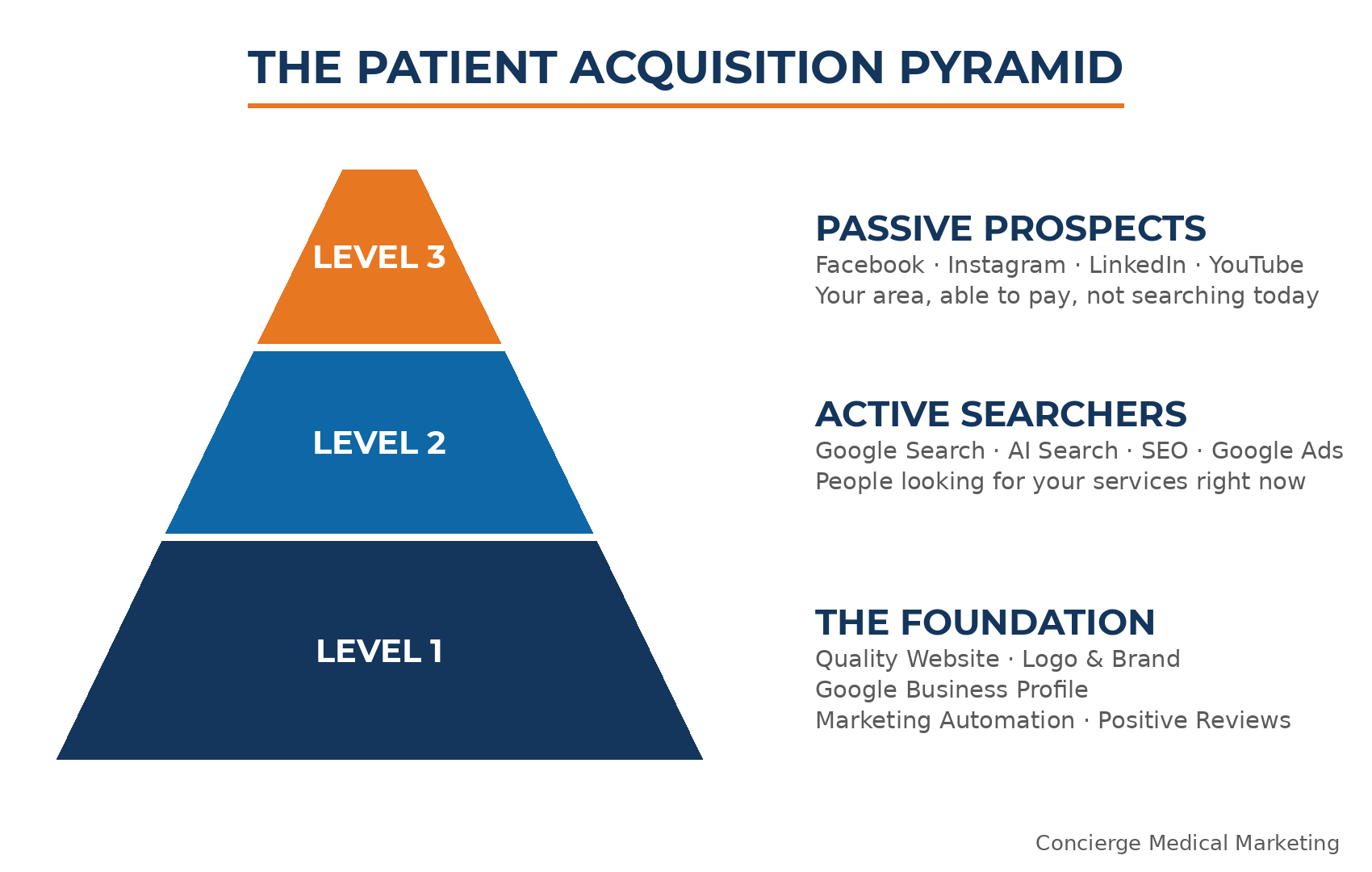
Level 1: The Foundation. A quality website, your logo and brand identity, a Google Business Profile optimized to its full potential, basic marketing automation to catch and follow up with the inquiries that come in, and a steady flow of positive reviews. Nothing else works without this. If your foundation is weak, every dollar spent above it leaks.
Level 2: Active Searchers. People who are actively looking for the services you provide, right now, on Google search and, increasingly, in AI search tools like ChatGPT. These are the highest-intent prospects there are: they have a need and they’re looking for a provider. Capturing them is what search engine optimization and Google Ads are for.
Level 3: Passive Prospects. Everyone else in your geographic area who fits your patient profile and has the ability to pay for membership care, but isn’t searching today. You reach them over time on Facebook, Instagram, LinkedIn, and YouTube. It works, but it’s a longer, slower slog, because you’re interrupting people instead of answering them. And here is the part most agencies won’t tell you: if the search volume in your market is sufficient at Level 2, you may never need Level 3 at all.
Keep that order in mind as you read the fees. Each program below maps to a level of the pyramid, and the smart move is almost always to fund the levels in order.
What Program Fees Actually Run
Our ongoing digital marketing programs for membership practices run from $750 per month to $3,500 per month, depending on what’s contracted. Here’s what that range looks like in practice:
Business Essentials, $750 per month. The foundation: the essentials a practice needs to be found and to look credible when patients research you. We secure your Google Business Profile (accessing your existing listing, or creating one if necessary) and optimize it to its full potential. We then syndicate your practice details to over 500 platforms across the internet, so your name, address, and phone number appear consistently everywhere patients and search engines look. That consistency gives Google increased confidence in your practice’s information, and that confidence is the bedrock of showing up in local search results. Basic marketing automation can also be included at this level, if desired. This is the right starting point for an established provider with a modest market and a working website.
Growth program, $2,500 per month, plus ad spend. The full growth engine: Business Essentials, search engine optimization, creating new highly focused content (blogs, press releases, service pages — 1 to 2 per month), creating backlinks, and Google PPC campaigns working together to fill your panel. Backlinks deserve a word of explanation: they are links from other reputable websites to yours, and they are one of the main ways Google decides whether your practice is a credible authority worth ranking. Earned steadily from relevant, trusted sites, they compound — every strong page we publish gives other sites something worth linking to. This is where most practices that are actively growing land, and it’s a step up from Essentials, not a leap. You move up when you’re ready to push harder, not all at once.
Google Ads management, $997 per month. Professional management of your Google Ads account is its own line item. That’s separate from the ad spend itself, which you pay to Google directly. (If you’re already running ads and want them reviewed before changing anything, we also offer a one-time Google Ads audit for $997. It covers Google Ads only, and it’s the fastest way to find out where an existing account is leaking money.)
Facebook and Meta marketing. Our growth program typically does not include Facebook/Meta marketing. Adding it is an additional $1,000 per month, which brings the total to $3,500 per month, plus ad spend. Meta can work well for membership practices in the right market, but it is an addition, not the foundation.
Website and brand build, about $5,000, one-time. A website is not part of the monthly fee. If your practice needs a new website — or a redesign — we build it as a one-time project: logo and brand, the website itself, and starter blog posts to get things rolling, typically around $5,000. From there, your monthly program takes over, and what’s included — SEO, content, campaigns — depends on the program you’ve signed up for.
One more piece of context: we’re not the top of this market. Large national agencies that serve medical practices commonly charge $5,000 to $10,000 or more per month for comparable programs — before ad spend. Some practices pay it gladly for a larger team and a national name. Neither end of the range is automatically right. What matters is that whoever quotes you can explain, line by line, what the money buys.
What Ad Spend Actually Runs
Ad spend is where markets differ most, so instead of quoting an industry range, here are the real numbers from our own client accounts. Across the membership practices we manage, the average cost per click on Google in August and September 2026 ran between $1.86 and $3.32, with a median of about $2.35. Our most expensive market, a concierge practice in Greater Boston, averaged $3.32 per click. A family practice in a smaller Arizona market averaged $1.86. A direct primary care practice sat in between, at about $2.35.
Those numbers surprise people, because published “average” figures for medical keywords often run $8 to $20 or more per click. The gap is management. On these very campaigns, Google’s own recommended bids ranged from $7.31 to $42.49 per click. Our accounts don’t pay Google’s asking price: bids are capped deliberately, and even in Boston the actual clicks came in between $2.50 and $4.16 each. An unmanaged account that accepts Google’s suggestions can easily pay several times more for the exact same patient.
A realistic starting ad budget for a single-location practice is $1,000 to $3,000 per month. At the click prices above, that typically buys several hundred targeted clicks a month. At a healthy conversion rate to consultation requests, that’s a steady stream of real conversations with prospective members, not just traffic.
One warning that will save you money: do not let Google’s built-in recommendations set your budget or your bids. Google’s suggestions are designed to increase your spend, not your memberships. If you’re already running ads and want to know where your account stands, our one-time Google Ads audit ($997) shows you exactly where the money is leaking, before you change anything. A managed account exists largely to protect you from that kind of waste.
The Math That Makes It Worth It
Marketing cost only makes sense next to membership value. Concierge patients typically pay $2,000 to $5,000+ per year in membership fees, and a well-matched member often stays for years.
Run your own numbers. If your membership is $3,500 a year and a new member stays three years, that member is worth over $10,000 in revenue. Against that, a $750 to $3,500 monthly program needs to produce only a handful of new members a year to pay for itself several times over. This is why membership practices can afford marketing that would crush a traditional practice: the lifetime value of one patient is completely different.
To run yours in about two minutes, use our free Concierge Membership Calculator. Enter your current number of membership patients, your membership fee, your panel goal, and your timeline, and it shows you the new members you need, the monthly pace to get there, the revenue waiting at your goal, and how many leads that takes. It’s a public copy of the same calculator we use on strategy calls — make your own copy and model your real numbers before you set a budget.
For direct primary care practices, the math is tighter. Monthly memberships of $75 to $150 mean you need more members to cover the same marketing cost, which pushes the strategy toward higher volume, longer-tail keywords, and tighter local targeting. The principles are the same; the margin for sloppy spending is smaller.
What Drives Your Cost Up or Down
Your market. A provider in a competitive metro with six concierge practices nearby will spend more than the only membership practice in a mid-size city. Competition sets click prices, and click prices set budgets.
Your timeline. Filling a panel in twelve months costs less per month than trying to force it in four. Urgency is expensive. (We wrote a companion piece on realistic timelines, because this is the second question every provider asks.)
Your starting point. A practice with a good website, a healthy review profile, and an existing patient base converting over starts ahead. A brand-new practice is buying its entire foundation at once.
Scope. One provider, one location, one service line is a smaller program than a multi-provider practice building a brand across a metro area.
A Word About Doing It Yourself, and About Cheap
You can do your own marketing. Some providers do, and a few do it well. The honest cost is your time: the hours learning Google Ads, writing content, and managing reviews are hours not spent on patients or on building the practice. Price your own time before you decide it’s free.
The other trap is the bargain freelancer or the $299-a-month “we do it all” package. At that price, the work is templated, the reporting is vanity metrics, and nobody is watching your ad account when Google changes something. Cheap marketing that doesn’t produce members isn’t cheap. It’s just a smaller loss, repeated monthly.
What We Recommend
Start with the level that matches your market and your timeline, not the biggest package on the menu. We generally recommend a 12-month agreement, because that’s the honest horizon for this kind of growth, and we’re willing to start with a 6-month minimum so you can see proof that the marketing is producing real growth opportunities before committing longer.
And one commitment from us: we serve only one clinic client per geographic area. Your competitor across town can’t hire us to outspend you. In a large metro, we may serve different practices in clearly different sections of the city, but never two practices competing for the same patients.
If you want help working out what a sensible budget looks like for your specific market, schedule a free strategy call. We’ll look at your competition, your search demand, and your goals, and give you a straight number, whether you hire us or not.