
Make an appointment today to discover how our expertise in practice branding, patient acquisition, advanced marketing tactics, and patient retention can help you thrive.

Steve Schwartz reveals secrets to successful marketing campaigns and growth strategies for the concierge medical industry, this guide draws from 25 years of digital marketing expertise and experience working with over 900 clients.
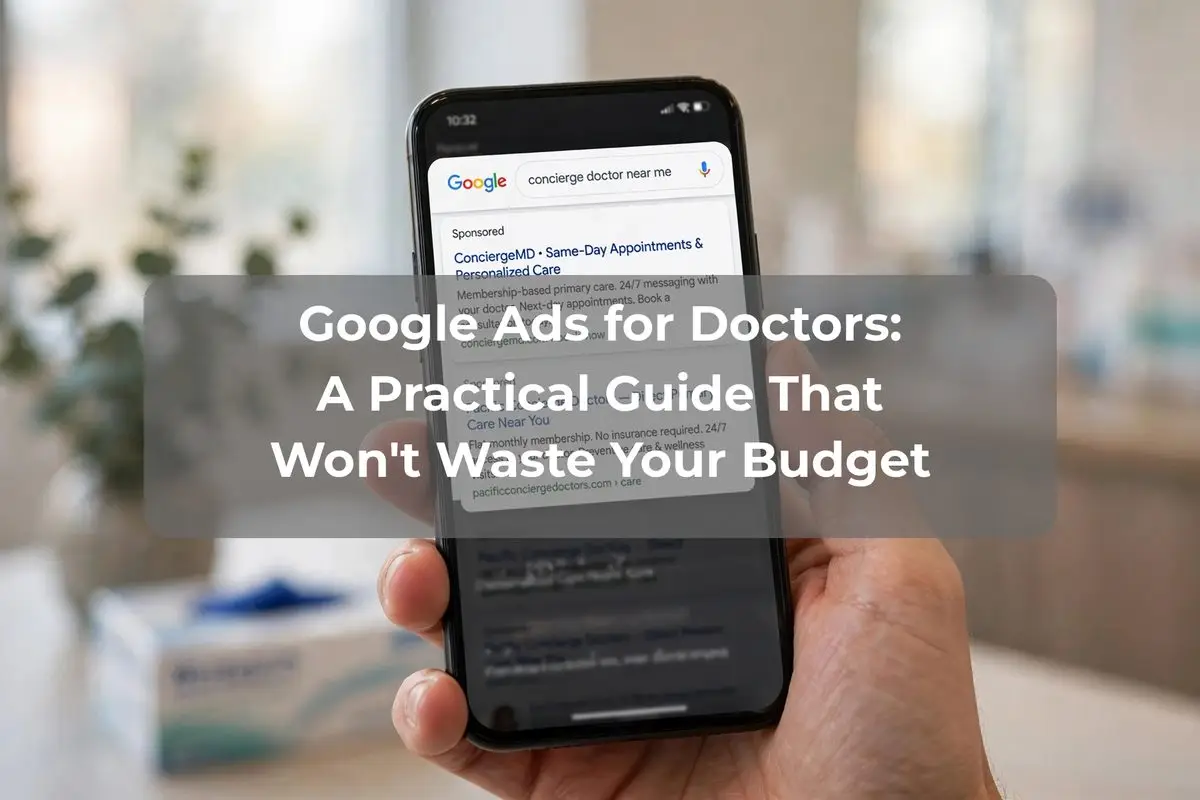
Google Ads for doctors is one of the fastest ways to fill a patient panel, and one of the easiest ways to burn $5,000 learning nothing. The difference is almost never the platform. It’s the setup.
Medical advertising on Google plays by different rules than other industries. Certain health terms are restricted. Remarketing is limited. Click costs in competitive markets are brutal. And Google’s own automated recommendations, the ones it pushes inside your account, are designed to increase your spend, not your results.
We manage Google Ads for concierge and DPC practices every day, physician-led, NP- and PA-led, and hybrid membership models alike. Here’s the setup that actually works.
Why Medical PPC Is Different
Google treats health advertising as a sensitive category, and that creates constraints most guides don’t mention.
First, personalized advertising restrictions. Google prohibits implying knowledge of a user’s health condition in ad copy. You can’t write “Suffering from diabetes? We can help.” You have to write around the condition: “Comprehensive metabolic care in [City].” This makes ad copy trickier and lowers click-through rates compared to other industries.
Second, remarketing limitations. Google restricts remarketing lists based on health-related site visits. If someone visits your diabetes management page, you generally can’t retarget them with ads. This kills one of the highest-ROI tactics in standard PPC, so your initial targeting has to be sharper.
Third, certification requirements. Depending on your services, Google may require healthcare advertiser certification (LegitScript for certain categories like addiction treatment). For standard concierge primary care, you typically don’t need it, but check Google’s healthcare advertising policies before you launch.
Campaign Structure That Works
Don’t dump all your keywords into one campaign. Structure matters enormously for medical practices. We build three campaign types:
Brand campaigns target searches for your practice name and your name. These clicks cost almost nothing ($1 to $3), convert at the highest rate, and protect you from competitors bidding on your name. Every practice should run one. If you don’t, a competitor or a directory will happily take that top spot.
Service campaigns target what patients search when they need care: “concierge doctor [city],” “direct primary care near me,” “private physician [city].” These are your workhorse campaigns. Keep keywords tightly themed, one service per ad group, with ad copy that mirrors the search term.
Competitor campaigns bid on other practices’ names in your market. This is aggressive but legal and effective. Keep budgets small here and watch quality scores. Only do this if your landing page genuinely offers a comparable or better alternative.
Start with exact match and phrase match keywords. Broad match in medical PPC is a budget fire. A broad match on “doctor” can match “doctor salary” or “doctor costume.” Use negative keywords aggressively from day one: “free,” “jobs,” “salary,” “costume,” “definition,” and every insurance term you don’t accept.
Landing Pages Make or Break the Campaign
Sending ad traffic to your homepage is the most common and most expensive mistake in Google Ads for doctors. Your homepage tries to speak to everyone. Your ad promised something specific. That mismatch kills conversions.
Each service campaign needs a dedicated landing page that continues the exact conversation the ad started. If the ad says “Concierge Doctor in Austin: Same-Day Appointments,” the landing page headline should say the same thing, not “Welcome to Our Practice.”
Every medical landing page needs five elements: a clear headline matching the ad, your phone number clickable at the top (most medical conversions happen by phone, not form), three to five trust signals (years in practice, patient count, review stars), a simple form asking only for name, phone, and reason for visit, and a photo of the actual clinician. Prospects choosing a membership-based practice are choosing a person. Stock photos of stethoscopes convert worse than a genuine photo of you in your office.
Budget Guidance and Realistic Costs
Here’s what concierge and DPC practices actually spend. In mid-size markets, expect $8 to $20 per click for high-intent terms like “concierge doctor [city].” In major metros (New York, Los Angeles, Miami), $20 to $40 per click is normal.
A realistic starting budget is $1,000 to $3,000 per month in ad spend for a single-location practice. That buys roughly 100 to 250 clicks. At a 5 to 10 percent conversion rate to consult request, that’s 5 to 25 consults a month.
Those click prices aren’t destiny, though. We’ve helped practices get quality clicks for under $3/click even in competitive markets. It takes tighter keyword selection, ruthless negative keywords, and landing pages that earn high quality scores, but it’s absolutely doable when the account is built right.
Now the math that makes it work: if your annual membership is $3,000 and your average member stays three years, each new patient is worth roughly $9,000 in lifetime revenue. Even at a $300 cost per acquisition, that’s a 30-to-1 return. The practices that lose money on Google Ads aren’t paying too much per click. They’re sending traffic to bad pages, targeting the wrong keywords, or letting Google’s automation spend their budget on junk.
For DPC practices with lower price points ($75 to $150/month), the math is tighter. You need higher volume and lower cost per click, which means leaning harder on longer-tail keywords and smaller geo-targeting radiuses.
Do Not Blindly Apply Google’s Recommendations
This is the contrarian rule I give every client, and it’s worth its own section. We don’t drink the Google Kool-Aid, and neither should you.
Inside every Google Ads account, there’s a Recommendations tab with an “optimization score.” Google pushes you to raise that score by applying its suggestions: add broad match keywords, increase budgets, enable automated bidding, expand location targeting, add more ad variations.
Almost every one of these recommendations increases your spend. Very few of them improve your cost per acquisition. In our experience managing medical accounts, blindly applying Google’s recommendations inflates spend 30 to 50 percent within 60 days while lead quality stays flat or drops.
I’m not saying ignore the tab entirely. Review each recommendation individually. “Fix disapproved ads” is useful. “Add broad match versions of your keywords” is Google asking permission to spend your money on worse traffic. The pattern: recommendations that give Google more control over your budget deserve skepticism. Recommendations that fix errors or add information deserve attention.
Check the Recommendations tab monthly, not weekly. Apply maybe one in five suggestions. Your optimization score will stay below 90 percent, and your cost per patient will stay where it should be.
Measuring What Matters
Track consult requests, not clicks. Set up conversion tracking for form submissions and phone calls (use Google’s call tracking or a service like CallRail). A campaign with a 3 percent click-through rate and 15 percent conversion rate beats a campaign with an 8 percent click-through rate and 2 percent conversion rate every time, but you’d never know it looking at clicks alone.
Review search term reports weekly for the first month, then biweekly. Add negative keywords relentlessly. In medical PPC, 20 percent of your search terms typically waste 80 percent of your budget. Finding and excluding them is the most valuable work you can do.
Give a new campaign 60 to 90 days before judging it. The algorithm needs conversion data to optimize, and medical decisions take time. Pausing after two weeks because “it’s not working yet” is like pulling a cake out of the oven after ten minutes.
Get a One-Time Google Ads Audit
If you’re already running Google Ads, we strongly recommend a one-time audit before you spend another dollar. We typically find quite a few items to change or delete in existing accounts: bloated broad-match keywords, missing negative keywords, campaigns with no conversion tracking, ad groups sending traffic to the homepage, and Google’s own recommendations quietly applied and inflating spend.
We offer one-time Google Ads audits at stevenschwartz.info. It’s the fastest way to find out exactly where your ad spend is going and what to fix first.
Google Ads for doctors rewards patience and punishes autopilot. Set it up with tight structure, point it at real landing pages, guard your budget against Google’s own recommendations, and measure consults instead of clicks. Do that, and paid search becomes one of the most predictable patient-acquisition channels a concierge practice can own.
Ready to stop wasting ad spend? Start with a one-time audit at stevenschwartz.info, or schedule a call and we’ll build your campaigns properly from scratch.